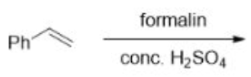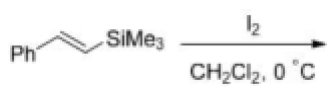
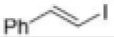
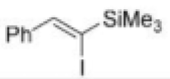


Correct option is A
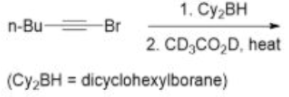
Vinyl silanes react with electrophiles in a highly regioselective process in which the silicon is replaced by the electrophile at the ipso carbon atom. The stereochemistry of the vinyl silane is important because this exchange usually occurs with retention of geometry as well.
Information Booster
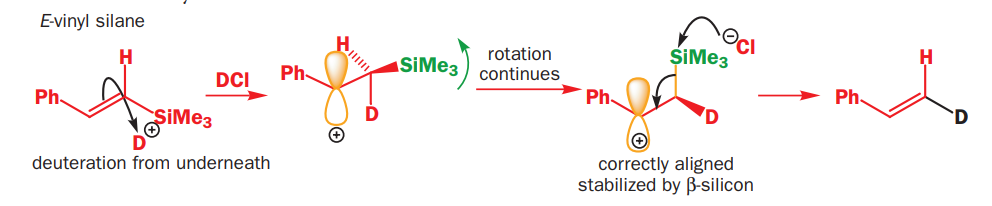
In principle, the alkenes could be protonated at either end but protonation next to silicon leads to the more stable cation β to silicon. In the vinyl silane the C–Si bond is orthogonal to the p orbitals of the π bond, but as the electrophile (D+ here) attacks the π bond, say from underneath, the Me3Si group starts to move upwards. As it rotates, the angle between the C–Si bond and the remaining p orbital decreases from 90°. As the angle decreases, the interaction between the C–Si bond and the empty p orbital of the cation increases. There is every reason for the rotation to continue in the same direction and no reason for it to reverse. The diagram shows that, in the resulting cation, the deuterium atom is in the position formerly occupied by the Me3Si group, trans to Ph. Loss of the Me3Si group now gives retention of stereochemistry.
The intermediate cation has only a single bond and so rotation might be expected to lead to a mixture of geometrical isomers of the product but this is not observed. The bonding interaction between the C–Si bond and the empty p orbital means that rotation is restricted. This stabilization weakens the C–Si bond and the silyl group is quickly removed before any further rotation can occur. The stabilization is effective only if the C–Si bond is correctly aligned with the vacant orbital, which means it must be in the same plane-rather like a π bond.