Correct option is A
Convergent Synthesis:
In chemistry a convergent synthesis is a strategy that aims to improve the efficiency of multistep synthesis, most often in organic synthesis. In this type of synthesis several individual pieces of a complex molecule are synthesized in stage one, and then in stage two these pieces are combined to form the final product.
In linear synthesis the overall yield quickly drops with each reaction step:

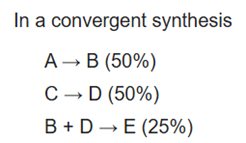
the overall yield of E (25%) looks much better. Convergent synthesis is applied in the synthesis of complex molecules and involves fragment coupling and independent synthesis. This technique is more useful if the compound is large and symmetric, where at least two aspects of the molecule can be formed separately and still come together.
Linear Synthesis:
In linear synthesis, the target molecule (TM) is synthesized through a series of linear transformations. The TM is assembled in a stepwise manner. E.g.,

Diverted Synthesis:
Diverted total synthesis in chemistry is a strategy in drug discovery aiming at organic synthesis of natural product analogues rather than the natural product itself. The target can be the modification of a natural product or the modification of an intermediate. The purpose can be gaining a scientific understanding of the biological activity of the original natural product or the discovery of new drugs with the same biological activity but simpler to produce.
Divergent Synthesis:
In chemistry a divergent synthesis is a strategy with the aim to improve the efficiency of chemical synthesis. It is often an alternative to convergent synthesis or linear synthesis.
In one strategy divergent synthesis aims to generate a library of chemical compounds by first reacting a molecule with a set of reactants. The next generation of compounds is generated by further reactions with each compound in generation 1. This methodology quickly diverges to large numbers of new compounds.

An entire library of new chemical compounds, for instance saccharides, can be screened for desirable properties. In another strategy divergent synthesis starts from a molecule as a central core from which successive generations of building blocks are added. A good example is the divergent synthesis of dendrimers, for example, where in each generation a new monomer reacts to the growing surface of the sphere.