Correct option is D
To determine which DNA markers are allelic, we analyze how segregation patterns appear in DH and F₂ progeny.
Understanding DH and F₂ Progeny Segregation Patterns:
Doubled Haploid (DH) Progeny:
- DH plants are produced from haploid gametes that undergo chromosome doubling.
- Since haploid cells contain one allele per locus, allelic markers segregate as fixed homozygous bands.
F₂ Progeny:
- F₂ plants result from selfing F₁, so they follow Mendelian segregation (1:2:1 or 3:1 ratios).
- If a DNA marker is allelic, the bands should segregate in an expected ratio of homozygous and heterozygous patterns.
Analyzing the Gel Patterns:
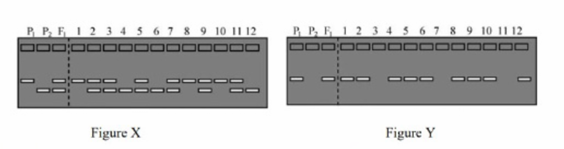
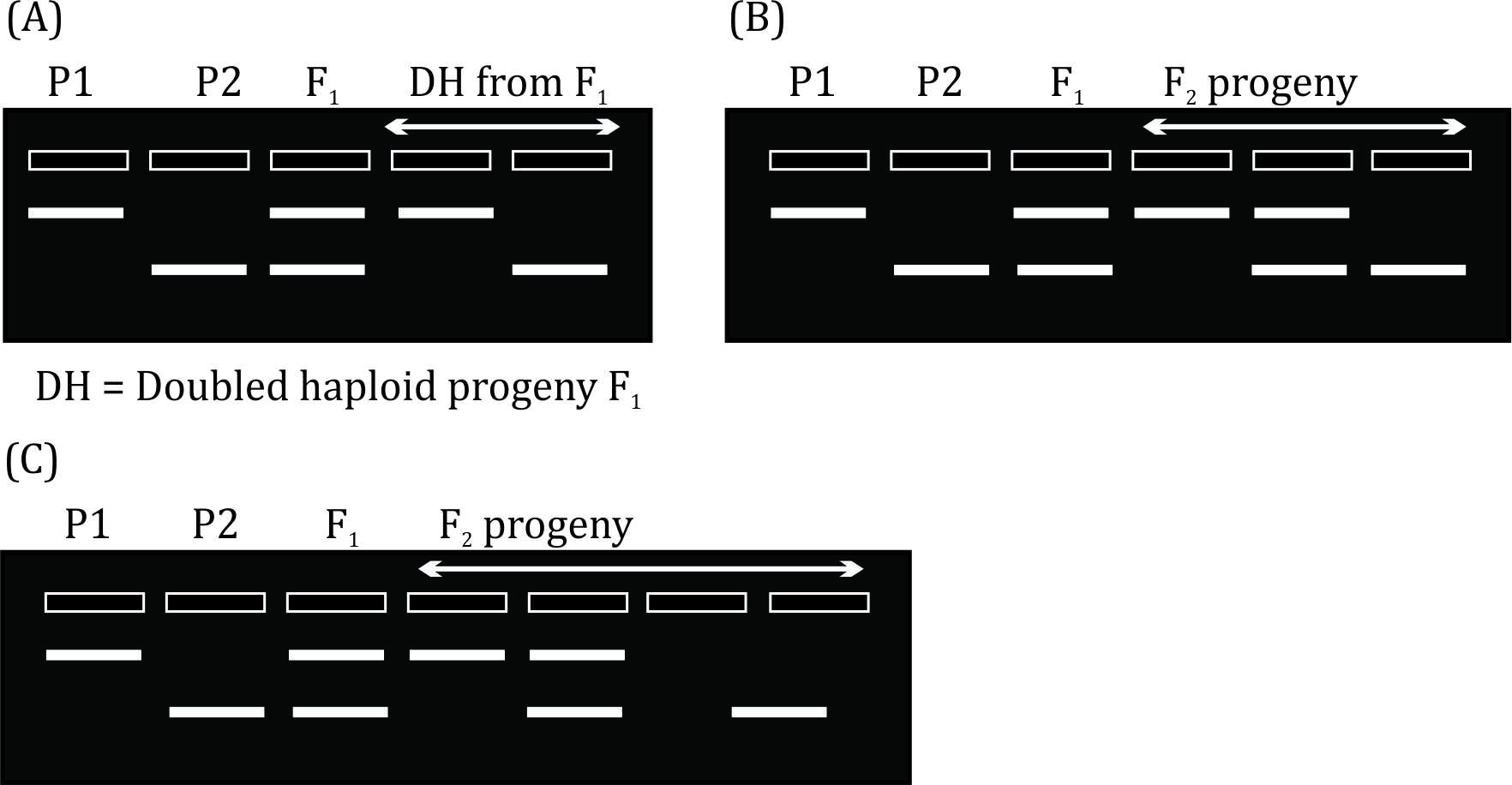
Panel A (DH Progeny):
- The DH lines show only one of the parental alleles per individual, which is characteristic of allelic markers.
- Thus, Panel A markers are allelic.
Panel B (F₂ Progeny):
- The F₂ progeny show Mendelian segregation of bands.
- Such segregation is characteristic of allelic markers.
- Thus, Panel B markers are allelic.
Panel C (F₂ Progeny):
- The banding pattern in F₂ does not follow clear Mendelian segregation.
- This suggests that Panel C markers are non-allelic (likely dominant markers or multi-locus markers).
Final Conclusion:
A and B are based on allelic markers, while C is not.
Correct Answer: Option 4 (A and B).
Information Booster
- Allelic markers are genetic variants at the same locus that segregate in expected Mendelian ratios.
- Doubled haploid (DH) plants are homozygous for all loci, making them useful for identifying allelic markers.
- F₂ progeny segregate in Mendelian ratios, which helps confirm whether markers are allelic.
- Non-allelic markers include multi-locus markers (e.g., dominant markers like RAPDs or ISSRs) that do not segregate in a Mendelian fashion.
- Codominant markers (e.g., SSRs, SNPs) are useful for distinguishing alleles at a single locus.