Correct option is A
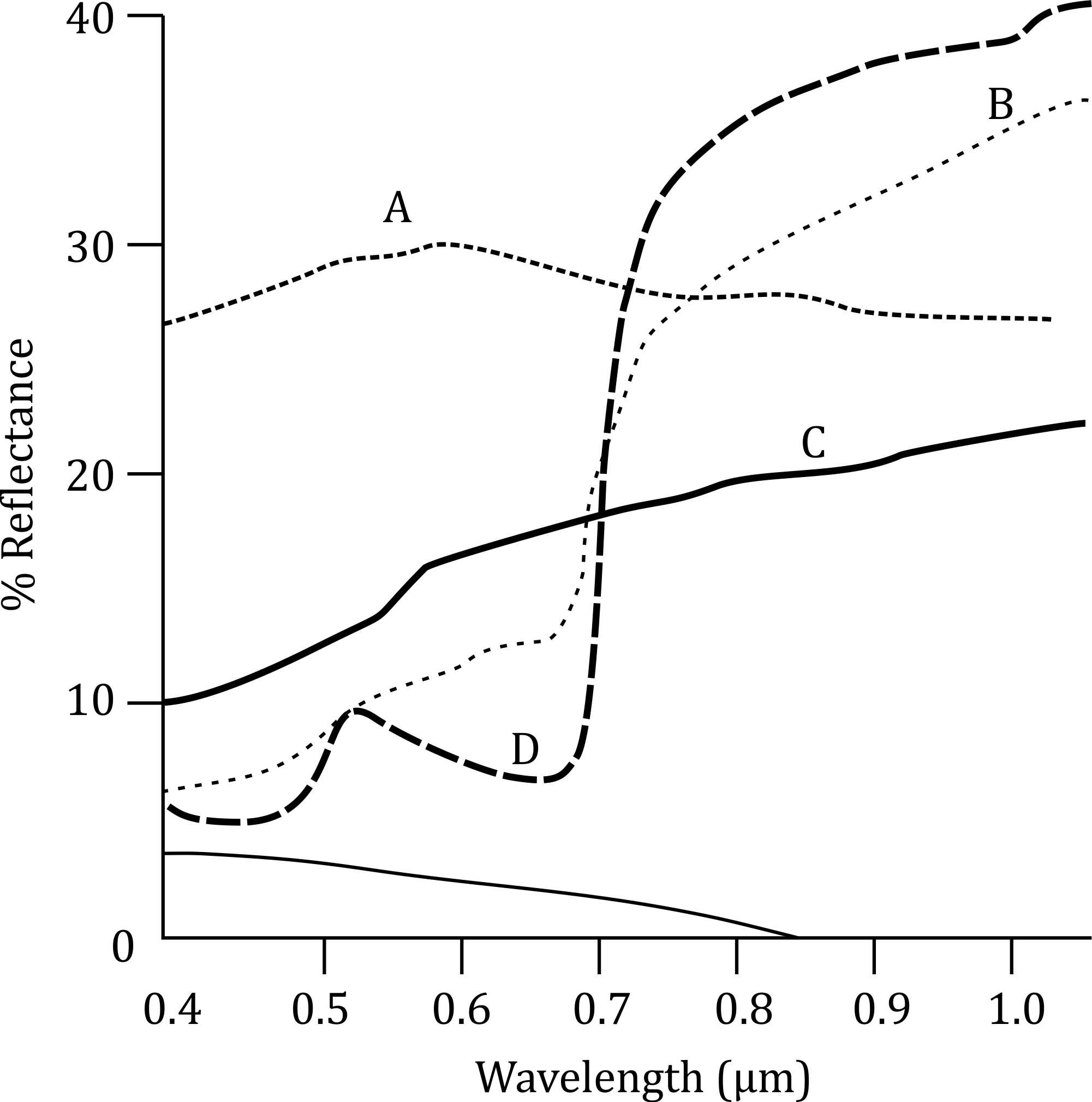
Reflectance curves help differentiat.e urban and natural surfaces based on how they reflect visible (0.4–0.7 µm) and near-infrared (0.7–1.0 µm) light.
Analysis of Each Surface Type:
1. Curve A - Concrete Road
- Concrete is a light-colored material, meaning it reflects moderate to high amounts of visible and infrared light.
- The curve for A is relatively high in visible and near-infrared (NIR) regions, which is characteristic of concrete surface
2. Curve B - Dry Grass Lawn
- Dry grass has higher reflectance in the visible spectrum compared to asphalt or water but less reflectance in the NIR region compared to live green vegetation.
- The curve B shows moderate reflectance, indicating a dry grass lawn (as dry grass lacks chlorophyll, reducing NIR reflectance).
3. Curve C - Asphalt Road
- Asphalt is dark-colored, meaning it absorbs most of the light and has a low reflectance curve throughout the spectrum.
- The curve for C is consistently low, aligning with the properties of asphalt.
4. Curve E - Waterbody
- Water absorbs most wavelengths, especially in the NIR region, where it has near-zero reflectance.
- Curve E shows very low reflectance across all wavelengths, which is a typical characteristic of water bodies.