Correct option is B
Consider the Arrhenius parameters as purely empirical quantities that enable us to discuss the variation of rate constants with temperature;
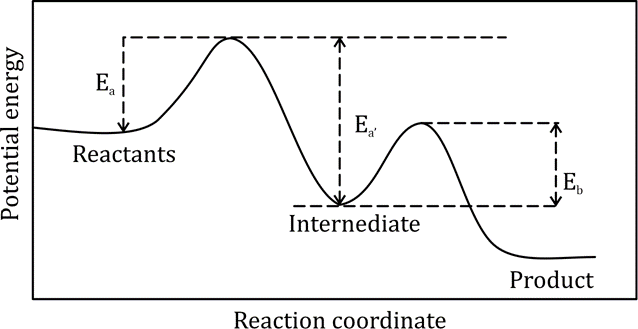
To interpret Ea we consider how the molecular potential energy changes in the course of a chemical reaction that begins with a collision between molecules of A and molecules of B.As the reaction event proceeds, A and B come into contact, distort, and begin to exchange or discard atoms. The reaction coordinate is the collection of motions, such as changes in interatomic distances and bond angles, that are directly involved in the formation of products from reactants. (The reaction coordinate is essentially a geometrical concept and quite distinct from the extent of reaction.) The potential energy rises to a maximum and the cluster of atoms that corresponds to the region close to the maximum is called the activated complex. After the maximum, the potential energy falls as the atoms rearrange in the cluster and reaches a value characteristic of the products. The climax of the reaction is at the peak of the potential energy, which corresponds to the activation energy Ea. Here two reactant molecules have come to such a degree of closeness and distortion that a small further distortion will send them in the direction of products. This crucial configuration is called the transition state of the reaction. Although some molecules entering the transition state might revert to reactants, if they pass through this configuration then it is inevitable that products will emerge from the encounter.
For a reaction involving the collision of two molecules, the activation energy is the minimum kinetic energy that reactants must have in order to form products. For example, in a gas-phase reaction there are numerous collisions each second, but only a tiny proportion are sufficiently energetic to lead to reaction.
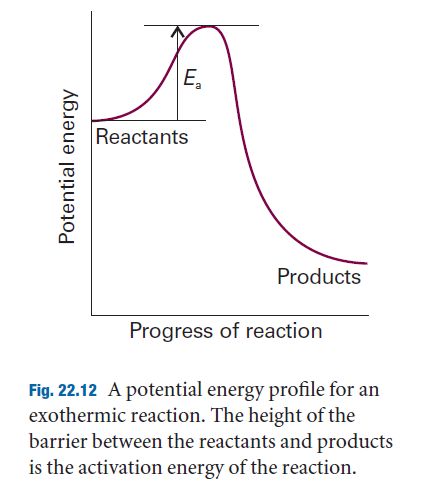
The activation energy (Ea) of a reaction is measured in kilojoules per mole (kJ/mol) or kilocalories per mole (kcal/mol).