Correct option is B
The Beer–Bouguer–Lambert (BBL) extinction law is an empirical relationship describing the attenuation in intensity of a radiation beam passing through a macroscopically homogenous medium with which it interacts. Formally, it states that the intensity of radiation decays exponentially in the absorbance of the medium, and that said absorbance is proportional to the length of beam passing through the medium, the concentration of interacting matter along that path, and a constant representing said matter's propensity to interact.
The extinction law's primary application is in chemical analysis, where it underlies the Beer–Lambert law, commonly called Beer's law. Beer's law states that a beam of visible light passing through a chemical solution of fixed geometry experiences absorption proportional to the solute concentration.
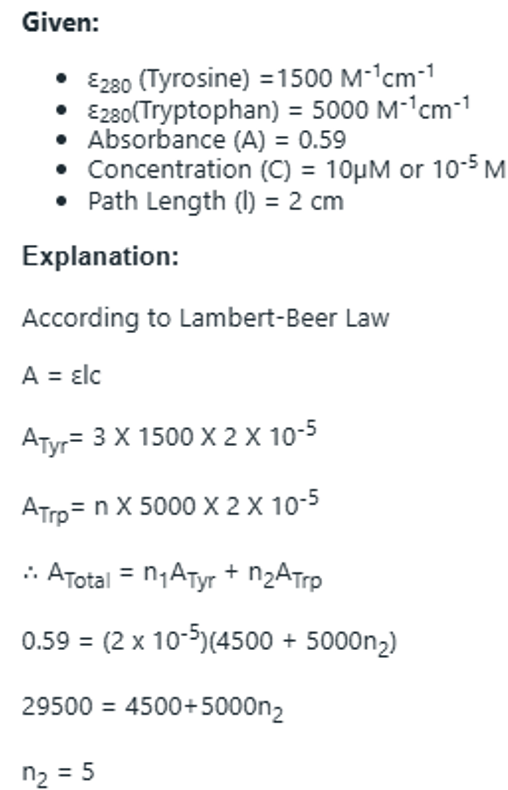
The absorbance of a material that has only one absorbing species also depends on the pathlength and the concentration of the species, according to the Beer–Lambert law
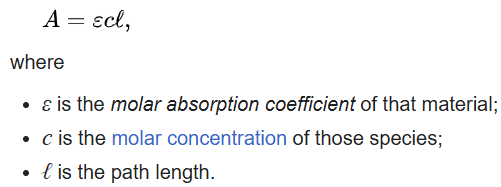
In chemistry, the molar absorption coefficient or molar attenuation coefficient (ε) is a measurement of how strongly a chemical species absorbs, and thereby attenuates, light at a given wavelength. It is an intrinsic property of the species.