hamburger menu
All Coursesall course arrow
adda247
reward-icon
adda247
    arrow
    arrow
    arrow
    ​For a reaction, raising the temperature from 200K to 300K results in the increase of rate constant by a factor of 2. The activation energy for this r
    Question

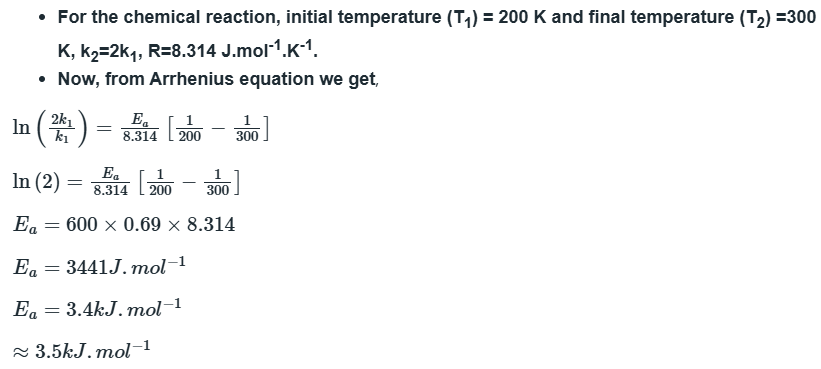
    ​For a reaction, raising the temperature from 200K to 300K results in the increase of rate constant by a factor of 2. The activation energy for this reaction in kJ mol-1 is closest to (ln2=0.69). 

    A.

    7.0

    B.

    3.5

    C.

    14.0

    D.

    0.83

    Correct option is B

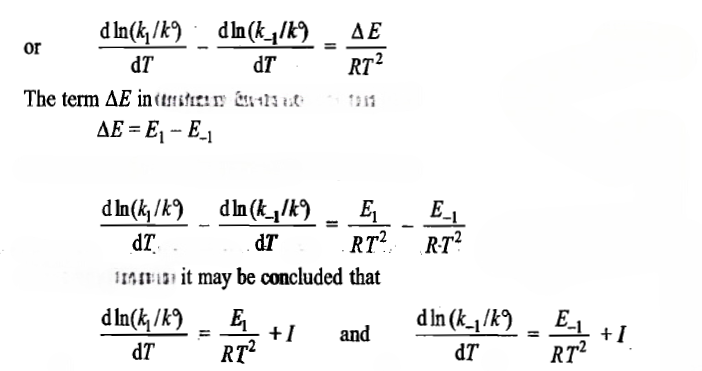
    The dependence of rate constant on temperature may be derived from the Van't Hoff equation as applicable to a reaction at equilibrium. Consider a general equilibrium reaction
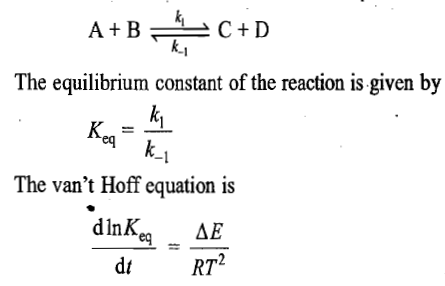
    where ΔE is the energy change of the reaction
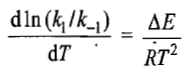
    where I represents a constant which may have any value including a value of zero. If we take it to be zero, then the above two relations may be written as
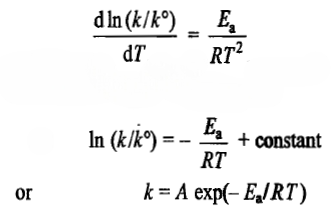
    The constant A is frequently referred to as the pre-exponential factor.
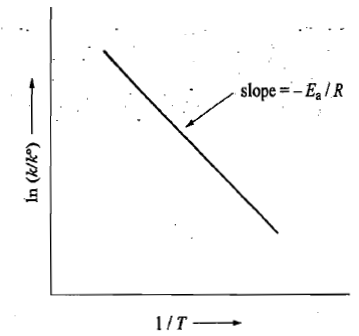
    The constant Ea is known as the energy of activation.
    Similar Questions

    test-prime-package

    Access ‘CSIR NET Chemical Sciences’ Mock Tests with

    • 60000+ Mocks and Previous Year Papers
    • Unlimited Re-Attempts
    • Personalised Report Card
    • 500% Refund on Final Selection
    • Largest Community
    students-icon
    368k+ students have already unlocked exclusive benefits with Test Prime!
    test-prime-package

    Access ‘CSIR NET Chemical Sciences’ Mock Tests with

    • 60000+ Mocks and Previous Year Papers
    • Unlimited Re-Attempts
    • Personalised Report Card
    • 500% Refund on Final Selection
    • Largest Community
    students-icon
    368k+ students have already unlocked exclusive benefits with Test Prime!
    Our Plans
    Monthsup-arrow