






Correct option is A
The cyclopentadienyl metallocenes of the elements of transition metals of 3d series are isomorphous. Except ferrocene, all other metallocenes are paramagnetic.
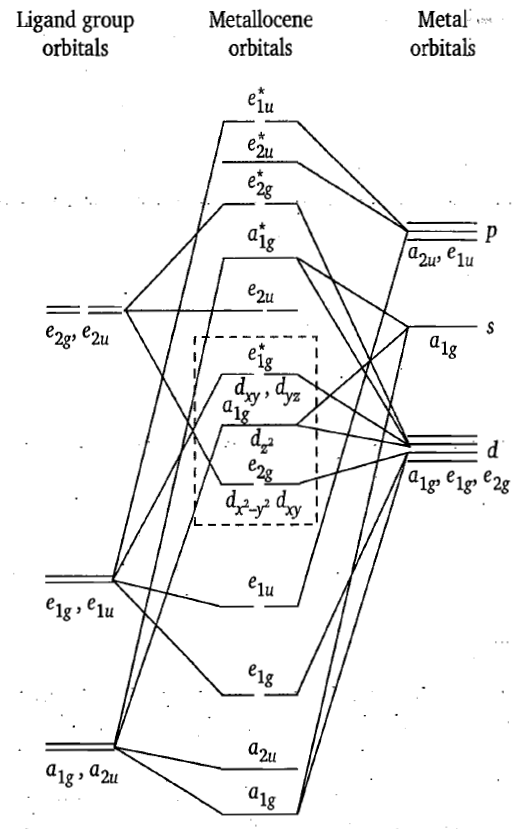
The molecular orbital energy diagram supported by photoelectron spectroscopy studies in conjunction with ligand field theory for ferrocene in figure.
The energy of a1gorbital of cyclopentadiene is too much less than a1g(4s or 3dz2 ) orbitals, therefore, a1gorbital of the ring interacts slightly with a1gorbitals of iron. Thus, a1gbonding molecular orbital is mainly ligand based and a1g(3dz2) orbital is non-bonding and localized on the metal. Similarly, the a2uorbital has little interaction with even higher energy Fe 4pzorbital with which it is formally able to combine. The pair of e1gMOs arises from the bonding combination of the ligand e1gorbitals with e1g(dxz and dyz) orbitals on metal and form two strong pi-bonds. This is due to the reason that energy difference between e1gorbitals of ligand and e1gorbitals of metal and their symmetries are well-matched. This is the main contribution to the stability of the complex. The corresponding anti-bonding e1g*orbitals are unoccupied but involve in electronic transitions. Although the interaction of ligand e1uorbitals with metal e1u(px, py) orbitals is favourable, but due to large energy difference they interact very little and the e1u molecular orbitals are again mainly ligand based but with some contribution from metal 4pxand 4pyorbitals. Since the energy of ligand e2gorbitals is higher than those of e2g(dxy and dx2-y2) orbitals of same symmetry of the metal, they do not interact very effectively and, therefore, the e2gmolecular orbitals are metal based and are non-bonding. Also the metal a1g(i.e., dz2) orbital does not interact very effectively with a1gorbitals of the ligand, therefore, is localized on metal and is non-bonding.
The orbitals of metallocenes that are of most interested are those having the greatest d-orbital character. These orbitals are the highest occupied and the lowest unoccupied molecular orbitals (HOMO and LUMO respectively).
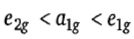
The electron-electron repulsion between the pi-electron density of the ligand e2gorbitals and the metal e2g(dx2-y2and dxy) orbitals is minimum as the lobes of the dx2-y2and dxy orbitals are not directed towards the cyclopentadiene ring. The a1g(dz2) orbital has one lobe and e1g(dyz and dzx) orbitals have two lobes directed towards the cyclopentadiene ring and, therefore, repulsion between a1gof metal and that of Cp ring lower than between e1gof metal and e1gof Cp ring.
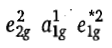
Therefore, the order of energy of molecular orbitals
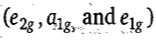
which are localized on metal is

The given complex has a configuration of
which corresponds to five unpaired electrons.



