hamburger menu
All Coursesall course arrow
adda247
reward-icon
adda247
    arrow
    arrow
    arrow
    The number of expected electronic transitions in [Cr(en)3]3+ and trans-[Cr(en)2F2]+ at 4 K is, respectively (en=ethylenediamine) ​
    Question

    The number of expected electronic transitions in [Cr(en)3]3+ and trans-[Cr(en)2F2]+ at 4 K is, respectively (en=ethylenediamine)


    A.

    3 and 3

    B.

    3 and 4

    C.

    3 and 5

    D.

    3 and 6

    Correct option is D

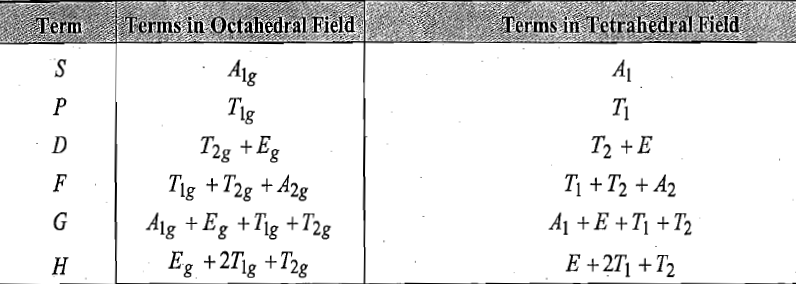
    Orgel diagrams are particularly useful in the interpretation of spin allowed electronic transitions of tetrahedral and high spin octahedral complexes but not for low spin octahedral complexes. The spin allowed electronic transitions occur between the two energy states that have same spin multiplicity.
    Combined Orgel diagram is shown in figure
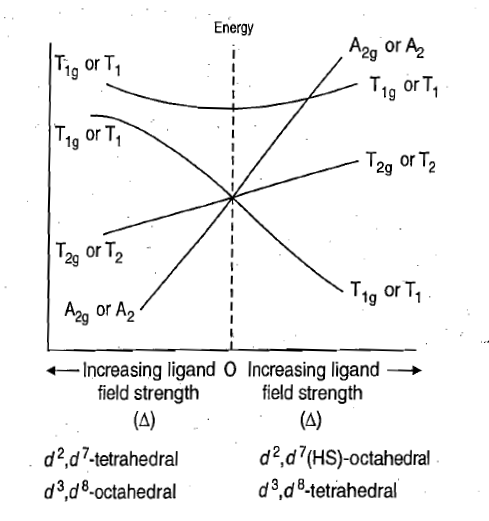
    [Cr(en)3]3+:There are three possible spin allowed d-d transitions. It is a d3complex (Cr3+).

     4T2g 4A2g 4T1g(F) 4A2g 4T1g(P) 4A2g\text{ }^{4}T_{2g} \longleftarrow \text{ }^{4}A_{2g} \\\text{ }^{4}T_{1g}(\text{F}) \longleftarrow \text{ }^{4}A_{2g} \\\text{ }^{4}T_{1g}(\text{P}) \longleftarrow \text{ }^{4}A_{2g}

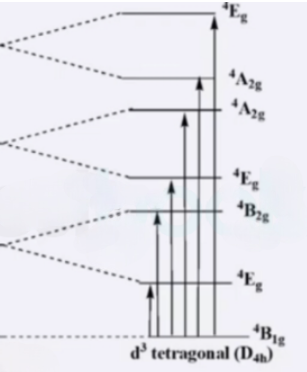
    trans-[Cr(en)2F2]+: It has D4h symmetry. Six transitions are possible.
    Similar Questions

    test-prime-package

    Access ‘CSIR NET Chemical Sciences’ Mock Tests with

    • 60000+ Mocks and Previous Year Papers
    • Unlimited Re-Attempts
    • Personalised Report Card
    • 500% Refund on Final Selection
    • Largest Community
    students-icon
    354k+ students have already unlocked exclusive benefits with Test Prime!
    test-prime-package

    Access ‘CSIR NET Chemical Sciences’ Mock Tests with

    • 60000+ Mocks and Previous Year Papers
    • Unlimited Re-Attempts
    • Personalised Report Card
    • 500% Refund on Final Selection
    • Largest Community
    students-icon
    354k+ students have already unlocked exclusive benefits with Test Prime!
    Our Plans
    Monthsup-arrow


