






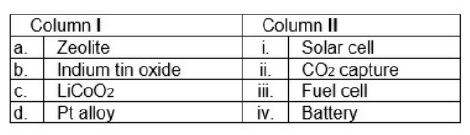




Correct option is C
Zeolite is a group of several microporous, crystalline aluminosilicate minerals commonly used as commercial adsorbents and catalysts. They mainly consist of silicon, aluminium, oxygen, and have the general formula

Zeolites have microporous structures with a typical diameter of 0.3–0.8 nm. Like most aluminosilicates, the framework is formed by linking of aluminum and silicon atoms by oxides. This linking leads to a 3-dimensional network of Si-O-Al, Si-O-Si, and Al-O-Al linkages. Zeolites have the potential of providing precise and specific separation of gases, including the removal of H2O, CO2, and SO2 from low-grade natural gas streams.
Indium tin oxide (ITO) is a ternary composition of indium, tin and oxygen in varying proportions. Depending on the oxygen content, it can be described as either a ceramic or an alloy. Indium tin oxide is one of the most widely used transparent conducting oxides, not just for its electrical conductivity and optical transparency, but also for the ease with which it can be deposited as a thin film, as well as its chemical resistance to moisture. As with all transparent conducting films, a compromise must be made between conductivity and transparency, since increasing the thickness and increasing the concentration of charge carriers increases the film's conductivity, but decreases its transparency.
ITO is often used to make transparent conductive coating for displays such as liquid crystal displays, OLED displays, plasma displays, touch panels, and electronic ink applications. Thin films of ITO are also used in organic light-emitting diodes and solar cells In organic light-emitting diodes, ITO is used as the anode (hole injection layer).
Lithium cobalt oxide, sometimes called lithium cobaltate or lithium cobaltite, is a chemical compound with formula LiCoO2. Lithium cobalt oxide is a dark blue or bluish-gray crystalline solid, and is commonly used in the positive electrodes of lithium-ion batteries.
The polymer electrolyte membrane fuel cell (PEMFC) is a developing electrochemical technology with the potential to revolutionize the transportation sector. The power output and longevity of commercial PEMFCs are linked to the performance of the cathode, where the oxygen reduction reaction (ORR) occurs with intrinsic challenges in long-term activity and stability. The ORR is particularly critical in determining the overall energy conversion efficiency of PEMFCs due to inherently hindered reaction kinetics. For those reasons, the development of high-performance ORR catalysts has been pivotal in the ongoing deployment of commercial PEMFC technology. Platinum (Pt) and its alloys show high activity and stability as catalysts toward the ORR, both of which are required for application in the acidic PEMFC operating environment.


