arrow
arrow
arrow
DNA polymerase PolA has high fidelity but low processivity, while DNA polymerase PolB has low fidelity but high processivity.In vitro reactions for DN
Question

DNA polymerase PolA has high fidelity but low processivity, while DNA polymerase PolB has low fidelity but high processivity.

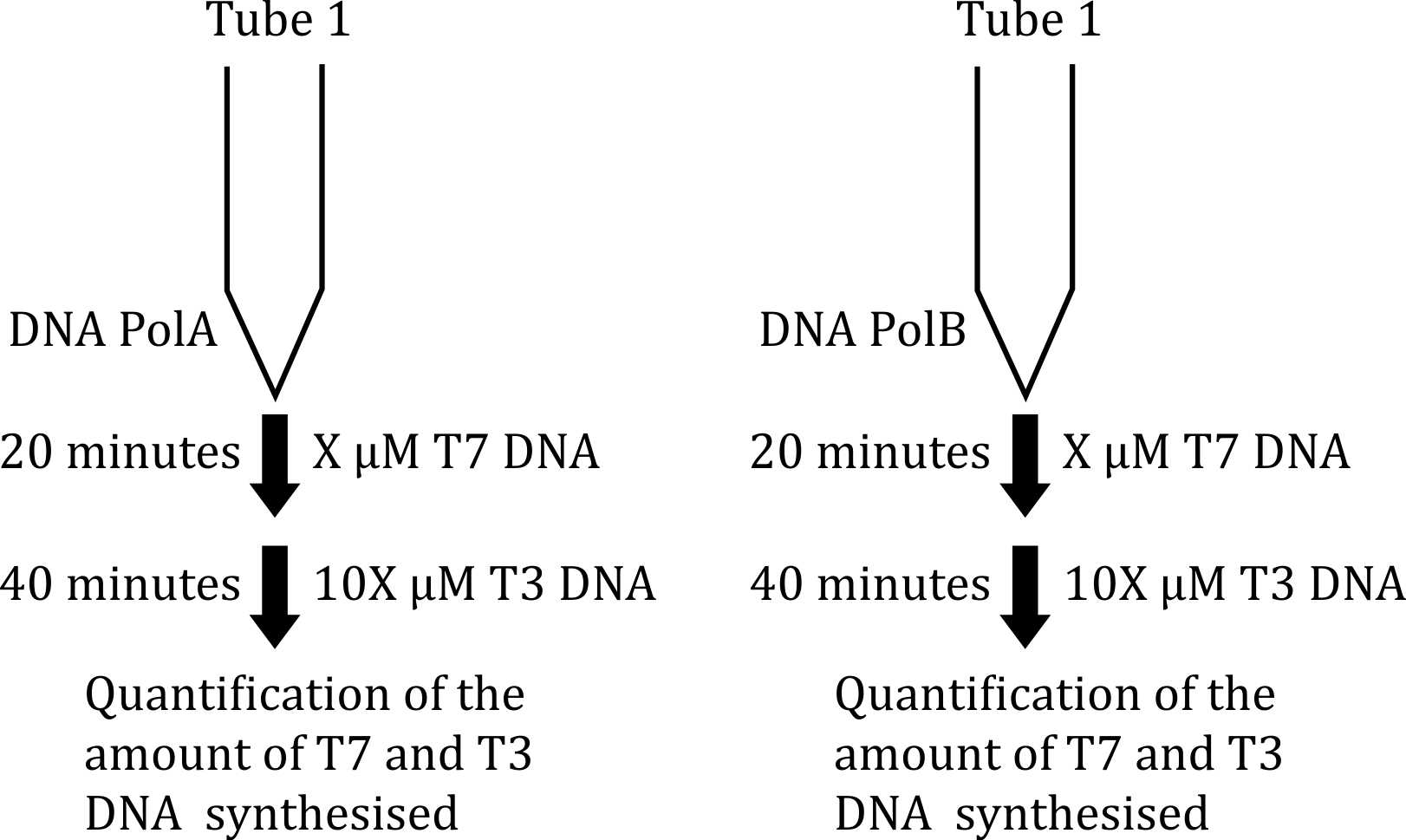
In vitro reactions for DNA synthesis using limiting amounts of PolA or PolB were set up to further characterize the enzymes according to the following scheme:

Which of the following outcomes do you expect?

A.

Tube 1 will have more T3 DNA, and tube 2 will have more T7 DNA.

B.

Tube 1 will have more T7 DNA, and tube 2 will have more T3 DNA.

C.

Both tubes will have more T3 DNA than T7 DNA.

D.

Both tubes will have more T7 DNA than T3 DNA.

Correct option is A

The key factors to consider are processivity and fidelity of the DNA polymerases.

  • PolA (Tube 1)

    • High fidelity, but low processivity → PolA works slowly and struggles to extend long DNA fragments.
    • Since T3 DNA is synthesized at 40 minutes, and PolA needs more time to incorporate nucleotides due to its low processivity, it will accumulate more T3 DNA over time.
  • PolB (Tube 2)

    • Low fidelity, but high processivity → PolB works fast and can synthesize long DNA fragments efficiently.
    • Since T7 DNA is synthesized within 20 minutes, PolB’s high processivity means it will quickly synthesize T7 DNA and not accumulate as much T3 DNA.

Thus, the expected results are:

  • Tube 1 (PolA) → More T3 DNA (accumulates over time).
  • Tube 2 (PolB) → More T7 DNA (synthesized rapidly).

 Correct answer: Option 1 (Tube 1 will have more T3 DNA, and tube 2 will have more T7 DNA).

Information Booster

  1. Processivity is the ability of DNA polymerase to continuously synthesize DNA without dissociating.
  2. High-fidelity polymerases introduce fewer errors but usually have low processivity.
  3. Low-fidelity polymerases work fast but make more errors.
  4. PolA (high fidelity, low processivity) → Works slowly but accurately.
  5. PolB (low fidelity, high processivity) → Works rapidly but may introduce errors.
  6. The time-dependent increase in DNA synthesis reflects the efficiency and characteristics of each polymerase.
Similar Questions

test-prime-package

Access ‘CSIR NET Life Sciences’ Mock Tests with

  • 60000+ Mocks and Previous Year Papers
  • Unlimited Re-Attempts
  • Personalised Report Card
  • 500% Refund on Final Selection
  • Largest Community
students-icon
353k+ students have already unlocked exclusive benefits with Test Prime!
test-prime-package

Access ‘CSIR NET Life Sciences’ Mock Tests with

  • 60000+ Mocks and Previous Year Papers
  • Unlimited Re-Attempts
  • Personalised Report Card
  • 500% Refund on Final Selection
  • Largest Community
students-icon
353k+ students have already unlocked exclusive benefits with Test Prime!
Our Plans
Monthsup-arrow