Correct option is D
The correct matches are:
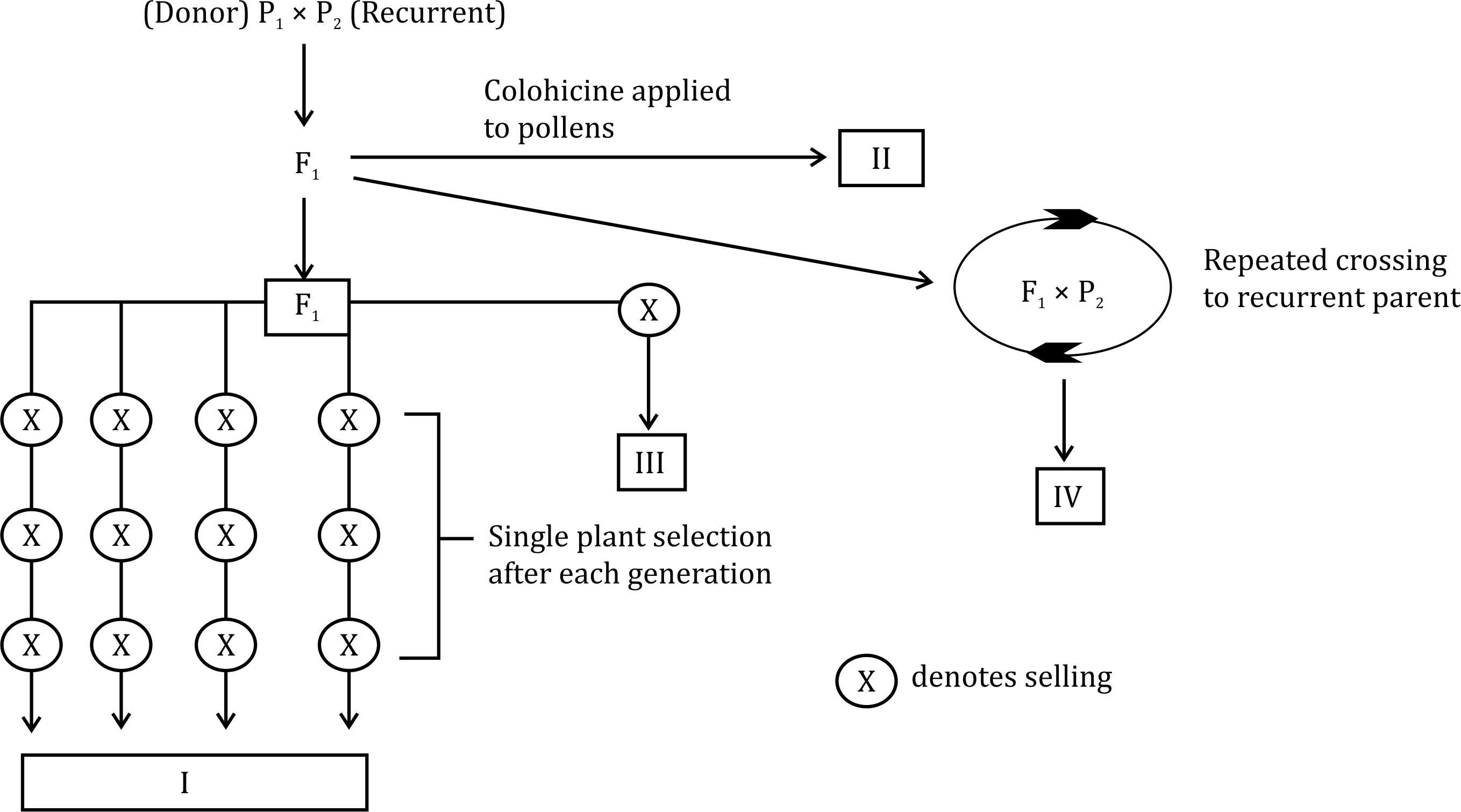
- I - Recombinant inbred lines (RILs) – immortal: RILs are immortal because they are genetically fixed over generations due to continuous selfing.
- II - Doubled haploid – Not immortal: Incorrect because doubled haploids are stable and fixed, but they are not immortal because they lack the capacity for genetic variation and adaptation over generations. Doubled haploid populations are not immortal as they are homozygous but do not undergo recombination or genetic variation over time.
- III - F2:3 – Not immortal: F2:3 populations are not immortal as they involve selfing and genetic variability persists across generations.
- IV - Near isogenic lines (NILs) – immortal: NILs are immortal due to their genetic uniformity and can be propagated indefinitely.
Information Booster:
Recombinant Inbred Lines (RILs) – Immortal: RILs are considered immortal because, after several generations of selfing, the genetic composition of these lines becomes fixed, which means they do not change across generations. This fixed genetic makeup makes them stable and allows them to be maintained indefinitely.
Doubled Haploid (DH) – Not Immortal: Doubled haploids are produced by doubling the chromosome number of haploid plants. While they are homozygous and genetically stable, they are not immortal because they lack genetic variation and do not undergo recombination. Therefore, they do not evolve or adapt over time, which means they cannot maintain "immortality" in the biological sense that includes potential genetic diversity.
F2:3 Populations – Not Immortal: F2:3 populations are created by selfing individual plants from the F2 generation. These populations are not immortal because they still contain genetic variation and recombination occurs, meaning they are not genetically fixed and can evolve over time.
Near Isogenic Lines (NILs) – Immortal: NILs are created by backcrossing a particular trait into a recurrent parent. Once established, NILs are immortal because they are genetically identical except for the trait of interest. The uniformity of their genetic composition allows them to be propagated over generations without change, making them stable and "immortal" in terms of their genetic uniformity.
Genetic Stability and Reproduction: The immortality of lines such as RILs and NILs depends on their genetic stability. These populations can reproduce generation after generation with no loss of the traits being studied, allowing for long-term studies without the introduction of new genetic variation.
Role of Selfing and Backcrossing: Selfing (repeated self-fertilization) in RILs helps to fix genetic traits, making them stable. In NILs, backcrossing is used to ensure genetic uniformity except for the gene of interest. Both methods contribute to creating stable, long-term populations.