






Correct option is A
Hemoglobin contains two parts : heme groups and globin proteins. A porphyrin ring containing an Fe atom is called a heme group. Cellular respiration is the process of using oxygen to break down glucose to produce CO2, water and energy for use by the cell. It has molar mass of about 64500. Hemoglobin is found in red blood cells that are called erythrocytes and is responsible for their characteristic colour. Without hemoglobin the blood is either colourless or a different colour. Hemoglobin picks up the weak ligand dioxygen from the lungs or gills and carries dioxygen in arterial blood to the muscles, where the oxygen is transferred to another heme containing protein, myoglobin which stores it until oxygen is required to decompose glucose to produce energy, CO2 and water. Hemoglobin then uses certain amino acid groups to bind CO2 and carry it in venous blood back to the lungs.
Myoglobin (or deoxy-myoglobin) is a protein which has only one heme group per molecule and serves as an oxygen storage molecule in the muscles. It has a molar mass of about 17000 and binds dioxygen molecule more strongly than hemoglobin.
The Physiology of Hemoglobin and Myoglobin
Hemoglobin has relatively high affinity for dioxygen at high partial pressure of dioxygen whereas myoglobin has relatively high affinity for dioxygen at lower partial pressure of dioxygen. In vertibrates dioxygen enters the blood in the lungs or gills where the partial pressure of dioxygen is relatively high and hemoglobin is virtually saturated with dioxygen in lungs. When hemoglobin carries dioxygen to muscle tissues, it experiences the lower partial pressure of dioxygen and its affinity for dioxygen has fallen off rapidly and in this situation affinity of myoglobin for dioxygen is relatively high. Therefore, in muscle tissues dioxygen is thermodynamically favourable transferred from hemoglobin to myoglobin. The reactions occuring in lungs and muscles tissues are as follows:
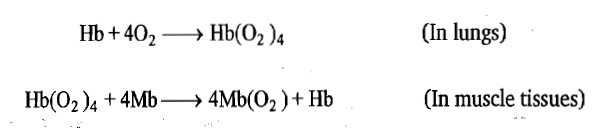
The oxygenation equilibrium for myoglobin is represented as:
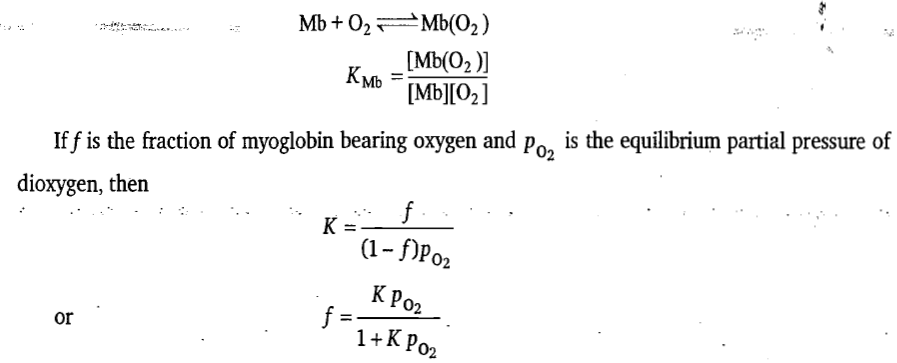
The equilibrium constant K is called the binding constant of myoglobin for O2.



