Correct option is C
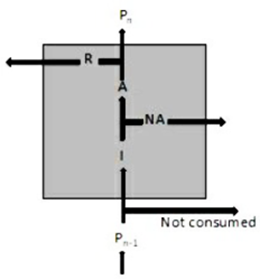
The production efficiency of an organism is the percentage of energy that is converted into new biomass (growth) relative to the Assimilated energy. It can be calculated using the formula:
In this case:
Energy ingested = 1,000 kJ
Energy used for growth = 150 kJ
Step 1: Find assimilated energy
Assimilated energy = Ingested energy − Energy lost in faeces
= 1000 kJ−500 kJ=500 kJ1000\ \text{kJ} - 500\ \text{kJ} = 500\ \text{kJ}1000 kJ−500 kJ=500 kJ
Step 2: Energy used for growth
Growth = 150 kJ
Information Booster:
Production efficiency indicates how much energy consumed by an organism is converted into biomass (growth) rather than being used for other processes like respiration or being lost.
The remaining energy after respiration and faeces loss contributes to growth in the organism, which is used for reproduction and survival.
Energy efficiency is typically lower in herbivores compared to carnivores due to their less efficient digestion and energy utilization.
Additional Knowledge:
50 (option 1) is incorrect because it overestimates the growth efficiency.
35 (option 2) is incorrect; it doesn’t align with the calculation based on the provided data.
15 (option 4) underestimates the energy efficiency of the herbivore.
Production efficiency=(1501000)×100=30%\text{Production efficiency} = \left(\frac{150}{1000}\right) \times 100 = 30\%