Correct option is C
Step 1: Identify Foreground (FG) Markers
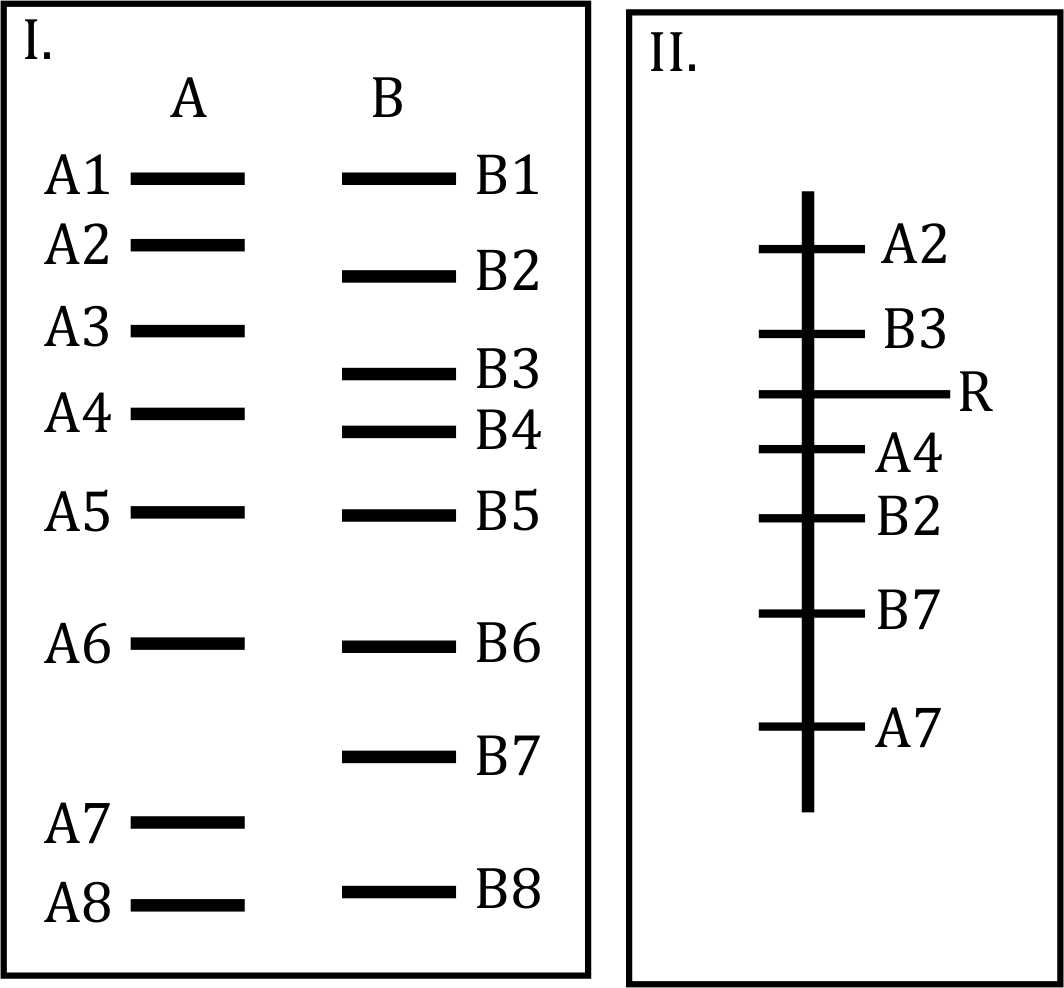
Foreground markers should be linked to the resistance gene (R) and should originate from the wild species (B) to confirm the transfer of the resistance gene.
From Panel II (Genetic Map):
- The gene R is located near B3 and B2.
- Thus, FG markers must include B3 and B2, as they are the closest to the resistance gene and can be used to confirm its presence.
Step 2: Identify Background (BG) Markers
Background selection markers should ensure maximum recovery of the cultivated variety (A) by selecting markers specific to A and not linked to R.
From Panel II (Genetic Map):
- The background markers should be far from the R gene but still within the same chromosome.
- Suitable BG markers from A: A2, A3, A4, A7 (They help retain the cultivated traits).
Step 3: Verify the Correct Answer
Foreground (FG) Markers:
- B3 and B2 (Markers near R from species B) → Correct
Background (BG) Markers:
- A2, A3, A4, A7 (Markers from the cultivated species A) → Correct
Thus, the correct answer is:
Option 3: FG: B3, B2 and BG: A2, A3, A4, A7
Information Booster:
1. Foreground (FG) vs. Background (BG) Selection in Marker-Assisted Breeding:
- Foreground Selection (FG): Ensures that the target gene (R) from donor (B) is present in the new variety.
- Background Selection (BG): Ensures most of the genome comes from the cultivated variety (A), maintaining desirable agronomic traits.
2. FG Markers are Close to the Gene
- Markers near R (B3, B2) ensure that the resistance gene is transferred with minimal unwanted DNA from species B.
3. BG Markers from A
- Markers like A2, A3, A4, A7 ensure that most of the plant's genome remains similar to cultivated variety A, preventing undesirable traits from the wild species.