

The West Bengal Civil Service (WBCS) Examination 2026 will be conducted strictly as per the revised exam scheme and updated WBCS Syllabus notified by the West Bengal Public Service Commission (WBPSC). WBCS is one of the most prestigious and competitive state-level civil service examinations, designed to recruit capable candidates for key administrative roles in West Bengal.
In this article, candidates will find a detailed and easy-to-understand explanation of the WBCS Revised Syllabus 2026, a clear overview of the latest exam pattern, and practical preparation tips curated to help aspirants plan their studies efficiently.
WBCS Syllabus 2026
The West Bengal Civil Service (WBCS) Examination 2026, conducted by WBPSC, is one of the most prestigious state-level exams, offering opportunities for top Group A, B, C, and D posts such as WBCS (Executive), West Bengal Revenue Service, West Bengal Co-operative Service, and more.
The selection process is carried out in three structured stages — Preliminary Examination, Main Examination, and Personality Test (Interview). Each stage plays a vital role in assessing a candidate’s knowledge, analytical ability, and suitability for civil service responsibilities.
For aspirants aiming to crack the exam, mastering the WBCS Syllabus 2026 is essential. A clear understanding of the syllabus helps you plan effectively for the WBCS Notification 2026, choose the right study material, and build a strong preparation strategy, ensuring you approach every stage with clarity, confidence, and precision.
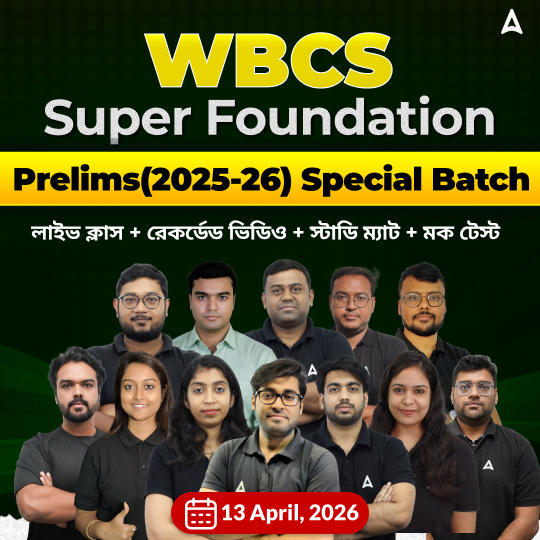
West Bengal Civil Services Syllabus 2026
A thorough understanding of the syllabus not only helps in focused preparation but also boosts the chances of scoring high in each stage of the exam.
| WBCS Syllabus 2026 | |
| Conducting Body | West Bengal Public Service Commission (WBCS) |
| Exam Date (Prelims) | To be announced |
| Stages | 1. Preliminary Examination 2. Main Examination 3. Personality Test |
| Total Marks | Prelims: 200 marks Mains: 2000 marks Personality Test: 200 marks |
| Duration | Prelims: 2 hours Mains: 3 hours per paper Personality Test: 30 mins |
| Mode of Exam | Offline (OMR for Prelims, Descriptive for Mains) |
| Official Website | www.pscwbapplication.in |
West Bengal CS Syllabus 2026
Below is the detailed WBCS Syllabus for the WBCS 2026 Exam, broken down paper-wise for both Preliminary and Main stages. The main exam consists of 8 papers out of which 6 are compulsory papers and one two subject consists of two papers. The 6 compulsory papers include:
- Bengali/Hindi/Urdu/Nepali/Santal
- English Essay
- General Studies-I
- General Studies–II
- Constitution of India and Indian Economy
- Arithmetic and Test of Reasoning
WBCS Preliminary Examination Syllabus
- The Exam comprises two objective-type papers:
General Studies Paper-I and General Studies Paper-II, each with 200 MCQs, 200 marks, and a duration of 2 hours. - Paper-II is qualifying in nature, requiring a minimum of 33% marks.
- Appearing in both papers is mandatory; absence in any leads to disqualification.
- The paper standard is that of a Graduate-level examination.
- The prelims exam is qualifying only, and the marks obtained will not be considered for final selection.
Here, we have shared a detailed subject-wise WBCS prelims syllabus:
| WBCS Prelims Syllabus | |
| Subject | Topics Covered |
| English Composition |
Synonyms & Antonyms, Idioms & Phrases, Vocabulary, Sentence Correction, Active-Passive Voice, Narration, Comprehension, Rearranging sentences, One-word substitution, Cloze Test
|
| General Science |
Everyday Science, Inventions, Scientific Terminology, Physics (Basics), Chemistry (Acids, Bases, Salts), Biology (Human Body, Plants), Space Science, Environment & Ecology
|
| Current Events of National and International Importance |
National & International Awards, Summits & Conferences, Important Appointments, Government Schemes, Sports Events, Reports, India’s international relations, Economic updates
|
| History of India |
Ancient, Medieval and Modern Indian History, Important Kings & Empires, Revolts, British Rule in India, Social Reform Movements, Freedom Struggle, Acts & Reforms
|
| Geography of India (with special reference to West Bengal) |
Physical Features, Climate, Rivers, Soils, Natural Resources, Agriculture, Population, Transport, West Bengal Districts, Rivers, Forests, Economic Geography
|
| Indian Polity and Economy |
Constitution of India, Fundamental Rights & Duties, Union & State Governments, Parliament, Judiciary, Panchayati Raj, Indian Economy, Budget, Five Year Plans, Economic Terminology
|
| Indian National Movement |
Early Nationalism, INC Formation, Swadeshi Movement, Non-Cooperation, Civil Disobedience, Quit India, Role of Revolutionaries, Partition of Bengal, Role of Important Leaders
|
| General Mental Ability |
Series (Number/Letter), Coding-Decoding, Analogy, Blood Relations, Direction Sense Test, Puzzles, Arithmetic Reasoning, Syllogism, Venn Diagrams, Ranking
|
WBCS Main Examination Syllabus
- The Main Exam includes a Written Examination (8 papers) and a Personality Test.
- 6 compulsory subject papers and 1 optional subject containing 2 papers.
- The Optional papers are written examination type and the compulsory papers are objective type MCQ based.
- Papers I–VI (compulsory) and VII–VIII (optional) are evaluated for final merit.
- Each merit-counted paper carries 200 marks and is of 3 hours duration.
- Group C & D candidates are exempt from Optional Papers (VII & VIII).
- There is negative marking for each incorrect answer.
Qualifying Papers
| WBCS Mains Syllabus | |||
|---|---|---|---|
| Subject | Topics | Marks | Nature |
| Bengali/Nepali | Letter writing, Report drafting, Précis, Composition & Translation | 200 | Compulsory |
| English | Letter writing, Report drafting, Précis, Composition & Translation from Indian languages to English | 200 | Compulsory |
| General Studies-I: | Indian History (National Movement) & Geography (with special reference to West Bengal) | 200 | Compulsory |
| General Studies-II: | Science & Technology, Environment, GK & Current Affairs, Biodiversity and Coastal Regulation zone, Global Warming, Industrial and Environmental Pollution, Ozone Layer related issures | 200 | Compulsory |
| Indian Constitution & Indian Economy (including RBI roles/functions) | Inclusive growth and issues arising from it. Government Budgeting. Issues related to direct and indirect farm subsidies and minimum support price; Public distribution system- objective, functioning, limitations, revamping; issues of buffer stocks and food security; Technology missions, economics of animal- rearing. Food processing and related industries in India and West Bengal – scope and significance. Location, upstream and downstream requirements, supply chain management. Land reforms in India with special reference to West Bengal. Effects of liberalisation on the economy, changes in industrial policy and their effect on industrial growth. Infrastructure: Energy, Ports, Roads, Airports, Railways etc. Investment models. Issues relating to poverty, hunger and unemployment. Issues relating to development and management of Social Sector/ Services relating to Health, Education, Human Resources and Human Development Index. Welfare schemes for vulnerable sections of the population by the Centre and States and the performance of these schemes; mechanisms, laws, institutions and bodies constituted for the protection and betterment of these vulnerable sections. Government policies and interventions for development in various sectors and issues arising out of their design and implementation. |
200 | Compulsory |
| Arithmetic and Test of Reasoning | 200 | Compulsory | |
| Optional Subject (two papers) – Only for Groups A & B | 200 | ||
List of Optional Subjects (for Paper VII & VIII)
(For Group A and B Only)
Bengali, Hindi, Sanskrit, English, Pali, Arabic, Persian, French, Urdu, Santali, Nepali, Comparative Literature, Agriculture, Animal Husbandry and Veterinary Science, Anthropology, Botany, Chemistry, Civil Engineering, Commerce and Accountancy, Computer Science, Economics, Electrical Engineering, Geography, Geology, History, Law, Management, Mathematics, Mechanical Engineering, Medical Science, Philosophy, Physiology, Physics, Political Science, Psychology, Sociology, Statistics, Zoology.
The standard of the optional papers is graduation.
WBCS Exam Pattern 2026
The WBCS Exam Pattern 2026 outlines the structure of the Preliminary, Main, and Personality Test stages. Understanding the pattern is crucial for effective preparation and time management throughout the selection process.
WBCS Prelims Exam Pattern
| WBCS Prelims Exam Pattern 2026 | |||
| Subjects Name | Marks | Questions | Duration |
| English Composition | 25 | 25 |
150 minutes
|
| General Science | 25 | 25 | |
| Current events of National & International Importance | 25 | 25 | |
| History of India | 25 | 25 | |
| Geography of India with special reference to West Bengal | 25 | 25 | |
| Indian Polity and Economy | 25 | 25 | |
| Indian National Movement | 25 | 25 | |
| General Issues on Environmental Ecology, Bio-Diversity and Climate Change- that do not require a subject specialization |
25 | 25 | |
| Total | 200 | 200 | |
WBCS Mains Exam Exam Pattern
Group ‘A’ & ‘B’ Services & Posts : 2(two) Optional Papers, and 6(six) Compulsory
Papers.
Group ‘C’ & ‘D’ Services & Posts : 6(six) Compulsory Papers
|
WBCS Mains Exam Pattern 2026
|
||||
| Compulsory Papers | Marks (Group A) | Marks (Group B) | Marks (Group C) |
Marks (Group D)
|
| Bengali/Hindi/Urdu/Nepali/Santali | 200 | 200 | 200 | 200 |
| English | 200 | 200 | 200 | 200 |
| General Studies-I | 200 | 200 | 200 | 200 |
| General Studies-II | 200 | 200 | 200 | 200 |
| Indian Constitution & Indian Economy (including RBI roles/functions) | 200 | 200 | 200 | 200 |
| Arithmetic and Test of Reasoning | 200 | 200 | 200 | 200 |
| Optional Subject (two papers) – Only for Groups A & B | 400 | 400 | — | — |
| Personality Test | 200 | 200 | 150 | 100 |
| Total Marks | 1800 | 1800 | 1350 | 1300 |
Personality Test for Selected Candidates in Groups A, B, C, and D:
Candidates selected based on merit in the Main Examination for Group A, B, C, and D services and posts will have to appear for the Personality Test. The key objectives and components of this test include:
- General Knowledge: Candidates will be asked questions related to matters of general interest.
- Range of Interests: The test will also focus on the candidate’s diverse interests and how well they are aware of various topics.
- Assessment of Personal Qualities: The test aims to evaluate personal attributes such as:
- Alertness of mind
- Power of clear and logical explanation
- Intellectual and moral integrity
- Leadership abilities
The main goal is to assess the overall personality, decision-making abilities, and suitability for the respective position. The Breakdown of the interview marks group-wise is given below:
| Group | Marks |
|---|---|
| Group A | 200 |
| Group B | 200 |
| Group C | 150 |
| Group D | 100 |
WBCS Syllabus 2026 PDF
The West Bengal Public Service Commission has released the updated WBCS Prelims & Mains Syllabus 2026. These changes are made to better evaluate candidates’ knowledge, analytical skills, and administrative ability.
In the new exam pattern, some new papers have been added, and the overall structure has been updated. This makes the selection process more detailed and in line with current administrative needs. To help candidates prepare better, a direct link to download the WBCS Syllabus 2026 PDF is given below, so aspirants can plan their studies according to the latest syllabus.
West Bengal CS Syllabus 2026 – click here to download PDF
WBCS Exam Preparation Tips 2026
Preparing for the WBCS 2026 exam needs a smart strategy, regular practice, and a clear understanding of the exam pattern. With the right approach and a disciplined study plan, candidates can clear all three stages of the exam with confidence.
- Understand the Exam Pattern & Syllabus
Start by carefully reviewing the latest syllabus and exam pattern for Prelims, Mains, and the Personality Test. - Make a Study Plan
Prepare a practical daily timetable that covers all subjects, ensuring proper time allocation for General Studies, current affairs, optional subjects, and language papers. - Focus on Current Affairs
Read newspapers like The Hindu etc and follow monthly current affairs magazines for national and international updates. - Practice Previous Year Papers & Mock Tests
Solve past WBCS papers to understand question trends. Take online or offline mock tests to improve speed and accuracy. - Revise Regularly
Make short notes and mind maps for revision. Weekly revision sessions help retain key facts and concepts. - Strengthen Basics
Use NCERT books (Class 6–12) to build a strong foundation in History, Polity, Geography, Science, and Economy.
| Also check |
| WBCS Salary |
| WBCS Previous Year Question Papers |


 TNUSRB Police Constable Syllabus And Exa...
 PSSSB ADA Syllabus 2026, Check Latest Ex...
 BTSC Work Inspector Syllabus 2026, Check...

 Adda247 Job portal has complete information about all Sarkari Jobs and Naukri Alerts, its latest recruitment notifications, from all state and national level jobs and their updates.