
The Tamil Nadu Public Service Commission has officially announced the annual planner, which includes the Group 4 Notification and Exam Release dates. All aspirants have a good opportunity to make a career in the government sector by grabbing the Group 4 posts. This is the right time to start preparation for the TNPSC Group 2026 exam, but to crack this exam, the first step for candidates is to understand the TNPSC Group 4 Syllabus and Exam Pattern details. For these details, candidates can refer to the article.
TNPSC Group 4 2026 Syllabus
By understanding the TNPSC Group 4 Syllabus and Exam Pattern, candidates can make strategies and work on the weak parts of the subjects so that they will crack the exam. The TNPSC Group 4 2026 Syllabus is divided into 3 parts – Part A, Part B and Part C. Part A includes the Tamil Cum Eligibility & Scoring Test, Part B includes General Studies, and Part C includes Aptitude and Mental Ability Test.
| TNPSC Group 4 Syllabus & Exam Pattern: Key Highlights | |
|
Organisation & Post Name
|
Category
|
|
Marking & Exam Structure Details
|
Selection Process
|
|
Exam Mode
|
Question Type
|
TNPSC Group 4 2026 Exam Pattern
The exam pattern outlines the exam structure, including question types, marking scheme, duration, and subjects. It helps candidates focus on key areas for roles like VAO, Junior Assistant, Typist, and Forest Guard in Tamil Nadu.
- The TNPSC Group 4 Exam will be conducted in offline mode.
- The total duration of the exam is 3 hours.
- There is no negative marking in the exam.
- Candidates must choose either General Tamil or General English, and this section is compulsory.
| TNPSC Group 4 Exam Pattern 2026 | ||||
| Subjects | Topics | Max. Questions | Total Marks | Time Duration |
|
Tamil Eligibility-cum-Scoring Test* (SSLC Standard)
|
இலக்கணம் | 25 |
150
|
3 Hours
|
| சொல்லகராதி | 15 | |||
| எழுதும் திறன் | 15 | |||
| கலைச்சொற்கள் | 10 | |||
| வாசித்தல்- புரிந்து கொள்ளும் திறன் | 15 | |||
| எளிய மொழி பெயர்ப்பு | 5 | |||
| இலக்கியம் தமிழ் அறிஞர்களும் தமிழ்த்தொண்டும் | 15 | |||
|
General Studies (SSLC Standard)
|
General Science | 5 |
150
|
|
| Geography | 5 | |||
| History, Culture of India, and Indian National Movement | 10 | |||
| Indian Polity | 15 | |||
| Indian Economy and Development Administration in Tamil Nadu | 20 | |||
| History, Culture, Heritage, and Socio-Political Movements of Tamil Nadu | 20 | |||
| Aptitude & Mental Ability Test (SSLC Standard) | Aptitude | 15 | ||
| Reasoning | 10 | |||
| Total | 200 |
300
|
||
Note: The minimum qualifying marks for all sections/categories are 90. Candidates scoring above 90 will be considered for selection, and the final cut-off marks will be released after the merit list PDF is released.
TNPSC Group 4 Syllabus 2026 Subject-wise
The TNPSC Group 4 exam includes sections like General Studies, Science, Aptitude, Current Affairs, General Awareness, and Tamil Eligibility-cum-Scoring Test. Preparing all areas evenly is crucial for a strong performance and success in this competitive exam.
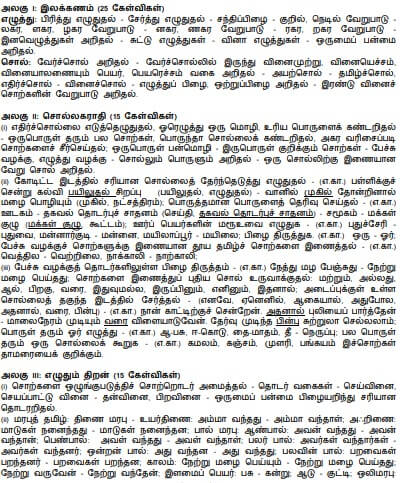
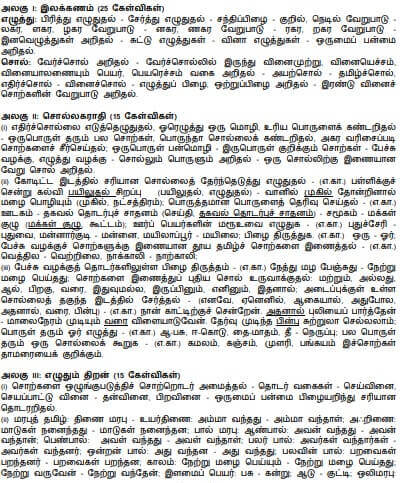
Part A: தமிழ் தகுதி மற்றும் மதிப்பீட்டுத் ததர்வு (SSLC Standard – 100 Questions)
TNPSC Group 4 Tamil Eligibility Cum Scoring Test
The Tamil Language Test is conducted to assess the knowledge of the language. Candidates are required to score 40% marks in this test. The test includes Tamil Grammar, Literature, Scholars, etc.
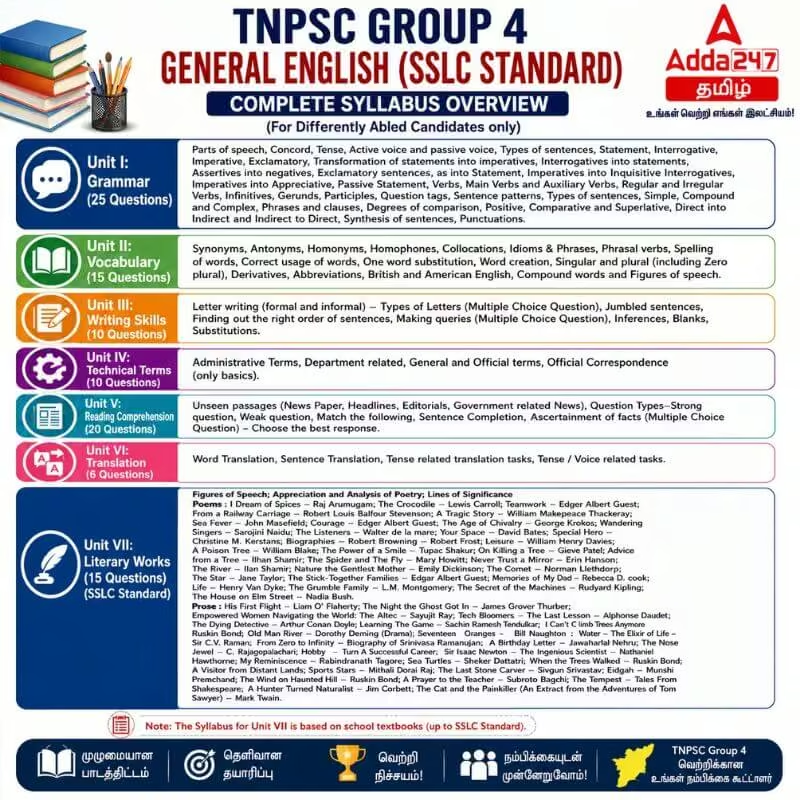
Part A: General English (SSLC Standard – 100 Questions) (For Differently Abled Candidates only)
Here, we have provided the TNPSC Group 4 Syllabus of Part C, which includes English topics for Differently Abled Candidates only.
| Units | Detailed Syllabus |
| Unit I: Grammar |
|
| Unit II: Vocabulary | Synonyms, Antonyms, Homonyms, Homophones, Collocations, Idioms & Phrases, Phrasal verbs, Spelling of words, Correct usage of words, One word substitution, Word creation, Singular and plural (including Zero-plural), Derivatives, Abbreviations, British and American English, Compound words, and Figures of speech |
| Unit III: Writing Skills | Writing formal and informal letters, Types of Letters (Multiple Choice Question), Jumbled sentences, Finding out the right order of sentences, Making queries (Multiple Choice Question), Notice, Biographies, Substitution. |
| Unit IV: Technical Terms | Administrative Terms, Department-related, General and Official terms, Official Correspondence (Only basics). |
| Unit V: Reading Comprehension | Unseen passage (including poems, advertisements, Government-related News), Question types: Short questions, Wh questions, Match the following, Sentence Completion, True/False statements, Phrase meaning, Choose the best title, Synonyms, Antonyms. |
| Unit VI: Translation | Word Translation, Sentence Translation, Tense-related translation tasks, Tense / Voice-related tasks. |
| Unit VII: Literary Works | The Model Millionaire – Oscar Wilde; A Retrieved Reformation – O. Henry; The Selfish Giant – Oscar Wilde; The Night the Ghost Got In – James Thurber; The Open Window – Saki; With the Photographer – Stephen Leacock; The Gift of the Magi – O. Henry; Our Local Team – S.J. Scully; Snake – D.H. Lawrence; The Piano – D.H. Lawrence; The Man He Killed – Thomas Hardy; O Captain! My Captain! – Walt Whitman; The River – Caroline Ann Bowles; Be the Best of Whatever You Are – Douglas Malloch; A Psalm of Life – H.W. Longfellow; Laugh and Be Merry – John Masefield; The Apology – Ralph Waldo Emerson; Women’s Rights – Annie Louisa Walker; The Cry of the Children – Elizabeth Barrett Browning; Migrant Bird – Famida Y. Basheer; To Cook and Eat – Debbie Lamedman The Flying Wonder – Stephen Leacock; The First Patient – Jerome K. Jerome; My Greatest Olympic Prize – Jesse Owens; The One Minute Apology – Spencer Johnson; The Unexpected – Robert Lynd; The Wooden Bowl – Leo Tolstoy; The Tears of the Desert – C. Rajagopalachari; The Last Leaf – O. Henry; The Merchant of Venice – William Shakespeare (Play); The Never Never Nest – Cedric Mount (Play) The Bishop’s Candlesticks – Norman Mckinnel (Play); The Dear Departed – Stanley Houghton (Play); India – My Land – Dr. Abdul Kalam; The Shilpi – S. Mangalam; Nine Gold Medals – David Roth, The Secret of the Machines – Rudyard Kipling; The Ant and the Cricket – Adapted from Aesop’s Fable; The Comet – Norman Littleford; The Snake and the Mirror – Vaikom Muhammad Basheer The Night the Ghost Got In – James Thurber; Two Gentlemen of Verona – A.J. Cronin, The Cat and the Painkiller – Mark Twain; The Model Millionaire – Oscar Wilde, The Refugee – K.A. Abbas; The Hero – R.K. Narayan; The Selfish Giant – Oscar Wilde; The Singers – Herbert Kaufman; The Tears of the Desert – C. Rajagopalachari; The Bench – Richard R. Thomas; The Wooden Bowl – Leo Tolstoy My Grandmother’s House – Kamala Das; The School Boy – William Blake; A Poison Tree – William Blake; Be the Best – Douglas Malloch; A Psalm of Life – H.W. Longfellow; Snake – D.H. Lawrence; No Men are Foreign – James Kirkup; The Cry of the Children – Elizabeth Barrett Browning; The Apology – Ralph Waldo Emerson; The Man He Killed – Thomas Hardy; Migrant Bird – Famida Y. Basheer; Women’s Rights – Annie Louisa Walker; The Piano – D.H. Lawrence; India – Dr Abdul Kalam. |
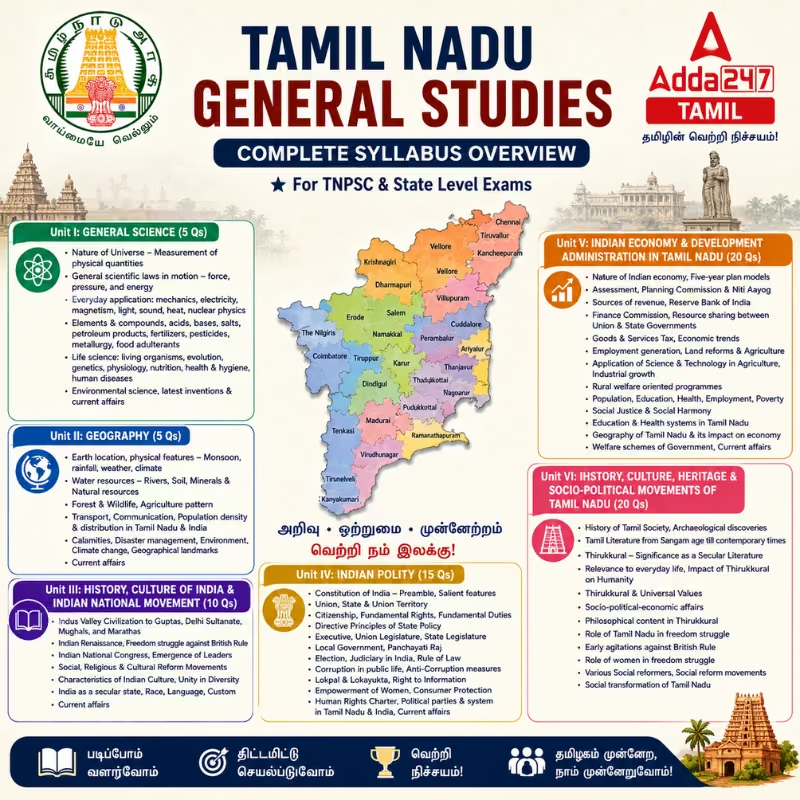
Part B: General Studies (SSLC Standard – 75 Questions)
This section highlights the all-important topics, including General Studies subjects unit wise are given below-
| TNPSC Group 4 Syllabus: Part B | |
| Unit | Detailed Syllabus |
| Unit I: General Science |
This unit covers the nature of the universe and the measurement of physical quantities. It includes general scientific laws related to motion, force, pressure, and energy. Emphasis is placed on the everyday applications of basic principles from mechanics, electricity, magnetism, light, sound, heat, and nuclear physics. It also includes the study of elements and compounds such as acids, bases, salts, petroleum products, fertilisers, pesticides, metallurgy, and food adulterants. Topics from life science include living organisms, evolution, genetics, physiology, nutrition, health, hygiene, and human diseases. Environmental science concepts, along with recent scientific inventions and current developments in technology, are also part of this unit. |
| Unit II: Geography | This unit focuses on Earth’s location and physical features, including monsoon, rainfall, weather, and climate. It covers water resources such as rivers, soil, minerals, and natural resources. Students will study forest and wildlife, agriculture patterns, transportation, communication, and population distribution in Tamil Nadu and India. The unit also includes disaster management, environmental issues, climate change, geographical landmarks, and current affairs related to geography. |
| Unit III: History, Culture of India, and Indian National Movement | This unit begins with the Indus Valley Civilisation and continues through the Gupta period, Delhi Sultanate, Mughals, and Marathas, leading up to Indian independence. It includes the Indian Renaissance, the emergence of leaders such as Raja Ram Mohan Roy, Swami Dayanand Saraswati, Vivekananda, and others, along with the freedom struggle and role of the Indian National Congress. It also covers social, religious, and cultural reform movements, characteristics of Indian culture, unity in diversity, and India as a secular state. Current affairs related to history and culture are also included. |
| Unit IV: Indian Polity | This unit deals with the Constitution of India, including the Preamble, salient features, and the structure of the Union, State, and Union Territories. It covers citizenship, fundamental rights, fundamental duties, and Directive Principles of State Policy. The roles of the executive, legislature, judiciary, and local governments such as Panchayati Raj institutions are explained. Topics such as elections, rule of law, corruption, anti-corruption measures, Lokpal and Lokayukta, Right to Information, empowerment of women, consumer protection, and human rights are also included. Additionally, it addresses political parties, the political system in Tamil Nadu and India, and current affairs. |
| Unit V: Indian Economy and Development Administration in Tamil Nadu | This unit explains the nature of the Indian economy, including Five-Year Plans, NITI Aayog, and the Planning Commission. It covers sources of revenue, the Reserve Bank of India, the Finance Commission, and resource sharing between Union and State governments. Topics include Goods and Services Tax (GST), economic trends, employment generation, land reforms, and agriculture. It also highlights the role of science and technology in development, industrial growth, rural welfare programs, population, education, health, and poverty. Social justice, education and health systems in Tamil Nadu, and the impact of geography on economic growth are also discussed, along with welfare schemes and current economic issues. |
| Unit VI: History, Culture, Heritage, and Socio-Political Movements of Tamil Nadu | This unit explores the history of Tamil society, including archaeological discoveries and Tamil literature from the Sangam age to modern times. It emphasises the significance of Thirukkural and its relevance to daily life, philosophy, and universal values. The unit also includes socio-political and economic developments, the role of Tamil Nadu in the freedom struggle, early agitations against British rule, and the contribution of women in the independence movement. Various social reformers, reform movements, and the social transformation of Tamil Nadu are also covered, along with current affairs. |
Part C: Aptitude and Mental Ability (SSLC Standard – 25 Questions)
Below is Part C of the TNPSC Group 4 Syllabus 2026, covering topics related to Aptitude and Mental Ability. The detailed syllabus is provided here for your reference.
| Units | Detailed Syllabus |
| Unit I: Aptitude |
|
| Unit II: Reasoning |
|
Download TNPSC Group 4 Syllabus 2026 PDF- Direct Link
The direct link to download the TNPSC Group 4 Syllabus and Exam Pattern 2026 has been provided in the official website or in the article. Every aspirant must download the syllabus PDF and analyse every subject with topic details so that they can create unique strategies and crack the exam. For the ease of the candidates, we have provided the direct link to download the syllabus PDF in the article below
Important Strategies to prepare for TNPSC Group 4 Exam
Preparing for the TNPSC Group 4 Exam requires a strategic approach: understand the syllabus, practice past papers, manage time well, and revise regularly. Consistency and focus are crucial to boost your chances of success. Follow these steps to improve your preparation.
- Understand the Syllabus and Exam Pattern: Go through the TNPSC Group 4 Syllabus and Exam Pattern in detail to clearly understand the subjects included, marking scheme, and the weightage of each topic.
- Create a Study Plan: Develop a structured study schedule by allocating sufficient time to every subject. Focus more on difficult topics while consistently revising the easier ones.
- Practice Mock Tests: After completing revisions, attempt mock tests based on the actual exam pattern to enhance accuracy, improve time management, and strengthen overall preparation
| Also Check |
| TNPSC Group 4 Salary |
| TNPSC Group 4 Previous Year Papers |


 APSC Home Guard Syllabus 2026, Check Lat...
 Bihar DCECE Paramedical Syllabus 2026, C...
 Railway GDCE Nursing Superintendent Syll...
 Adda247 Job portal has complete information about all Sarkari Jobs and Naukri Alerts, its latest recruitment notifications, from all state and national level jobs and their updates.