
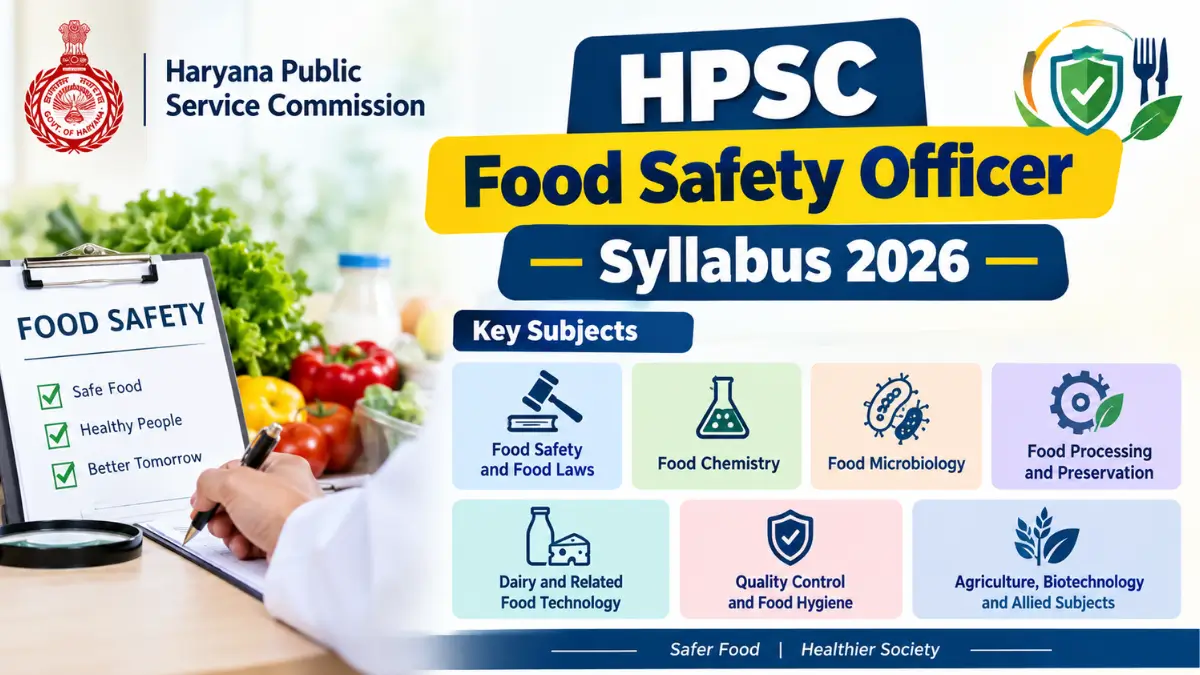
The Haryana Public Service Commission (HPSC) has announced the revised HPSC FSO Syllabus and examination scheme for the Food Safety Officer (Group-B) recruitment 2026 under Advertisement No. 25/2026. Candidates can check the complete syllabus, subject-wise topics, exam pattern, marking scheme and selection process to prepare effectively for the upcoming examination and understand the requirements of each stage of recruitment.
HPSC FSO Syllabus : Overview
The HPSC FSO Syllabus and Exam Pattern 2026 will be important for candidates preparing for the Group-B Food Safety Officer vacancies. The selection process includes a Screening Test, Subject Knowledge Test and Interview/Viva-Voce.
| Particulars | Details |
|---|---|
| Recruiting Authority | Haryana Public Service Commission |
| Post Name | Food Safety Officer |
| Department | Food & Drugs Administration Department, Haryana |
| Post Group | Group-B |
| Selection Process | Screening Test, Subject Knowledge Test, Interview/Viva-Voce |
| Official Website | hpsc.gov.in |
Must Check: HPSC Food Safety Officer Recruitment 2026
Haryana Food Safety Officer Exam Pattern 2026
The selection process includes a Screening Test, a Subject Knowledge Test, and an Interview. The Screening Test is used for shortlisting candidates, while the Subject Knowledge Test and Interview contribute to the final merit.
Screening Test Exam Pattern
| Particulars | Details |
|---|---|
| Type of Questions | Multiple-Choice Questions (MCQs) |
| Total Questions | 100 |
| Total Marks | 100 |
| Duration | 2 hours |
| Options per Question | 5 (5th option = leave un-attempted) |
| Negative Marking | 1/4 mark for a wrong answer |
| Unattempted Question Rule | 1/4 mark deducted if the fifth option is not darkened |
| Minimum Qualifying Marks | 25% |
| Purpose | Shortlisting candidates |
| Medium of Exam | English |
| Shortlisting Ratio | 4× advertised posts (plus bracketed candidates) |
| Disqualification Rule | Not darkening any of 5 circles in more than 10% questions |
| Merit Weightage | Not counted in final merit (qualifying only) |
Important instructions:
- Each question has five options. Candidates must darken the fifth option if they do not wish to attempt a question.
- One-fourth of a mark is deducted for every incorrect answer.
- If a question is left unattempted and the fifth option is not darkened, one-fourth of a mark is deducted.
- Candidates who do not darken any of the five circles for more than 10% of the questions will be disqualified.
- Candidates up to four times the number of advertised posts, including bracketed candidates, will be shortlisted for the next stage.
- Screening Test marks will not be included in the final merit list.
Subject Knowledge Test Exam Pattern
| Particulars | Details |
|---|---|
| Exam Type | Subjective |
| Total Marks | 150 |
| Duration | 3 hours |
| Medium | English |
| Minimum Qualifying Marks | 35% |
| Final Merit Weightage | 87.5% |
| Shortlisting Ratio | 2× advertised posts (plus bracketed candidates) |
Candidates who secure at least 35% marks and meet the applicable shortlisting criteria will be considered for the Interview stage.
Haryana Food Safety Officer Screening Test Syllabus 2026
The Screening Test assesses candidates’ general knowledge, reasoning ability, numerical skills, and knowledge of Haryana. The syllabus includes the following subjects:
- General Science: Basic scientific concepts and developments.
- Current Events: National and international current affairs.
- History of India: Important historical events and developments.
- Indian and World Geography: Physical, social, and economic geography.
- Indian Culture: Cultural heritage, traditions, and important developments.
- Indian Polity: Constitution, political system, and governance.
- Indian Economy: Basic economic concepts and developments.
- General Mental Ability: Reasoning and analytical ability.
- Basic Numeracy: Class 10-level mathematical concepts.
- Data Interpretation: Class 10-level graphs, charts, and numerical data.
- Haryana General Knowledge: History, geography, polity, economy, culture, and other important aspects of Haryana.
Candidates should prepare all the listed areas and practise MCQs regularly to improve speed and accuracy.
Haryana Food Safety Officer Subject Knowledge Test Syllabus 2026
The Subject Knowledge Test carries 150 marks and has a duration of three hours. The revised syllabus covers 12 units related to food science, nutrition, microbiology, processing, food safety, laboratory analysis, food laws, and regulatory systems.
Unit I: Food Chemistry and Constituents
- Composition, classification, structure, and properties of carbohydrates, proteins, lipids, water, vitamins, minerals, and dietary fibre.
- Food enzymes and their functions.
- Physical chemistry of food, including pH, water activity, colloids, and emulsions.
- Anti-nutritional factors and natural toxicants.
- Chemical changes in food during cooking and storage.
Unit II: Human Nutrition and Public Health
- Digestion, absorption, and metabolism of nutrients.
- Balanced diet and Recommended Dietary Allowance (RDA).
- Nutritional assessment, including BMI, BMR, biological value, NPU, and PER.
- Macro- and micronutrient deficiencies.
- Malnutrition and food fortification.
- Diet-related non-communicable diseases.
- Major nutrition and food-security programmes in India.
Unit III: Food Microbiology
- Classification, morphology, physiology, and growth of food-related microorganisms.
- Sources and causes of food contamination.
- Foodborne pathogens, infections, and intoxications.
- Microbial spoilage of food.
- Beneficial microorganisms and food fermentation.
- Microbiological examination methods, including standard plate count and indicator organisms.
Unit IV: Primary Production and Food Supply
- Traditional and modern farming systems in India and Haryana.
- Production of cereals, pulses, oilseeds, millets, horticultural crops, and spices.
- Dairy, meat, poultry, fisheries, aquaculture, and apiculture.
- Good agricultural practices and animal husbandry practices.
- Sustainable agriculture and pest management.
- Roles of ICAR, Krishi Vigyan Kendras (KVKs), and NABARD.
Unit V: Food Commodities and Product Technology
- Composition and quality attributes of major food commodities.
- Processing of milk, meat, poultry, fish, eggs, cereals, pulses, oilseeds, and edible oils.
- Processing of fruits, vegetables, spices, and beverages.
- Product-specific identity and quality parameters.
- Common food adulterants and authenticity concerns.
Unit VI: Preservation, Processing, Packaging and Storage
- Thermal processing, pasteurisation, sterilisation, and canning.
- Dehydration, chilling, freezing, irradiation, and fermentation.
- Aseptic processing and novel processing methods.
- High-pressure processing (HPP), membrane separation, pulsed electric fields, cold plasma, microwave, ohmic, and infrared processing.
- Hurdle technology and food additives.
- Nutraceuticals and packaging materials.
- Food-contact safety, shelf life, and cold-chain management.
Unit VII: Food Hazards, Hygiene and Safety Management
- Biological, chemical, physical, and allergen hazards.
- Food contaminants, residues, adulterants, and food fraud.
- Food safety risk analysis.
- Hygiene requirements for food establishments.
- FSSAI Schedule 4 requirements.
- Good Manufacturing Practices (GMP) and Good Hygiene Practices (GHP).
- Good Agricultural Practices (GAP) and Good Laboratory Practices (GLP).
- HACCP principles and ISO 22000:2018.
- Monitoring, verification, traceability, and food recall.
Unit VIII: Food Sampling, Analysis and Laboratory Quality
- Sampling plans and representative sampling.
- Sample preparation, preservation, transportation, and chain of custody.
- Classical chemical and physical analytical methods.
- Spectroscopic, chromatographic, and mass-spectrometric techniques.
- Immunological, molecular, and microbiological methods.
- Method validation, calibration, and reference materials.
- Proficiency testing and measurement uncertainty.
- Screening and confirmatory analysis.
- FSSAI Rapid Analytical Food Testing (RAFT) kits.
- Laboratory recognition and ISO/IEC 17025.
Unit IX: Indian Food Law and Regulatory Compliance
- Food Safety and Standards Act, 2006.
- Important definitions, authorities, powers, offences, and penalties.
- Food Safety and Standards Rules, 2011.
- Regulations on licensing, product standards, and food additives.
- Contaminants, packaging, labelling, and advertising regulations.
- Food imports, organic foods, and nutraceuticals.
- Inspection, surveillance, sampling, seizure, and documentation.
- Referrals, food recall, and regulatory compliance.
- Roles of the Food Safety Officer, Designated Officer, Food Analyst, and Commissioner of Food Safety.
Unit X: FSSAI Systems, Institutions and Initiatives
- Establishment, structure, and functions of FSSAI.
- State Food Authorities and their responsibilities.
- Food safety training and capacity building.
- Consumer education and awareness programmes.
- Eat Right India, food fortification, Clean Street Food Hubs, and Safe and Nutritious Food initiatives.
- Repurpose Used Cooking Oil (RUCO).
- Roles of BIS, AGMARK, APEDA, EIC, MPEDA, Spices Board, CFTRI, NIFTEM, ICAR, ICMR, and DFRL.
Unit XI: International Food Control and Standards
- Codex Alimentarius Commission.
- JECFA, JEMRA, and JMPR.
- WTO Sanitary and Phytosanitary (SPS) Agreement.
- WTO Technical Barriers to Trade (TBT) Agreement.
- International food-control systems.
- Voluntary standards and legal requirements.
- Certification, auditing, and accreditation.
Unit XII: Food Biotechnology and Emerging Developments
- Principles of biotechnology and fermentation.
- Industrial bioprocessing and enzyme production.
- Enzyme immobilisation and downstream processing.
- Genetic engineering, molecular detection, and genetically modified foods.
- Biosafety and emerging food hazards.
- Rapid diagnostic methods and new food-processing technologies.
- Recent FSSAI regulations, standards, and initiatives.
- Relevant government schemes and official regulatory sources.
- Differences between binding regulations, draft regulations, and advisories.
Haryana Food Safety Officer Interview 2027
The Interview is the final stage of the selection process and carries 12.5% weightage in the final merit list. Candidates shortlisted after the Subject Knowledge Test must attend the Interview as directed by the commission. They should prepare food safety concepts, food laws, regulatory responsibilities, and relevant developments in the food sector.
Candidates must appear at every required stage. Absence from the Screening Test, Subject Knowledge Test, or Interview will result in disqualification, according to the provided examination scheme.
Haryana Food Safety Officer Revised Syllabus 2026 PDF
HPSC has issued a revised syllabus and examination scheme for the Food Safety Officer (Group-B) recruitment under Advertisement No. 25/2026. The Haryana Public Service Commission (HPSC) has released the HPSC FSO Syllabus 2026 and examination scheme for Food Safety Officer (Group-B) posts. Candidates can refer to the official PDF to check the subject-wise syllabus, exam pattern, marking scheme and selection criteria for the upcoming examination.
How to Prepare for HPSC FSO Exam 2026?
Candidates should prepare according to the separate requirements of the Screening Test and Subject Knowledge Test.
- Start with your graduation/postgraduation subjects: Revise the fundamental concepts of your relevant discipline.
- Focus on food safety: Study food contamination, adulteration, hygiene, microbiology and food preservation.
- Revise food analysis: Pay attention to commonly used analytical methods and quality-control concepts.
- Study applicable laws: Keep track of important food-safety legislation and regulations.
Practice objective questions: Solve questions related to food science, microbiology, chemistry and food technology. - Follow HPSC updates: Check the Commission’s website regularly for the separately released syllabus and examination scheme.
- Prepare for the subject test: Give additional attention to technical concepts because the selection process includes a Subject Knowledge Test.





 TNPSC Group 4 Syllabus 2026, Download Ex...
 UPSSSC PET Syllabus and Exam Pattern 202...
 Odisha Police Constable Syllabus & E...


 Adda247 Job portal has complete information about all Sarkari Jobs and Naukri Alerts, its latest recruitment notifications, from all state and national level jobs and their updates.