SSC JE Fluid Mechanics Questions with Detailed Solutions
Get SSC JE Fluid Mechanics Questions to prepare for your upcoming exam. Solve the most expected questions and detailed solutions that can be asked in the exam.
Important SSC JE Fluid Mechanics Questions
Q1.
A.
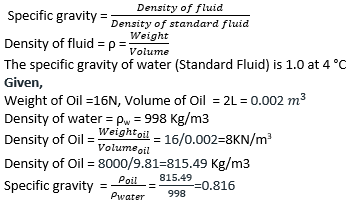
0.846
B.
0.786
C.
0.856
D.
0.816
✓ Correct
Answer & Solution
Correct option is D
Q2.
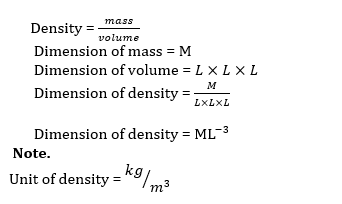
Density of a fluid is its mass per unit volume. The dimension of density of a fluid is __________.
A.
B.
C.
✓ Correct
D.
Answer & Solution
Correct option is C
Q3.
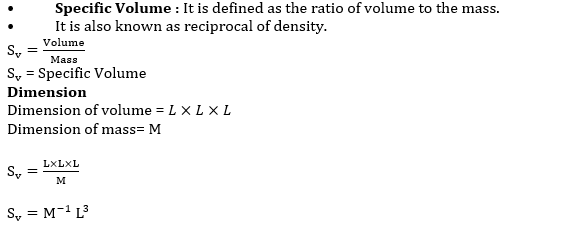
The reciprocal of density is known as specific volume. The dimension of specific volume of a fluid is ___________.
A.
B.
✓ Correct
C.
D.
Answer & Solution
Correct option is B
Q4.
A.
B.
C.
D.
✓ Correct
Answer & Solution
Correct option is D
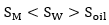
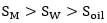
Specific gravity : Specific gravity is defined as the ratio of density of fluid to the density of standard fluid. • In liquid standard fluid is taken as water. • In gas standard fluid is taken as air. Specific gravity of different fluid : i) Mercury : 13.6 ii) Water : 1 iii) Oil : 0.7 to 0.9
Q5.
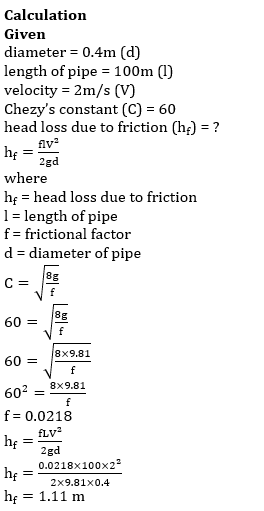
Find the head loss due to friction in a pipe of diameter 0.4 m and length 100 m, through which water is flowing at a velocity of 2 m/s using Chezy’s formula, for which C = 60.
A.
1.11 m
✓ Correct
B.
1.51 m
C.
1.61 m
D.
1.41 m
Answer & Solution
Correct option is A
Q6.
The surface of a liquid acts like a stretched elastic membrane under tension. This is mainly due to ___________.
A.
Viscosity
B.
Capillarity
C.
Surface tension
✓ Correct
D.
Velocity of flow
Answer & Solution
Correct option is C
Surface tension : Surface tension is a phenomenon due to which the exposed liquid behaves like a stretched membrane • When a liquid is exposed to the air it behaves like a stretched membrane as the water molecule are attracted to each other. Surface tension (σ)
Unit of surface tension = N/m • Capillary action is an effect of surface tension that is only applicable to small tube that contain liquids.
Q7.
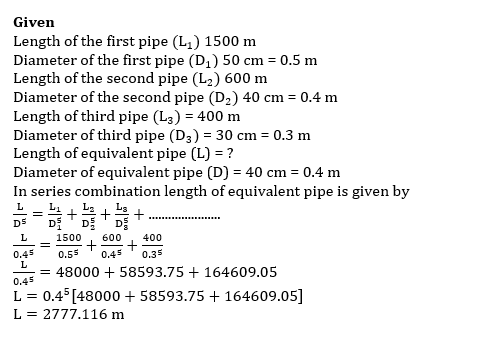
A compound piping system consists of 1500 m of 50 cm, 600 m of 40 cm and 400 m of 30 cm diameter pipes of the same material connected in series. Calculate the equivalent length of a 40 cm pipe of the same material.
A.
2500 m
B.
2400 m
C.
2900 m
D.
2778 m
✓ Correct
Answer & Solution
Correct option is D
Q8.
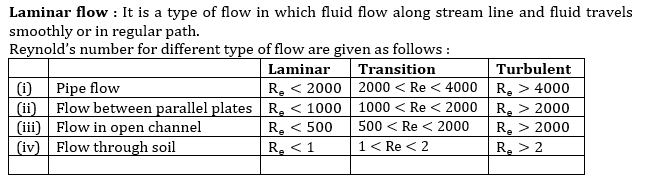
For laminar flow through pipes, the Reynolds number should be:
A.
Greater than 4000
B.
2000 to 3000
C.
Less than 2000
✓ Correct
D.
3000 to 4000
Answer & Solution
Correct option is C
Q9.
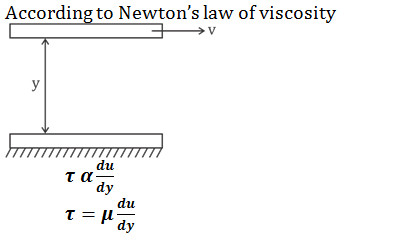
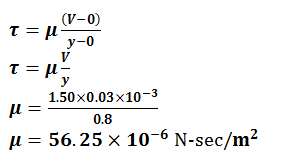
A plate at a distance of 0.03 mm from a fixed plate moves at 0.8 m/s and requires a force of 1.50 N/m² area of plate. Determine the dynamic viscosity of liquid between the plates.
A.
B.
✓ Correct
C.
D.
Answer & Solution
Correct option is B
Q10.
There are two types of energy losses through pipes, major losses and minor losses. Major losses through pipes are due to _____________.
A.
leakage of pipe
B.
friction
✓ Correct
C.
contraction of pipe
D.
sudden enlargement of pipe
Answer & Solution
Correct option is B
The major loss of energy or head is due to friction. Minor losses: Minor energy (head) loss occurs in the following cases- 1. Loss of head due to sudden enlargement. 2. Loss of head due to sudden contraction. 3. Loss of head due to an obstruction in the pipe. 4. Loss of head at the entrance to a pipe. 5. Loss of head at the exit to a pipe. 6. Loss of head due to bend in the pipe, and 7. Loss of head in various pipe fittings.
Q11.
A combination of two or more pipes connected end-to-end (series) is known as pipe in series. For pipes in series, the discharge through the pipe is ___________.
A.
constant
✓ Correct
B.
sum of discharge through each pipe
C.
not constant
D.
constant for a particular section of the pipe
Answer & Solution
Correct option is A
Pipes in series combination: -Pipes are said to be in series if they are connected end-to-end (in continuity with each other) so that the fluid flows in a continuous line without branching. -Discharge in each pipe is constant. -Head loss in each pipe is different. Pipes in parallel combination: -The main pipeline divides into two or more parallel pipes and then reunites (or join) into a single pipe downstream. -The head loss in each pipe is the same.
Q12.
A channel is said to be the most economical section when, it gives maximum discharge for a given area and slope. What is the relation between hydraulic radius and depth for the most economical trapezoidal section?
A.
Hydraulic radius = 2 times depth
B.
Hydraulic radius = 1.5 times depth
C.
Hydraulic radius = depth/2
✓ Correct
D.
Hydraulic radius = depth/3
Answer & Solution
Correct option is C
Conditions for the most economical or efficient section: From Chezys and Mannings equation that the velocity of flow will be maximum when hydraulic radius R will be maximum for factors like the slope of bed, and surface roughness being constant. Hydraulic radius is maximum if the wetted perimeter is minimum. Most economical rectangular section: Width of the channel is twice the depth of flow (B = 2y). Hydraulic radius is half of the depth of flow. (R= y/2) Most economical trapezoidal section: Half of the top width must be equal to the sloping side. The hydraulic radius must be half the depth of water. Most economical triangular section: The side slope has to be inclined at 45∘. Hydraulic radius (R) =
Most economical circular section: The depth of flow(y) = 0.81D. (for maximum velocity) The hydraulic radius(R) for maximum velocity is 0.3 D The depth of flow(y) = 0.95D. (for maximum discharge) Where D = Diameter of channel
Q13.
A combination of two or more pipes connected between two points so that the discharge divides at the first junction and re-joins at the next is known as ____________.
A.
pipes in parallel
✓ Correct
B.
pipes in series
C.
pipes in horizontal
D.
pipes in vertical
Answer & Solution
Correct option is A
Pipes in series combination: Pipes are said to be in series if they are connected end-to-end (in continuity with each other) so that the fluid flows in a continuous line without branching. Discharge in each pipe is constant. Head loss in each pipe is different. Pipes in parallel combination: The main pipeline divides into two or more parallel pipes and then reunites (or join) into a single pipe downstream. The head loss in each pipe is the same.
Q14.
A water supply pipe with a diameter of 0.5 m conveys 0.8 m³/sec of water from a source, where the lowest water level is at RL 92.00 m to a reservoir level where it is delivered at RL 108.00 m. The distance between source and supply is 500 m and the friction factor of a pipe is 0.03. Calculate the static head required to calculate the capacity of the pump.
A.
16 m
✓ Correct
B.
18 m
C.
12 m
D.
14 m
Answer & Solution
Correct option is A
Given, Diameter of pipe = 0.5 m, Discharge = 0.8 m³/sec , Friction factor = 0.03 water required to be lift by pump from R.L 92.00 m to R.L 108.00 m => Static head required to calculate capacity of pump (H) = difference between R.L at delivery and source point ∴ static head required = 108.00 - 92.00 = 16.00 m
Q15.
Steady state of flow refers to:
A.
Flow changes with time
B.
Depth of flow in a channel will remain same
C.
Flow does not change with time
✓ Correct
D.
Depth of flow in a channel will very
E.
Flow changes with time & space
Answer & Solution
Correct option is C
Types of flow : i) Steady flow : The flow in which flow condition like velocity, pressure does not changes with time is known as steady flow. ii) Unsteady flow : The flow in which flow condition like velocity,pressure can changes with time is known as unsteady flow. iii) Uniform flow : The type of flow in which the velocity at any given time does not changes with respect to space. iv) Non-uniform flow : The type of flow in which the velocity at any given time changes with respect to space. v) Laminar flow : The type of flow in which fluid particle move along well defined path or stream line and all stream lines are straight and parallel.