SSC JE Power System Questions with Detailed Solutions

Get SSC JE Power System Questions to prepare for your upcoming exam. Solve the most expected questions and detailed solutions that can be asked in the exam.

Important SSC JE Power System Questions

Q1.

A single phase transmission line is transmitting 1,100 KW power at 11 kV and at unity power factor. If it has a total resistance of 5Ω, what is the efficiency of the transmission line?

  • A.

    89.65%

  • B.

    100%

  • C.

    80.96%

  • D.

    95.65%

    ✓ Correct
  • E.

    55.65%

Answer & Solution

Correct option is D

Given:∙ Power transmitted (P0)=1,100 kW∙ Voltage (V)=11 kV=11,000 V∙ Resistance (R)=5 Ω∙ Power factor =1 (Unity)Formula Used:∙ Current (I)=P0V∙ Power loss (Ploss)=I2R∙ Input power (Pin)=P0+Ploss∙ Efficiency (η)=P0Pin×100Solution:Current:\textbf{Given:} \\[6pt]\bullet \; \text{Power transmitted } (P_0) = 1,100 \, kW \\\bullet \; \text{Voltage } (V) = 11 \, kV = 11,000 \, V \\\bullet \; \text{Resistance } (R) = 5 \, \Omega \\\bullet \; \text{Power factor } = 1 \, (\text{Unity}) \\[12pt]\textbf{Formula Used:} \\[6pt]\bullet \; \text{Current } (I) = \dfrac{P_0}{V} \\[10pt]\bullet \; \text{Power loss } (P_{loss}) = I^2 R \\[10pt]\bullet \; \text{Input power } (P_{in}) = P_0 + P_{loss} \\[10pt]\bullet \; \text{Efficiency } (\eta) = \dfrac{P_0}{P_{in}} \times 100 \\[12pt]\textbf{Solution:} \\[6pt]\text{Current:}​​

I=1,100,00011,000=100 APower loss:Ploss=(100)2×5=50 kWInput power:Pin=1,100 kW+50 kW=1,150 kWEfficiency:η=1,1001,150×100=95.65%I = \dfrac{1,100,000}{11,000} = 100 \, A \\[12pt]\text{Power loss:} \\P_{loss} = (100)^2 \times 5 = 50 \, kW \\[12pt]\text{Input power:} \\P_{in} = 1,100 \, kW + 50 \, kW = 1,150 \, kW \\[12pt]\text{Efficiency:} \\\eta = \dfrac{1,100}{1,150} \times 100 = 95.65\%​​

Q2.

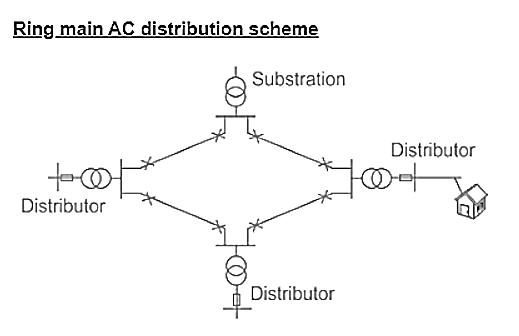
Which of the following plays a vital role in the determination of sending end and receiving end voltage in ring main AC distribution scheme?

  • A.

    Breakdown voltage of a distribution transformer oil

  • B.

    Eddy current loss

  • C.

    Power factor

    ✓ Correct
  • D.

    Hysteresis loss

Answer & Solution

Correct option is C

 In a ring main AC distribution system, power factor significantly impacts the voltage drop between the sending and receiving ends. 
 Power factor represents the efficiency of how electrical power is utilized. A lower power factor indicates greater reactive power flow, which leads to increased voltage drop along the circuit. 
 This is because the current flowing through the system is higher for the same amount of real power delivered. 
 Therefore, power factor is a crucial consideration in determining the voltage regulation within a ring main network. 

Q3.

The ring main distribution system is preferred over radial distribution system because _________.

  • A.

    it has fewer voltage fluctuation at consumers side

    ✓ Correct
  • B.

    it always possesses unity power factor

  • C.

    there is no requirement of distribution transformer

  • D.

    there is no Ohmic loss

Answer & Solution

Correct option is A

A ring main distribution system is preferred over a radial distribution system because in a ring system, power can flow in both directions from a transformer, meaning if a fault occurs on one section of the ring, the power can still reach consumers through the other section, minimizing voltage fluctuations at consumer terminals due to the redundancy in the circuit. 

Q4.

Which of the following conditions is favourable for the application of radial distribution network?

  • A.

    Power is generated at high voltage and substation is located at the load centre

  • B.

    Power is generated at high voltage and substation is located very far away from the load centre

  • C.

    Power is generated at low voltage and substation is located very far away from load centre

  • D.

    Power is generated at low voltage and substation is located at the load centre

    ✓ Correct

Answer & Solution

Correct option is D

A radial distribution network is most suitable when the substation is located near the load center because it minimizes voltage drops and line losses due to the short transmission distance. 
Additionally, low voltage generation is also favorable for radial systems as they are simple and cost-effective at lower voltage levels. Placing the substation at the load center further enhances these advantages. 

Q5.

Which of the following statements is correct for the radial distribution network’s distributors load change?

  • A.

    The consumer situated at very close to the distributor will be subjected with serious voltage fluctuations.

  • B.

    The consumer situated at the middle of the distributor will be subjected with serious voltage fluctuations.

  • C.

    The consumer situated at the distant end of the distributor will be subjected with serious voltage fluctuations.

    ✓ Correct
  • D.

    No consumer in the distribution network will be subjected with any voltage fluctuations.

Answer & Solution

Correct option is C

In a radial distribution network, power flows from the substation to the consumers, with each consumer connected along a single feeder. As electricity travels through the conductor, it encounters resistance, causing a voltage drop. This means that consumers further away from the substation experience a larger voltage drop compared to those closer, resulting in more significant voltage fluctuations. 

Q6.

What is the diversity factor in a power system?

  • A.

    The ratio of the maximum demand of the power station to the sum of average demands of all consumers connected to it

  • B.

    The ratio of the maximum demand of the power station to the sum of individual minimum demands of all consumers

  • C.

    The ratio of maximum demand of the power station to the sum of individual maximum demands of all consumers connected to it

  • D.

    The ratio of the sum of individual maximum demands of all consumers to the maximum demand of the power station

    ✓ Correct

Answer & Solution

Correct option is D

The diversity factor is a measure of the non-coincidence of peak demands among multiple consumers.
It is given by:

Diversity Factor=Sum of individual maximum demandsMaximum demand of the system (power station)\text{Diversity Factor} = \dfrac{\text{Sum of individual maximum demands}}{\text{Maximum demand of the system (power station)}}​

 Since all consumers do not peak at the same time, the system's peak is less than the sum of individual peaks.
 Therefore, diversity factor is always ≥1.

Q7.

A single phase transmission line is transmitting 1,100 KW power at 11 kV and at unity power factor. If it has a total resistance of 5Ω, what is the efficiency of the transmission line?

  • A.

    89.65%

  • B.

    100%

  • C.

    80.96%

  • D.

    95.65%

    ✓ Correct

Answer & Solution

Correct option is D

Given:∙ Power transmitted (P0)=1,100 kW∙ Voltage (V)=11 kV=11,000 V∙ Resistance (R)=5 Ω∙ Power factor =1 (Unity)Formula Used:∙ Current (I)=P0V∙ Power loss (Ploss)=I2R∙ Input power (Pin)=P0+Ploss∙ Efficiency (η)=P0Pin×100Solution:Current:\textbf{Given:} \\[6pt]\bullet \; \text{Power transmitted } (P_0) = 1,100 \, kW \\\bullet \; \text{Voltage } (V) = 11 \, kV = 11,000 \, V \\\bullet \; \text{Resistance } (R) = 5 \, \Omega \\\bullet \; \text{Power factor } = 1 \, (\text{Unity}) \\[12pt]\textbf{Formula Used:} \\[6pt]\bullet \; \text{Current } (I) = \dfrac{P_0}{V} \\[10pt]\bullet \; \text{Power loss } (P_{loss}) = I^2 R \\[10pt]\bullet \; \text{Input power } (P_{in}) = P_0 + P_{loss} \\[10pt]\bullet \; \text{Efficiency } (\eta) = \dfrac{P_0}{P_{in}} \times 100 \\[12pt]\textbf{Solution:} \\[6pt]\text{Current:}​​

I=1,100,00011,000=100 APower loss:Ploss=(100)2×5=50 kWInput power:Pin=1,100 kW+50 kW=1,150 kWEfficiency:η=1,1001,150×100=95.65%I = \dfrac{1,100,000}{11,000} = 100 \, A \\[12pt]\text{Power loss:} \\P_{loss} = (100)^2 \times 5 = 50 \, kW \\[12pt]\text{Input power:} \\P_{in} = 1,100 \, kW + 50 \, kW = 1,150 \, kW \\[12pt]\text{Efficiency:} \\\eta = \dfrac{1,100}{1,150} \times 100 = 95.65\%​​

Q8.

Which of the following statements is true regarding the setting of an earth fault relay?

  • A.

    The setting should always be equal to the rated full-load current of the line.

  • B.

    The setting should always be greater than the rated full-load current of the line.

  • C.

    The setting does not depend upon the rated full-load current of the line.

  • D.

    The setting should always be less than the rated full-load current of the line.

    ✓ Correct

Answer & Solution

Correct option is D

An earth fault relay is designed to detect small faults to the ground, which are typically much smaller than the normal load current. If the relay setting was equal to or greater than the load current, it wouldn't trip for small earth faults, defeating its purpose. Therefore, the setting needs to be significantly lower to ensure quick detection and isolation of earth faults. 

Q9.
With the increase in voltage level of the distribution network, the weight and corresponding cost of the conductor material will be _________ and _________, respectively, for the same voltage drop.
  • A.decreased; decreased
    ✓ Correct
  • B.increased; decreased
  • C.decreased; increased
  • D.increased; increased

Answer & Solution

Correct option is A

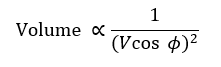
When we increase the voltage level in a distribution network, the same amount of power can be transmitted using a lower current. Since current reduces, the cross-sectional area (and hence the volume) of the conductor required also reduces.
This means thinner conductors can be used, which results in a reduction in the weight of conductor material.
As a result, both the weight and the cost of the conductor decrease, assuming the same voltage drop condition is maintained.

Hence, increasing voltage reduces the volume (and cost) of the conductor material.

Q10.
In radial distribution system, the consumers are dependent on ________ and _________.
  • A.multiple feeder, multiple distributor
  • B.single feeder, single distributor
    ✓ Correct
  • C.multiple feeder, single distributor
  • D.single feeder, multiple distributor

Answer & Solution

Correct option is B

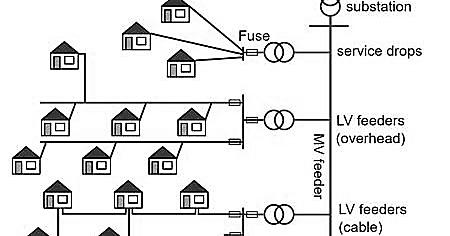
A radial distribution system is designed like a tree, with power flowing from a single source (substation) through feeders to distributors, and then to individual consumers. 
Since there's only one feeder supplying the entire network, and each consumer is connected to a single distributor off that feeder, they are dependent on both the feeder and the distributor. 

Q11.
In a thermal power plant, the overall efficiency can be determined using which of the following?
  • A.Boiler Efficiency × Generator Efficiency × Turbine Efficiency
    ✓ Correct
  • B.Carnot Cycle Efficiency
  • C.Rankine Cycle Efficiency
  • D.Regenerative Cycle Efficiency

Answer & Solution

Correct option is A

In a thermal power plant, the overall efficiency is the product of the efficiencies of its main components:
Boiler Efficiency: Measures how efficiently heat is transferred from the combustion process to the steam.
Turbine Efficiency: Indicates how efficiently the steam energy is converted into mechanical energy.
Generator Efficiency: Refers to how effectively mechanical energy is converted into electrical energy.
Overall Efficiency=Boiler Efficiency×Turbine Efficiency×Generator Efficiency

Q12.
What is Cold Reserve Capacity in a power system?
  • A.The power generating capacity that is not currently in use but can be brought online when needed.
    ✓ Correct
  • B.The power generating capacity that is permanently shut down.
  • C.The power generating capacity that is unavailable due to maintenance or other reasons.
  • D.The power generating capacity that is readily available and online, ready to be dispatched.

Answer & Solution

Correct option is A

Cold reserve capacity refers to a backup power source that is available but not actively generating electricity, meaning it can be quickly activated when needed, unlike "hot reserve" which is readily available and online. 

Q13.
Which crop is primarily used to produce biomass alcohol fuel or ethanol in India?
  • A.Corn
  • B.Wheat
  • C.Rice
  • D.Sugarcane
    ✓ Correct

Answer & Solution

Correct option is D

In India, ethanol is primarily produced from sugarcane molasses, a by-product of sugar production. While other crops like corn can be used for ethanol production globally, sugarcane is the dominant feedstock in India. 

Q14.
What is the primary purpose of a back-to-back power electronic converter (PEC) in type-C doubly-fed induction generator wind power plants?
  • A.To match stator and rotor frequencies
    ✓ Correct
  • B.To convert mechanical power to electrical power
  • C.To regulate wind turbine speed
  • D.To control reactive power production

Answer & Solution

Correct option is A

DFIG function: A DFIG allows the wind turbine to operate at variable speeds by controlling the rotor frequency, which is achieved by adjusting the power supplied to the rotor windings through the back-to-back converter.
Back-to-back converter role: This converter essentially acts as a bridge between the rotor and the grid, allowing for variable frequency power to be injected into the rotor, thereby controlling the turbine's speed and power output. 

Q15.
Cold reserve is the reserve capacity of the plant in ________ but NOT in ________.
  • A.service, service
  • B.service, operation
    ✓ Correct
  • C.operation, service
  • D.operation, operation

Answer & Solution

Correct option is B

Cold reserve refers to the reserve capacity of a plant that is available for service (meaning it can be brought online if needed) but is not currently in operation. It is important to distinguish between "cold reserve" and "hot reserve": 
Cold reserve: This capacity is not actively generating power but can be readily started up when needed. Think of it like a car parked in the driveway that's ready to go on a trip but is currently not running.
Hot reserve: This capacity is already running and connected to the grid but is not currently being used to its full potential. Imagine a car running at a low speed on the highway, ready to accelerate if needed. It's in service and contributing to the overall power supply, but not operating at full capacity.