SSC JE Basic Electrical Questions with Detailed Solutions

Get SSC JE Basic Electrical Questions to prepare for your upcoming exam. Solve the most expected questions and detailed solutions that can be asked in the exam.

Important SSC JE Basic Electrical Questions

Q1.

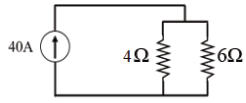
The power dissipated in the 6.0 resistor is ________.

  • A.

    1536 W

    ✓ Correct
  • B.

    1000 W

  • C.

    3456 W

  • D.

    1024 W

Answer & Solution

Correct option is A

Concept: The power dissipated by a resistor is calculated using:P=I2×RWhere:∙ P=Power in watts∙ I=Current through the resistor∙ R=Resistance in ohmsCalculation:Given:∙ Total current =40 A∙ Resistors in parallel: 4Ω and 6Ω∙ Total resistance in parallel:Req=4×64+6=2410Use current division rule to find current through 6Ω resistor:I6Ω=40×44+6=40×410=16 AP=(16)2×6=256×6=1536 W\textbf{Concept:} \; \text{The power dissipated by a resistor is calculated using:} \\[6pt]P = I^2 \times R \\[12pt]\text{Where:} \\\bullet \; P = \text{Power in watts} \\\bullet \; I = \text{Current through the resistor} \\\bullet \; R = \text{Resistance in ohms} \\[12pt]\textbf{Calculation:} \\[6pt]\text{Given:} \\\bullet \; \text{Total current } = 40 \, A \\\bullet \; \text{Resistors in parallel: } 4 \Omega \text{ and } 6 \Omega \\\bullet \; \text{Total resistance in parallel:} \\[6pt]R_{eq} = \dfrac{4 \times 6}{4 + 6} = \dfrac{24}{10} \\[12pt]\text{Use current division rule to find current through 6}\Omega \text{ resistor:} \\[6pt]I_{6\Omega} = 40 \times \dfrac{4}{4+6} = 40 \times \dfrac{4}{10} = 16 \, A \\[12pt]P = (16)^2 \times 6 = 256 \times 6 = 1536 \, W​​

Q2.

The energy consumed by a 5 Ω resistor carrying a current of 20 A for 10 minutes will be ______.

  • A.

    120 KJ

  • B.

    120 J

  • C.

    2000 J

  • D.

    1200 KJ

    ✓ Correct

Answer & Solution

Correct option is D

Concept: Energy consumed is the product of power and time:E=P×t=I2×R×tWhere:∙ E=Energy in joules∙ I=Current in amperes∙ R=Resistance in ohms∙ t=Time in secondsCalculation:Given:∙ R=5 Ω∙ I=20 A∙ t=10 minutes=600 secondsNow,E=(20)2×5×600=400×5×600=1,200,000 J=1200 kJ\textbf{Concept:} \; \text{Energy consumed is the product of power and time:} \\[6pt]E = P \times t = I^2 \times R \times t \\[12pt]\text{Where:} \\\bullet \; E = \text{Energy in joules} \\\bullet \; I = \text{Current in amperes} \\\bullet \; R = \text{Resistance in ohms} \\\bullet \; t = \text{Time in seconds} \\[12pt]\textbf{Calculation:} \\[6pt]\text{Given:} \\\bullet \; R = 5 \, \Omega \\\bullet \; I = 20 \, A \\\bullet \; t = 10 \, \text{minutes} = 600 \, \text{seconds} \\[12pt]\text{Now,} \\E = (20)^2 \times 5 \times 600 = 400 \times 5 \times 600 = 1,200,000 \, J = 1200 \, kJ​​

Q3.

How is the resistance of a wire related to the length of the wire?

  • A.

    Inversely proportional

  • B.

    Directly proportional

    ✓ Correct
  • C.

    Not related

  • D.

    Proportional to square of length

Answer & Solution

Correct option is B

The resistance of a wire is directly proportional to its length. According to the formula for resistance,

​R=ρLAR = \rho \frac{L}{A}​​

where RRR is the resistance, ρ is the resistivity of the material, L is the length, and A is the cross-sectional area of the wire.

As the length L increases, the resistance R increases as well, making them directly proportional.

Q4.

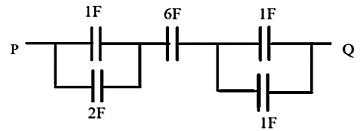
The total capacitance between points P and Q in the figure is:

  • A.

    10 F

  • B.

    11 F

  • C.

    1 F

    ✓ Correct
  • D.

    43/6 F

Answer & Solution

Correct option is C

Concept:∙ For capacitors in parallel, the total capacitance Ceq is the sum of the individual capacitances:Ceq=C1+C2+⋯+Cn∙ For capacitors in series, the total capacitance Ceq is given by:1Ceq=1C1+1C2+⋯+1CnCalculation:∙ The two 1F capacitors are in parallel:C1=1F+1F=2F∙ The resulting 2F capacitance is in series with the 6F capacitor:1C2=12F+16F=11.5F => C2=1.5F∙ The 1F and 2F capacitors are in parallel:C3=1F+2F=3F∙ The resulting 1.5F and 3F capacitors are in series:1Ceq=13F+11.5F=11F => Ceq=1F\textbf{Concept:} \\[6pt]\bullet \; \text{For capacitors in parallel, the total capacitance } C_{eq} \text{ is the sum of the individual capacitances:} \\[6pt]C_{eq} = C_1 + C_2 + \cdots + C_n \\[12pt]\bullet \; \text{For capacitors in series, the total capacitance } C_{eq} \text{ is given by:} \\[6pt]\dfrac{1}{C_{eq}} = \dfrac{1}{C_1} + \dfrac{1}{C_2} + \cdots + \dfrac{1}{C_n} \\[12pt]\textbf{Calculation:} \\[6pt]\bullet \; \text{The two 1F capacitors are in parallel:} \\[6pt]C_1 = 1F + 1F = 2F \\[12pt]\bullet \; \text{The resulting 2F capacitance is in series with the 6F capacitor:} \\[6pt]\dfrac{1}{C_2} = \dfrac{1}{2F} + \dfrac{1}{6F} = \dfrac{1}{1.5F} \;\;\Rightarrow\;\; C_2 = 1.5F \\[12pt]\bullet \; \text{The 1F and 2F capacitors are in parallel:} \\[6pt]C_3 = 1F + 2F = 3F \\[12pt]\bullet \; \text{The resulting 1.5F and 3F capacitors are in series:} \\[6pt]\dfrac{1}{C_{eq}} = \dfrac{1}{3F} + \dfrac{1}{1.5F} = \dfrac{1}{1F} \;\;\Rightarrow\;\; C_{eq} = 1F​​

Q5.

In a capacitor, if a charge of 1 coulomb accumulates on each plate when a potential difference of 1 volt is applied across the plates, then the capacitance will be __________.

  • A.

    1 farad

    ✓ Correct
  • B.

    1 picofarad

  • C.

    1 microfarad

  • D.

    1 nano-farad

Answer & Solution

Correct option is A

To find the capacitance (C), we can use the formula:C=QVWhere:∙ Q is the charge (1 coulomb),∙ V is the potential difference (1 volt).Substituting the values:C=1C1V=1 faradThus, the capacitance will be 1 farad.\text{To find the capacitance (C), we can use the formula:} \\[8pt]C = \dfrac{Q}{V} \\[12pt]\text{Where:} \\\bullet \; Q \text{ is the charge (1 coulomb),} \\\bullet \; V \text{ is the potential difference (1 volt).} \\[12pt]\text{Substituting the values:} \\[6pt]C = \dfrac{1C}{1V} = 1 \, \text{farad} \\[12pt]\text{Thus, the capacitance will be 1 farad.}​​

Q6.

In a parallel circuit, if there are 'n' resistors, each of resistance 'R' ohms, connected in parallel, then the total resistance is equal to _____.

  • A.

    R/n

    ✓ Correct
  • B.

    R × n

  • C.

    (R²)/n

  • D.

    R + n

Answer & Solution

Correct option is A

When n identical resistors of resistance R are connected in parallel, the total (equivalent)resistance is given by:1Req=1R+1R+⋯+1R=nR => Req=RnSo, the total resistance is R divided by n.\text{When } n \text{ identical resistors of resistance } R \text{ are connected in parallel, the total (equivalent)} \\\text{resistance is given by:} \\[8pt]\dfrac{1}{R_{eq}} = \dfrac{1}{R} + \dfrac{1}{R} + \cdots + \dfrac{1}{R} = \dfrac{n}{R} \;\;\Rightarrow\;\; R_{eq} = \dfrac{R}{n} \\[12pt]\text{So, the total resistance is } R \text{ divided by } n.​​

Q7.

The polar form of a vector is 10 ∠ 30. What is the rectangular form of this vector?

  • A.

    √3+j5

  • B.

    10√3+j2

  • C.

    5√3+j5

    ✓ Correct
  • D.

    15√3+j3

Answer & Solution

Correct option is C

The polar form is represented as a∠θ, where:a=10θ=30∘To convert to rectangular form, the formulas are:x=acos⁡(θ)y=asin⁡(θ)Where:x is the real part.y is the imaginary part.Using the values:x=10cos⁡(30∘)=53y=10sin⁡(30∘)=5Thus, the rectangular form is:Rectangular form =53+j5\text{The polar form is represented as } a \angle \theta, \text{ where:} \\[6pt]a = 10 \\\theta = 30^\circ \\[12pt]\text{To convert to rectangular form, the formulas are:} \\[6pt]x = a \cos(\theta) \\y = a \sin(\theta) \\[12pt]\text{Where:} \\x \text{ is the real part.} \\y \text{ is the imaginary part.} \\[12pt]\text{Using the values:} \\[6pt]x = 10 \cos(30^\circ) = 5\sqrt{3} \\y = 10 \sin(30^\circ) = 5 \\[12pt]\text{Thus, the rectangular form is:} \\[6pt]\text{Rectangular form } = 5\sqrt{3} + j5​​

Q8.

A 415 V, 3-phase voltage is applied to a balanced star connected purely resistive load of 10 Ω. What is the ratio of reactive power to active power?

  • A.

    Infinity

  • B.

    1

  • C.

    0

    ✓ Correct
  • D.

    100

Answer & Solution

Correct option is C

Concept:The power factor is the ratio of active power to apparent power, given as:cos⁡ϕ=PSWhere:∙ P=Active Power∙ Q=Reactive Power∙ S=Apparent PowerExplanation:In a purely resistive load (as given in the question), the current and voltage are in phase.This means:∙ The power factor cos⁡ϕ=1∙ Reactive Power Q=0, since resistors do not store energyTherefore,QP=0P=0\textbf{Concept:} \\[6pt]\text{The power factor is the ratio of active power to apparent power, given as:} \\[6pt]\cos \phi = \dfrac{P}{S} \\[12pt]\text{Where:} \\\bullet \; P = \text{Active Power} \\\bullet \; Q = \text{Reactive Power} \\\bullet \; S = \text{Apparent Power} \\[12pt]\textbf{Explanation:} \\[6pt]\text{In a purely resistive load (as given in the question), the current and voltage are in phase.} \\\text{This means:} \\[6pt]\bullet \; \text{The power factor } \cos \phi = 1 \\\bullet \; \text{Reactive Power } Q = 0, \text{ since resistors do not store energy} \\[12pt]\text{Therefore,} \\[6pt]\dfrac{Q}{P} = \dfrac{0}{P} = 0​​

Q9.

The average power delivered to an AC series circuit is given by:

  • A.

    ​Vrms×IrmscosθV_{rms} × I_{rms} cosθ​​

    ✓ Correct
  • B.

    ​I(max)×V(max)×Sin(θ)I(max)×V(max)×Sin(θ)​​

  • C.

    Zero

  • D.

    ​I(max)×V(max)I(max)×V(max)​​

Answer & Solution

Correct option is A

∙ In an AC circuit, average power (P) is given by:P=Vrms×Irms×cos⁡θwhere:∙ Vrms:Root mean square voltage∙ Irms:Root mean square current∙ θ:Phase angle between voltage and current∙ cos⁡θ:Power factor\bullet \; \text{In an AC circuit, average power (P) is given by:} \\[6pt]P = V_{rms} \times I_{rms} \times \cos \theta \\[12pt]\text{where:} \\\bullet \; V_{rms} : \text{Root mean square voltage} \\\bullet \; I_{rms} : \text{Root mean square current} \\\bullet \; \theta : \text{Phase angle between voltage and current} \\\bullet \; \cos \theta : \text{Power factor}​​

Q10.

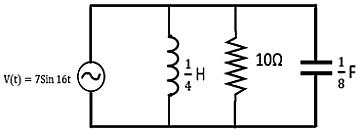
The susceptance of the circuit given in the diagram is ________

  • A.

    ​j74 S\frac{j7}{4} \, S​​​

    ✓ Correct
  • B.

    ​(110−j74)S\left( \frac{1}{10} - \frac{j7}{4} \right) S​​

  • C.

    ​(110+j74)S\left( \frac{1}{10} + \frac{j7}{4} \right) S​​

  • D.

    ​j47 S\frac{j4}{7} \, S​​

Answer & Solution

Correct option is A

​∙ Admittance Y=G+jB where B is susceptance.∙ For parallel elements in admittance form:B=j(ωC−1ωL)Given:∙ ω=16∙ C=18 F∙ L=14 HCalculation:B=j(16×18−116×14)B=j(2−14)=j⋅74\bullet \;\; \text{Admittance } Y = G + jB \text{ where } B \text{ is susceptance.} \\[6pt]\bullet \;\; \text{For parallel elements in admittance form:} \\[6pt]B = j \left( \omega C - \dfrac{1}{\omega L} \right) \\[12pt]\text{Given:} \\[6pt]\bullet \;\; \omega = 16 \\ \bullet \;\; C = \dfrac{1}{8} \, F \\ \bullet \;\; L = \dfrac{1}{4} \, H \\[12pt]\text{Calculation:} \\[6pt]B = j \left( 16 \times \dfrac{1}{8} - \dfrac{1}{16 \times \tfrac{1}{4}} \right) \\[10pt]B = j \left( 2 - \dfrac{1}{4} \right) = j \cdot \dfrac{7}{4}​​

Q11.
How much energy in “kilowatt hours” is consumed in operating ten 100-watt bulbs for 20 hours per day in a month (30 days)?
  • A.10000 kilowatt-hours
  • B.5000 kilowatt-hours
  • C.600 kilowatt-hours
    ✓ Correct
  • D.600000 kilowatt-hours

Answer & Solution

Correct option is C

∙ Energy consumed (E) is calculated using the formula:E=P×TwhereP=Power in kilowatts (kW),T=Time in hours (h)1 kW=1000 watts (W)For multiple devices, multiply the power of one device by the number of devices and the time of use.Given:∙ Power of one bulb=100 W∙ Number of bulbs=10∙ Operating time=20 hours per day∙ Days in a month=30Calculation:Step 1: Total power of 10 bulbs10×100 W=1000 W=1 kWStep 2: Energy consumed in one dayEday=1 kW×20 hours=20 kWhStep 3: Energy consumed in 30 daysEmonth=20×30=600 kWh\bullet \; \text{Energy consumed (E) is calculated using the formula:} \\[8pt]E = P \times T \\[12pt]\text{where} \\[6pt]P = \text{Power in kilowatts (kW)}, \quad T = \text{Time in hours (h)} \\[8pt]1 \, \text{kW} = 1000 \, \text{watts (W)} \\[8pt]\text{For multiple devices, multiply the power of one device by the number of devices and the time of use.} \\[14pt]\textbf{Given:} \\[6pt]\bullet \; \text{Power of one bulb} = 100 \, W \\[4pt]\bullet \; \text{Number of bulbs} = 10 \\[4pt]\bullet \; \text{Operating time} = 20 \, \text{hours per day} \\[4pt]\bullet \; \text{Days in a month} = 30 \\[14pt]\textbf{Calculation:} \\[8pt]\text{Step 1: Total power of 10 bulbs} \\[6pt]10 \times 100 \, W = 1000 \, W = 1 \, kW \\[12pt]\text{Step 2: Energy consumed in one day} \\[6pt]E_{day} = 1 \, kW \times 20 \, \text{hours} = 20 \, kWh \\[12pt]\text{Step 3: Energy consumed in 30 days} \\[6pt]E_{month} = 20 \times 30 = 600 \, kWh​​

Q12.
Which of the following is a pure resistive device?
  • A.Generator
  • B.Heater
    ✓ Correct
  • C.Transformer
  • D.Motor

Answer & Solution

Correct option is B

A pure resistive device means that it primarily converts electrical energy into heat with minimal energy loss to other forms like light or mechanical energy. A heater is designed specifically to produce heat, making it the correct answer. 

Q13.
If R1 = 1Ω; R2 = 2 Ω,; R3 = 3 Ω,; R2 and R3 are connected in parallel and the combination is in series with R1, then the total resistance will be ________.
  • A.2.2 Ω
    ✓ Correct
  • B.2.8 Ω
  • C.1.5 Ω
  • D.1.2 Ω

Answer & Solution

Correct option is A

Step 1: Find the equivalent resistance of R2 and R3 in parallel:1R23=1R2+1R3=12+13=3+26=56 => R23=65=1.2 ΩStep 2: Add R1 in series with R2∥R3:Rtotal=R1+R23=1+1.2=2.2 Ω\text{Step 1: Find the equivalent resistance of } R_2 \text{ and } R_3 \text{ in parallel:} \\[8pt]\frac{1}{R_{23}} = \frac{1}{R_2} + \frac{1}{R_3} = \frac{1}{2} + \frac{1}{3} = \frac{3 + 2}{6} = \frac{5}{6} \;\Rightarrow\; R_{23} = \frac{6}{5} = 1.2 \, \Omega \\[12pt]\text{Step 2: Add } R_1 \text{ in series with } R_2 \parallel R_3 : \\[8pt]R_{\text{total}} = R_1 + R_{23} = 1 + 1.2 = 2.2 \, \Omega​​

Q14.

A certain length of wire has its resistance measured as 20 Ω at 20℃ and 40 Ω at 60℃. Calculate the temperature coefficient.

  • A.

    (1/40)/°C

    ✓ Correct
  • B.

    (1/30)/°C

  • C.

    (1/60)/°C

  • D.

    30°C

Answer & Solution

Correct option is A

Concept of Temperature Coefficient of Resistance:

The temperature coefficient of resistance (α) tells us how much the resistance of a material changes per degree change in temperature. The relation is given by:​​

​Rt=R0(1+α(T−T0))Where:∙ R0=Resistance at reference temperature T0∙ Rt=Resistance at temperature T∙ α=Temperature coefficient of resistance∙ T0=Initial temperature∙ T=Final temperatureGiven Data:∙ R0=20 Ω at T0=20∘C∙ Rt=40 Ω at T=60∘CCalculation:Using the formula:Rt=R0(1+α(T−T0))40=20(1+α(60−20))40=20(1+40α)2=1+40α1=40αα=140 per∘C \\[10pt]R_t = R_0 \left( 1 + \alpha (T - T_0) \right) \\[14pt]\textbf{Where:} \\[6pt]\bullet \; R_0 = \text{Resistance at reference temperature } T_0 \\[4pt]\bullet \; R_t = \text{Resistance at temperature } T \\[4pt]\bullet \; \alpha = \text{Temperature coefficient of resistance} \\[4pt]\bullet \; T_0 = \text{Initial temperature} \\[4pt]\bullet \; T = \text{Final temperature} \\[14pt]\textbf{Given Data:} \\[6pt]\bullet \; R_0 = 20 \, \Omega \; \text{at } T_0 = 20^\circ C \\[4pt]\bullet \; R_t = 40 \, \Omega \; \text{at } T = 60^\circ C \\[14pt]\textbf{Calculation:} \\[6pt]\text{Using the formula:} \\[6pt]R_t = R_0 \left( 1 + \alpha (T - T_0) \right) \\[12pt]40 = 20 \left( 1 + \alpha (60 - 20) \right) \\[8pt]40 = 20 (1 + 40\alpha) \\[8pt]2 = 1 + 40\alpha \\[8pt]1 = 40\alpha \\[8pt]\alpha = \frac{1}{40} \; \text{per}^\circ C​​

Q15.

A voltage source of V(t) = (10t³ - 5t + 10 ) Volt is applied across a 10F capacitor, the current through the capacitor at t = 2 sec is _________.

  • A.

    1100 A

  • B.

    1150 A

    ✓ Correct
  • C.

    1160 A

  • D.

    1000 A

Answer & Solution

Correct option is B

∙ Voltage across the capacitor:V(t)=10t3−5t+10∙ Capacitance:C=10 FWe are to find the current through the capacitor at t=2 s.Formula Used:The current through a capacitor is:i(t)=C⋅dV(t)dtGiven:V(t)=10t3−5t+10Differentiate V(t) with respect to t:dV(t)dt=30t2−5Now plug into the current formula:i(t)=10⋅(30t2−5)=300t2−50Now substitute t=2:i(2)=300⋅(2)2−50=300⋅4−50=1200−50=1150 A\bullet \; \text{Voltage across the capacitor:} \\[6pt]V(t) = 10t^3 - 5t + 10 \\[12pt]\bullet \; \text{Capacitance:} \quad C = 10 \, F \\[12pt]\text{We are to find the current through the capacitor at } t = 2 \, s. \\[12pt]\textbf{Formula Used:} \\[6pt]\text{The current through a capacitor is:} \\[6pt]i(t) = C \cdot \frac{dV(t)}{dt} \\[12pt]\textbf{Given:} \\[6pt]V(t) = 10t^3 - 5t + 10 \\[12pt]\text{Differentiate } V(t) \text{ with respect to } t: \\[6pt]\frac{dV(t)}{dt} = 30t^2 - 5 \\[12pt]\text{Now plug into the current formula:} \\[6pt]i(t) = 10 \cdot (30t^2 - 5) = 300t^2 - 50 \\[12pt]\text{Now substitute } t = 2: \\[6pt]i(2) = 300 \cdot (2)^2 - 50 = 300 \cdot 4 - 50 = 1200 - 50 = 1150 \, A​​