SSC JE Civil Questions with Detailed Solutions

Get SSC JE Civil Questions to prepare for your upcoming exam. Solve the most expected questions and detailed solutions that can be asked in the exam.

Important SSC JE Civil Questions

Q1.

Which of the following precautions need to be adopted for concreting in sub-zero temperature?

(i) Pre-heating of materials of concrete
(ii) Economical heating of materials of concrete
(iii) Admixtures of anti-freezing materials
(iv) Electrical heating of concrete mass

  • A.

    ​Only (i) and (ii)​

  • B.

    ​Only (i), (ii), (iii)​

  • C.

    ​(i), (ii), (iii), and (iv)​

    ✓ Correct
  • D.

    ​Only (ii) and (iii)​

Answer & Solution

Correct option is C

When concrete is placed in sub-zero temperatures, certain precautions are necessary to ensure proper setting and strength gain:
Pre-heating concrete materials:
This prevents the mixing water from freezing and helps maintain a suitable temperature for hydration.
Economical heating methods:
Materials are warmed just enough to achieve the required temperature without unnecessary expenditure.
Use of anti-freeze admixtures:
These additives reduce the freezing point of water in the mix, allowing hydration to proceed even at low temperatures.
Electrical heating of the concrete mass:
Applying controlled heat during curing prevents freezing and supports the development of adequate strength.
Q2.

As per Euler’s theory, for which of the following end conditions is the longest effective length of a column obtained?

  • A.

    When both the ends of the column are hinged

  • B.

    When one end of the column is fixed and the other end is free

    ✓ Correct
  • C.

    When both the ends of the column are fixed

  • D.

    When one end of the column is fixed and the other end is hinged

Answer & Solution

Correct option is B

​​​​​Definition:
The effective length of a column is defined as the distance between two consecutive points of zero bending moment (or points of contra-flexure).
It represents the equivalent length of an idealized column that would buckle under the same load as the actual column.
End Condition                                 Effective Length
Both ends hinged                                    L
One end fixed and the other free            2L
Both ends fixed                                       L/2
One end fixed and the other hinged        L/√2

The effective length depends on the end support conditions of the column, as shown below:

Q3.

Two simply supported beams with central (mid span) concentrated loads have the following particulars. Compare the slope at the ends.

Particulars

Beam A

Beam B

Length of the beam

5 m

10 m

EI

EI

2EI

Value of central concentrated load

2 kN

1 kN


  • A.

    Slope of beam A > Slope of beam B

  • B.

    Slope of beam A < Slope of beam B

  • C.

    Insufficient data to compare the slopes

  • D.

    Slope of Beam A = Slope of Beam B

    ✓ Correct

Answer & Solution

Correct option is D

​​​For a simply supported beam with a central load (P):δC=PL348EIθB=θA=wL216EICalculation:Slope at support A:θA=wL216EISubstituting values: θA=2×5216EI=5016EISlope at support B:θB=wL216EISubstituting values: θB=1×10216×2EI=5016EIHence, Slope of Beam A = Slope of Beam BAt midspan (C), the slope is zero and the beam deflects symmetrically.\begin{aligned}&\text{For a simply supported beam with a central load (P):} \\[6pt]&\delta_C = \frac{PL^3}{48EI} \\[6pt]&\theta_B = \theta_A = \frac{wL^2}{16EI} \\[10pt]&\text{Calculation:} \\[6pt]&\text{Slope at support A:} \\[4pt]&\theta_A = \frac{wL^2}{16EI} \\[4pt]&\text{Substituting values: } \theta_A = \frac{2 \times 5^2}{16EI} = \frac{50}{16EI} \\[10pt]&\text{Slope at support B:} \\[4pt]&\theta_B = \frac{wL^2}{16EI} \\[4pt]&\text{Substituting values: } \theta_B = \frac{1 \times 10^2}{16 \times 2EI} = \frac{50}{16EI} \\[10pt]&\text{Hence, } \boxed{\text{Slope of Beam A = Slope of Beam B}} \\[6pt]&\text{At midspan (C), the slope is zero and the beam deflects symmetrically.}\end{aligned}​​

Q4.

A material has the modulus of elasticity equal to 3  times its modulus of rigidity. Which of the following statements may be INCORRECT?

  • A.

    There is a change in the volume of the material.

    ✓ Correct
  • B.

    Poisson's ratio is equal to 0.5.

  • C.

    Volumetric strain is equal to zero.

  • D.

    The bulk modulus is infinite.

Answer & Solution

Correct option is A

​We know,E=2G(1+μ)Given,E=3G=>3G=2G(1+μ)=>1+μ=32=>μ=0.5Volumetric strain=σE(1−2μ)=>Volumetric strain=σE(1−2×0.5)=0Bulk Modulus, K=1Volumetric strain=∞\begin{aligned}&\text{We know,} \quad E = 2G(1 + \mu) \\[6pt]&\text{Given,} \quad E = 3G \\[6pt]&\Rightarrow 3G = 2G(1 + \mu) \\[6pt]&\Rightarrow 1 + \mu = \frac{3}{2} \\[6pt]&\Rightarrow \mu = 0.5 \\[8pt]&\text{Volumetric strain} = \frac{\sigma}{E}(1 - 2\mu) \\[6pt]&\Rightarrow \text{Volumetric strain} = \frac{\sigma}{E}(1 - 2 \times 0.5) = 0 \\[8pt]&\text{Bulk Modulus, } K = \frac{1}{\text{Volumetric strain}} = \infty\end{aligned}​​

Q5.

The Moody chart, a logarithmic chart between friction factor and____for a variety of relative roughness in a pipe flow.

  • A.

    the discharge of the flow

  • B.

    the density of the fluid

  • C.

    Reynolds number

    ✓ Correct
  • D.

    the velocity of the flow

Answer & Solution

Correct option is C

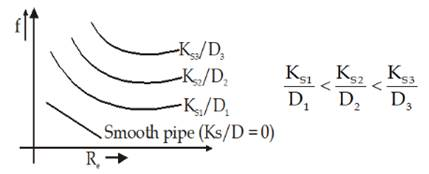
​​​​​The Moody chart is used in fluid mechanics to determine the Darcy-Weisbach friction factor for flow in a pipe. It plots the friction factor on the vertical axis and the Reynolds number on the horizontal axis, both on logarithmic scales. Various curves on the chart represent different relative roughness values of the pipe. This chart helps engineers assess head loss due to friction in pipes.

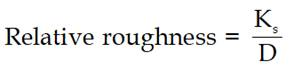
Relative roughness is the ratio of pipe roughness and the pipe diameter. 

Q6.

If water is flowing through a pipe of diameter 8 cm under  40 N/cm2N/cm^2​ of pressure and with 3 m/s of mean velocity, what will be the kinetic head? (Acceleration due to gravity is 10 m/s2s^2​.)

  • A.

    0.18 m

  • B.

    0.25 m

  • C.

    ​​0.53 m

  • D.

    ​​0.45 m

    ✓ Correct

Answer & Solution

Correct option is D

​​​Bernoulli:pρg+v22g+z=constantGiven: P=40 N/cm2=40×104 N/m2, v=3 m/s, g=10 m/s2, ρ=1000 kg/m3Kinetic head:v22g=322×10=920=0.45 mPressure head:pρg=40×1041000×10=40×104104=40 m\displaystyle\text{Bernoulli:}\quad \frac{p}{\rho g}+\frac{v^{2}}{2g}+z=\text{constant} \\[6pt]\text{Given:}\; P=40\,\text{N/cm}^2=40\times10^{4}\,\text{N/m}^2,\; v=3\,\text{m/s},\; g=10\,\text{m/s}^2,\; \rho=1000\,\text{kg/m}^3 \\[6pt]\text{Kinetic head:}\quad \frac{v^{2}}{2g}=\frac{3^{2}}{2\times10}=\frac{9}{20}=0.45\ \text{m} \\[6pt]\text{Pressure head:}\quad \frac{p}{\rho g}=\frac{40\times10^{4}}{1000\times10}=\frac{40\times10^{4}}{10^{4}}=40\ \text{m}​​

Q7.

During the calibration of a rectangular suppressed weir in a 40 cm crest width laboratory channel, the discharge passing over the weir was measured volumetrically. What is the coefficient discharge of the weir if it was found to pass discharge of 0.025 m3/secm^3/sec​ under the head of 0.1 m?


  • A.

    ​Cd=0.92C_d=0.92​​

  • B.

    ​Cd=0.89C_d=0.89

    ​

  • C.

    ​Cd=0.66C_d=0.66​

    ✓ Correct
  • D.

    ​Cd=0.75C_d=0.75​

Answer & Solution

Correct option is C

​Given:Q=0.025 m3/sb=40 cm=0.4 mH=0.1 mg=9.81 m/s2Formula Used:Q=Cd×23×b×2g×H3/2Substituting the values:0.025=Cd×23×0.4×2×9.81×(0.1)3/2=>Cd=0.025(23×0.4×19.62×0.03162)=>Cd≈0.66\begin{aligned}&\text{Given:} \\[4pt]&Q = 0.025 \, \text{m}^3/\text{s} \\ &b = 40 \, \text{cm} = 0.4 \, \text{m} \\ &H = 0.1 \, \text{m} \\ &g = 9.81 \, \text{m/s}^2 \\[6pt]&\text{Formula Used:} \\[4pt]&Q = C_d \times \frac{2}{3} \times b \times \sqrt{2g} \times H^{3/2} \\[6pt]&\text{Substituting the values:} \\[4pt]&0.025 = C_d \times \frac{2}{3} \times 0.4 \times \sqrt{2 \times 9.81} \times (0.1)^{3/2} \\[6pt]&\Rightarrow C_d = \frac{0.025}{\left( \frac{2}{3} \times 0.4 \times \sqrt{19.62} \times 0.03162 \right)} \\[6pt]&\Rightarrow C_d \approx 0.66\end{aligned}​​

Q8.

​Identify the correct methods of surface preparation used for joining old and new concrete each other.
i) Sandblasting
ii) Chipping
iii) Removal of surface by grinding

  • A.

    Only i


    ​​

  • B.

    Only i and ii
    ​

  • C.

    ​Only ii
    ​

  • D.

    ​All of i, ii and iii​

    ✓ Correct

Answer & Solution

Correct option is D

When joining old and new concrete, the bond strength depends on proper surface preparation of the existing concrete. The following methods are commonly used:

Sandblasting: Abrasive method to roughen the surface and remove contaminants like laitance, dirt, or loose particles.

Improves mechanical bond.

Chipping: Manual or mechanical removal of the surface to expose coarse aggregates and increase roughness.

Ensures proper anchorage.

Grinding: Used to smooth out or uniformly remove a thin surface layer.

Helps in removing laitance and exposing a fresh surface.

Q9.

How much deduction should be made in the hollows of blocks during a hollow concrete block wall construction?

  • A.

    All openings

  • B.

    Width deduction

  • C.

    No deduction

    ✓ Correct
  • D.

    Half of the openings

Answer & Solution

Correct option is C

In the construction of hollow concrete block walls, the volume of the hollow portion (cavity) within the block is not deducted during measurement. This is because:

The full block size (including the hollow portion) is considered for calculation.

Deductions are typically made only for openings like doors, windows, and chases — not for the hollows inside blocks, as they are part of the unit.

This aligns with standard CPWD and IS code measurement practices for block masonry.

Q10.

A tank has height and width as 4 m and 3 m , respectively. Determine the total water force, in kN , acting on the bottom of the tank when it is completely filled with water. Take density of water as 1000 kg/m³ and acceleration due to gravity as 9.81 m/sec² (Take the length of tank as 3 m.)

  • A.

    351.26

  • B.

    400.57

  • C.

    345.13

  • D.

    353.16

    ✓ Correct

Answer & Solution

Correct option is D

​​​Height of water column (h)=4 mWidth of tank (w)=3 mLength of tank (l)=3 mDensity of water (ρ)=1000 kg/m3Acceleration due to gravity (g)=9.81 m/s2Step 1: Area of the bottom of the tankA=length×width=3×3=9 m2Step 2: Pressure at the bottomP=ρgh=1000×9.81×4=39240 N/m2Step 3: Total forceF=P×A=39240×9=353160 N=353.16 kN\text{Height of water column } (h) = 4\, \text{m} \\[4pt]\text{Width of tank } (w) = 3\, \text{m} \\[4pt]\text{Length of tank } (l) = 3\, \text{m} \\[4pt]\text{Density of water } (\rho) = 1000\, \text{kg/m}^3 \\[4pt]\text{Acceleration due to gravity } (g) = 9.81\, \text{m/s}^2 \\[10pt]\textbf{Step 1: Area of the bottom of the tank} \\[4pt]A = \text{length} \times \text{width} = 3 \times 3 = 9\, \text{m}^2 \\[10pt]\textbf{Step 2: Pressure at the bottom} \\[4pt]P = \rho g h = 1000 \times 9.81 \times 4 = 39240\, \text{N/m}^2 \\[10pt]\textbf{Step 3: Total force} \\[4pt]F = P \times A = 39240 \times 9 = 353160\, \text{N} = 353.16\, \text{kN}​​

Q11.

A compound pipeline consists of two pieces of identical pipes. The equivalent length of the same diameter and the same friction factor for this compound pipeline is L₁ when the pipes are connected in series and is L₂ when the pipes are connected in parallel. Determine the ratio of equivalent lengths, that is, L₁ to L₂.

  • A.

    32:1

  • B.

    4:1

  • C.

    8:1

    ✓ Correct
  • D.

    64:1

Answer & Solution

Correct option is C

​​​hf=fLV22gdh_f = \frac{f L V^2}{2 g d}
=fL2gdV2 = \frac{f L}{2 g d} V^2==fL2gd(4Qπd2)2 = \frac{f L}{2 g d} \left( \frac{4Q}{\pi d^2} \right)^2(:v = Q/A= (Q/πd24\frac{\pi d^2}{4})​
=8fQ2π2g(Ld5) = \frac{8 f Q^2}{\pi^2 g} \left( \frac{L}{d^5} \right)
Series connection (Q1=Q2):hf=hf1+hf2\textbf{Series connection (} Q_1 = Q_2 \textbf{):}h_f = h_{f1} + h_{f2}
L1d5=ld5+ld5=2ld5\frac{L_1}{d^5} = \frac{l}{d^5} + \frac{l}{d^5} = \frac{2l}{d^5}
∴ L1=2l\therefore\ L_1 = 2l
Parallel connection (Q1=Q/2):\textbf{Parallel connection (} Q_1 = Q/2 \textbf{):}
hf=hf1h_f = h_{f1}
Q2Ld5=(Q2)2ld5L2=l4\frac{Q^2 L}{d^5} = \frac{\left( \frac{Q}{2} \right)^2 l}{d^5}L_2 = \frac{l}{4}
Ratio:L1L2=8:1\textbf{Ratio:}\frac{L_1}{L_2} = 8 : 1​​​​​​​​​​​

Q12.

In a sieve analysis of soil, the total weight of soil taken was 500 g. The mass of soil retained over 4.75 mm sieve was 100 g, mass retained over 2 mm sieve was 150 g, and the mass retained over 425-micron sieve was 200 g. The effective size of the soil will be:

  • A.

    425 microns

    ✓ Correct
  • B.

    4.75 mm

  • C.

    2 mm

  • D.

    75 microns

Answer & Solution

Correct option is A

Effective size (D₁₀) is the particle size corresponding to 10% finer by weight in the grain size distribution curve.

We calculate cumulative retained weight and percent passing for each sieve:

Sieve Size

Mass Retained (g)

Cumulative Retained (g)

% Cumulative Retained

% Passing

4.75 mm

100

100

20%

80%

2.00 mm

150

250

50%

50%

425 micron

200

450

90%

10%

75 micron

50

500

100%

0%

Q13.

In a circular tube of diameter 100 mm and length 15 m with laminar flow, the Darcy friction factor is estimated to be 0.05. Calculate the Reynolds number.

  • A.

    900

  • B.

    1000

  • C.

    2500

  • D.

    1280

    ✓ Correct

Answer & Solution

Correct option is D

Diameter (D) = 100 mm = 0.1 m

Darcy friction factor (f) = 0.05

Flow is laminar.

Formula Used:

For laminar flow in a circular pipe, the Darcy friction factor is given by:

f = 64 / Re

Re = 64 / 0.05 = 1280

Q14.

Calculate the net area of the tension member consists a drilled hole of diameter 22 mm to place a M20 bolt. Take thickness of the tension member as 10 mm and gross area 1000 mm².

  • A.

    550 mm²

  • B.

    1000 mm²

  • C.

    780 mm²

    ✓ Correct
  • D.

    680 mm²

Answer & Solution

Correct option is C

Calculate the net area of a tension member which has:
 A drilled hole of diameter = 22 mm (for M20 bolt)
 Thickness of member = 10 mm
 Gross area = 1000 mm²
Formula Used:
Net Area = Gross Area − (Hole Diameter × Thickness)
Calculation:
Reduction due to hole = 22×10 = 220  mm²
Net Area = 1000−220 = 780  mm²

Q15.

If a cantilever beam is subjected to an upward point load at the free end, the nature of the
stresses developed will be:


  • A.

    ​tensile above the neutral axis and compressive below the neutral axis of the beam cross-section

  • B.

    ​tensile above as well as below the neutral axis of the beam cross-section

  • C.

    compressive above the neutral axis and tensile below the neutral axis of the beam cross-section

    ✓ Correct
  • D.

    ​​​compressive below as well as above the neutral axis of the beam cross-section

Answer & Solution

Correct option is C

​​​Nature of Bending Stress in a Cantilever Beam
Case 1: Hogging Bending Moment (Load Acting Downwards)
When a cantilever experiences a hogging moment, the fibres above the neutral axis (NA) undergo tensile stress, while the fibres below the neutral axis experience compressive stress.

Case 2: Sagging Bending Moment (Load Acting Upwards)
Under a sagging moment, the stress pattern reverses. The fibres above the neutral axis are in compression, whereas the fibres below the neutral axis are in tension.