SSC JE Building Material Questions with Detailed Solutions

Get SSC JE Building Material Questions to prepare for your upcoming exam. Solve the most expected questions and detailed solutions that can be asked in the exam.

Important SSC JE Building Material Questions

Q1.

The defect in which white patches appear on a brick surface is known as:

  • A.

    efflorescence

    ✓ Correct
  • B.

    spots

  • C.

    bloating

  • D.

    blisters

Answer & Solution

Correct option is A

Defects in Bricks
i) Chuffs : Shape of bricks changes due to falling of rain water on hot bricks.
ii) Bloating : Spongy like structure due to presence of sulphur in brick earth.
iii) Blistering : Red stain blisters in drainage system.
iv) Efflorescence : White patches appears on the brick surface due to presence of alkali in the brick earth.
Q2.

Which of the following form of iron is obtained after smelting of calcined ore in a blast furnace?

  • A.

    Cast iron

  • B.

    Pig iron

    ✓ Correct
  • C.

    Wrought iron

  • D.

    Mild steel

Answer & Solution

Correct option is B

• Pig Iron : Pig iron is obtained after smelting of calcined ore in a blast furnace.
Carbon Content = 3.5% to 4.5%
• Wrought Iron : It is the purest form of iron.
Carbon Content = up to 0.08%
• Cast Iron : Carbon Content = 2% to 4%
• Mild Steel : It is an alloy of iron and carbon having carbon content of about 0.23%

Q3.

Which of the following wood defect(s) develop(s) when a tree grows rapidly?
1) Coarser grain
2) Widened annular rings
3) Lesser strength

  • A.

    2 and 3 only

  • B.

    1 and 2 only

  • C.

    1, 2and3

    ✓ Correct
  • D.

    1 only

Answer & Solution

Correct option is C

Natural defects in timber :
i) Coarser Grain : If tree grows rapidly, the annual rings are widened. It is known as coarse grain timber and posses lesser strength.
ii) Knots : It is the most common defect in timber. It occurs when branches die off and the base become enclosed by a second layer of wood.
iii) Burls : They are formed when tree receives shock or injury in its young age.
=> Due to injury the growth of tree is completely upset and irregular projection appear on the body of tree.
iv) Twisting : The fiber of tree get twisted due to high wind velocity.
v) Shake : This defect occurs due to lack of nutrients.

Q4.

Fly-ash is a by-product of:

  • A.

    lime

  • B.

    coal

    ✓ Correct
  • C.

    pig iron

  • D.

    gypsum

Answer & Solution

Correct option is B

Fly Ash:
It is a byproduct of the burning of coal in electric power generating plants.
It is called fly ash because it is transported from the combustion chamber by exhaust gases.
It is collected from the exhaust gases by electrostatic precipitators or bag filters.

Q5.

Which of the following ingredients is found in high content in rapid hardening cement which results in shortening the final setting time?

  • A.

    Sulphates

  • B.

    Lime

    ✓ Correct
  • C.

    Alumina

  • D.

    Silica

Answer & Solution

Correct option is B

Rapid Hardening Cement: -
Rapid Hardening Portland Cement (IS: 8041) has high lime content and can be obtained by increasing the C3S content but is normally obtained from OPC clinker by finer grinding (450 m2/kg).
The basis of application of rapid hardening cement (RHC) is hardening properties and heat emission rather than setting rate. This permits addition of a little more gypsum during manufacture to control the rate of setting.
RHC attains same strength in one day which an ordinary cement may attain in 3 days. However, it is subjected to large shrinkage and water requirement for workability is more.

Q6.

Both granite and basalt belong to ____________ and are used as building stones.

  • A.

    Marble group

  • B.

    Sedimentary group

  • C.

    Metamorphic group

  • D.

    Igneous group

    ✓ Correct

Answer & Solution

Correct option is D

Igneous Rocks:
Igneous rocks form when magma (molten rock) cools and crystallizes, either at volcanoes on the surface of the Earth or while the melted rock is still inside the crust.
The two main types of igneous rocks are extrusive and intrusive.
Example: - Granite, Basalt, Pumice and pegmatite etc.
Sedimentary Rocks:
Sedimentary rocks are formed by the deposition and subsequent cementation of the material at the Earth’s surface within the bodies of water.
Examples: - Limestone, Chalk, Clay, Sandstone, Shale etc.
Metamorphic Rocks: 
Metamorphic rocks arise from the transformation of existing rock types, in a process called metamorphism.
Examples: -  Gneiss, Quartzite, Slate, Schist, Quartzite and marble etc.

Q7.

During the construction of particle board in the extrusion pressing process, what is the orientation of the wood particles with respect to the plane of board?

  • A.

    0°

  • B.

    90°

    ✓ Correct
  • C.

    45°

  • D.

    30°

Answer & Solution

Correct option is B

Extruded Particle Board : -
A board manufactured by mixing particles of wood and/or other lignocellulosic materials of predetermined sizes and shapes with synthetic resins and pressing while the mix is being forced through an extrusion hot platen press, pressure being applied in the direction of the length of extrusion which tends to orient the particles considerably in a direction at right angles to the direction of extrusion.

Q8.

Compressive strength development due to cement and its fineness are in which relation with each other?

  • A.

    Inversely proportional

  • B.

    Partially connected

  • C.

    Directly proportional

    ✓ Correct
  • D.

    Insignificant

Answer & Solution

Correct option is C

If the fineness of the cement is greater, surface area of the particles of the cement is also greater. And greater surface area leads to an increase in rapid hydration reaction.
Hydration reaction is increase so, the strength of development of cement will also increase.
So, increase in fineness of the cement will ultimately lead to increase in development of the strength of the cement.

Q9.

The portion of the trunk having inner annular rings surrounded by the pith is called:

  • A.

    cambium

  • B.

    sapwood

  • C.

    bark

  • D.

    heartwood

    ✓ Correct

Answer & Solution

Correct option is D

Pith: 
It is the innermost part of tree consisting of cellular tissue which is used for nourishment of tree in young age.
Heartwood: 
The inner annual rings surrounding the pith are known as heartwood. It imparts rigidity to the tree.
Cambium Layer: 
It is a thin layer of sap between sapwood and the inner bark.
Inner bark: 
It gives protection to the cambium layer.
Outer bark: 
It is the outermost part of the tree.

Q10.
Freezing of freshly laid concrete seriously impairs the structural integrity of concrete and results in strength loss due to the:
  • A.Endothermic reaction
  • B.Formation of ice lenses in capillary cavities
    ✓ Correct
  • C.High workability
  • D.Air-entraining agents

Answer & Solution

Correct option is B

Freezing of freshly laid concrete seriously impairs the structural integrity of concrete and results in strength loss due to the formation of ice lenses in capillary cavities. It happens in cold weather concreting.
Effect of cold water on concreting :
→ In cold weather hydration process of cement get slow due to this delay in setting time taken place.
→ To overcome the delay in setting accelerator may be used as admixture.
→ Hot water may be used to overcome from delay setting.
→ When temperature falls below the freezing point the formation of ice lenses occurs in capillary cavity due to this structural integrity of concrete takes place and ultimately loss of strength of concrete takes place.

Q11.

Which of the following statements of Abraham Law for water to cement ratio is true?

  • A.

    Compressive strength increases with increasing w/c Ratio

  • B.

    Concrete strength directly proportional to w/c Ratio

  • C.

    No effect of w/c ratio on compressive strength

  • D.

    Compressive strength increases with decreasing w/c Ratio

    ✓ Correct

Answer & Solution

Correct option is D

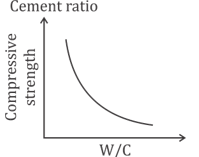
According to Abraham law with increase in the water-cement ratio, compressive strength of concrete get decreases and vice-versa.
When water-cement ratio of cement increases then chances of segregation of concrete increases and also shrinkage of concrete increases due to more heat of hydration due to which compressive strength of concrete decreases.
Relation between compressive strength of concrete and water cement ratio

Q12.

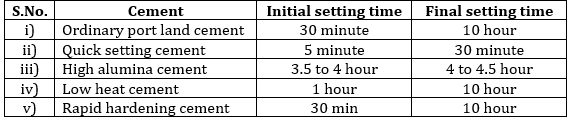
The initial and final setting time durations for ordinary Portland cement, respectively, are :

  • A.

    30 minutes and 10 hours

    ✓ Correct
  • B.

    15 minutes and 30 minutes

  • C.

    2 hours and 24 hours

  • D.

    1 hour and 3 hours

Answer & Solution

Correct option is A

• Initial setting time of cement : It is the time elapsed after adding the water to the cement, when the cement paste start loosing its plasticity is known as initial setting time of cement.
• Final setting time of cement : It is the time elapsed after adding water to the cement, when cement paste has hardened sufficiently in such a way that 1 mm needle makes and impression on paste in the mould but 5 mm needle does not make any impression.

Q13.
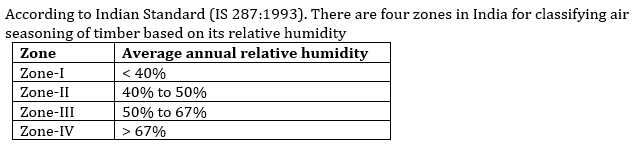
As per Indian Standard (IS 287 : 1993), India is divided into how many zones based on its relative humidity for air seasoning of timber?
  • A.Five
  • B.Three
  • C.Two
  • D.Four
    ✓ Correct

Answer & Solution

Correct option is D


Q14.
A very thin sheet of wood which is cut from the round logs with 0.5 to 5 mm thickness is called:
  • A.Blockboard
  • B.Chipboard
  • C.Veneer
    ✓ Correct
  • D.Fibre wood

Answer & Solution

Correct option is C


• Veneer :
→ A very thin sheet of wood which is cut from the round logs with 0.5 mm to 5 mm thickness is known as Veneer.
→ Fine Veneers are made from expansive wood like wallnut, teak wood.
→ Veneers are used to make plywood, lamination board, Batten boards.
• Fiber board :
→ This is also known as pressed wood
→ These board are made from wood fiber or agricultural fiber
→ Thickness of fibre board varies between 3 mm to 12 mm.
• Chip board :
→ These are made up of saw dust, wood chips and synthetic resin or other suitable binder.
→ These boards are used for partition doors, furniture making etc.
• Block board :
→ Block boards are made up of strip of wood having 25 mm width.
→ These boards are used for the construction of bus bodies, railway carriage, river craft etc.
→ These boards are glued to form a slab which is glued between two or more Veneer.
Q15.

The process of stones which includes excavating, wedging, heating and blasting is called:

  • A.

    placing

  • B.

    quarrying

    ✓ Correct
  • C.

    dressing

  • D.

    seasoning

Answer & Solution

Correct option is B

Quarrying of stones:
The process of taking out stones from natural rock beds is known as the quarrying of stones.
The operations carried out under the ground at a great depth are known as the mining of stones. 
The operations carried out at ground level are known as the quarrying of stones.
Dressing of stones:
The stones after being quarried are to be cut into suitable sizes with suitable surfaces.
This process is known as the dressing of stones.
Seasoning of stones:
The stones obtained fresh from the quarry contain some moisture which is known as quarry sap.
The process of removing moisture from freshly quarried stones with the help of any method or technique is known as stone seasoning.