SSC JE Analogy Questions with Detailed Solutions

Get SSC JE Analogy Questions to prepare for your upcoming exam. Solve the most expected questions and detailed solutions that can be asked in the exam.

Important SSC JE Analogy Questions

Q1.

11 is related to 77 following a certain logic. Following the same logic, 16 is related to 112.
To which of the following is 21 related, following the same logic?

(NOTE: Operations should be performed on the whole numbers, without breaking down the numbers into its constituent digits. E.g. 13 – Operations on 13 such as adding/subtracting/multiplying etc. to 13 can be performed. Breaking down 13 into 1 and 3 and then performing mathematical operations on 1 and 3 is not allowed.)​

  • A.

    145

  • B.

    147

    ✓ Correct
  • C.

    149

  • D.

    151

Answer & Solution

Correct option is B

The logic followed here is:

Logic: 1st number × 7 = 2nd number.

Now,

For, 11 : 77

=> 11 × 7 = 77.

For, 16 : 112

=> 16 × 7 = 112.

Similarly, for 21 ∶ ?

=> 21 × 7 = 147.

Hence, the correct answer is "Option B".
Q2.

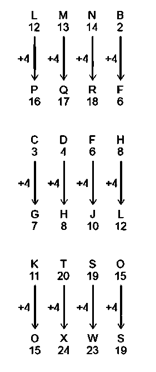
LMNB is related to PQRF in a certain way based on the English alphabetical order. In the same way, CDFH is related to GHJL. To which of the following is KTSO related, following the same logic?​

  • A.

    LKFR

  • B.

    RTJH

  • C.

    OXWS

    ✓ Correct
  • D.

    BMGH

Answer & Solution

Correct option is C

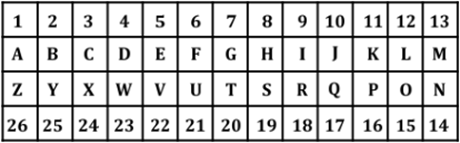
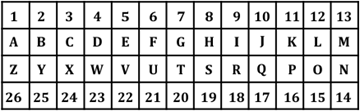
The English alphabetical series is given as-

The logic is as follows:

Therefore, we see that KTSO is related to OXWS by the same logic.

Hence, the correct answer is "Option C".

Q3.

Select the set in which the numbers are related in the same way as are the numbers of the following sets.
(NOTE: Operations should be performed on the whole numbers, without breaking down the numbers into its constituent digits. E.g. 13 – Operations on 13 such as adding/subtracting/multiplying etc. to 13 can be performed. Breaking down 13 into 1 and 3 and then performing mathematical operations on 1 and 3 is not allowed.)
(4, 32, 8)
(9, 54, 6)​

  • A.

    (9, 106, 12)

  • B.

    (13, 62, 4)

  • C.

    (7, 77, 11)

    ✓ Correct
  • D.

    (8, 89, 17)

Answer & Solution

Correct option is C

The logic followed here is:

Logic: 1st number × 3rd number = 2nd number.

Now,

For, (4, 32, 8)

=> 4 × 8 = 32.

For, (9, 54, 6)

=> 9 × 6 = 54.

Similarly, for (7, 77, 11)

=> 7 × 11 = 77.

Hence, the correct answer is "Option C".

Q4.

In the following number-pairs, the second number is obtained by applying certain mathematical operations to the first number. Select the set in which the numbers are related in the same way as are the numbers of the following sets.
(NOTE: Operations should be performed on the whole numbers, without breaking down the numbers into its constituent digits. E.g., 13 – Operations on 13 such as adding/subtracting/multiplying etc. to 13 can be performed. Breaking down 13 into 1 and 3 and then performing mathematical operations on 1 and 3 is not allowed.)
(36, 75)
(42, 87)​

  • A.

    (36, 77)

  • B.

    (47, 99)

  • C.

    (45, 93)

    ✓ Correct
  • D.

    (48, 100)

Answer & Solution

Correct option is C

The logic followed here is:

Logic: (1st number × 2) + 3 = 2nd number.

Now,

For, 36 : 75

=> (36 × 2) + 3

= 72 + 3 = 75.

For, 42 : 87

=> (42 × 2) + 3

= 84 + 3 = 87.

Similarly, for 45 ∶ 93

=> (45 × 2) + 3

= 90 + 3 = 93.

Hence, the correct answer is "Option C".

Q5.

Select the word-pair that best represents a similar relationship to the one expressed in the pair of words given below.
(The words must be considered as meaningful English words and must not be related to each other based on the number of letters/number of consonants/vowels in the word.)

Horse : Mare​

  • A.

    Fox : Goose

  • B.

    Peacock : Vixen

  • C.

    Drone : Duck

  • D.

    Buck : Doe

    ✓ Correct

Answer & Solution

Correct option is D

The logic followed here is:

Logic: Gender-specific terms for animals.

Here,

Horse ∶ Mare → Mare is the female term for a Horse.

Similarly,

Buck ∶ Doe → Doe is the female term for a Buck.

Hence, the correct answer is "Option D".

Q6.

5 is related to 67 following a certain logic. Following the same logic, 7 is related to 93. To which of the following is 11 related following the same logic?
(NOTE: Operations should be performed on the whole numbers, without breaking down the numbers into their constituent digits. E.g. 13 – Operations on 13 such as adding / subtracting /multiplying to 13 can be performed. Breaking down 13 into 1 and 3 and then performing mathematical operations on 1 and 3 is not allowed.)​

  • A.

    145

    ✓ Correct
  • B.

    144

  • C.

    146

  • D.

    148

Answer & Solution

Correct option is A

The logic followed here is:

Logic: (1st number × 13) + 2 = 2nd number.

Now,

For, 5 : 67

=> (5 × 13) + 2

= 65 + 2 = 67.

For, 7 : 93

=> (7 × 13) + 2

= 91 + 2 = 93.

Similarly, for 11 ∶ ?

=> (11 × 13) + 2

= 143 + 2 = 145.

Hence, the correct answer is "Option A".

Q7.

IK 3 is related to EO 7 in a certain way. In the same way, YO 5 is related to US 9. To which of the following is ZU 5 related, following the same logic?​

  • A.

    VY 9

    ✓ Correct
  • B.

    VW 7

  • C.

    WV 7

  • D.

    VX 9

Answer & Solution

Correct option is A

Solution:

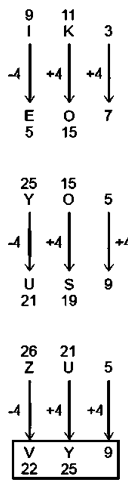
The logic followed here is,

IK 3: EO 7

Hence, the correct answer is "VY 9".

Q8.

Select the option in which the numbers share the same relationship as that shared by the given number triads.
2-8-32
5-20-80
(NOTE: Operations should be performed on the whole number, without breaking down the numbers into its constituent digits. E.g. 13- Operations on 13 such as adding/subtracting/multiplying etc. to 13 can be performed. Breaking down 13 into 1 and 3 and then performing mathematical operations on 1 and 3 is NOT allowed.)​

  • A.

    3-12-48

    ✓ Correct
  • B.

    5-25-100

  • C.

    1-4-12

  • D.

    4-8-12

Answer & Solution

Correct option is A

The logic followed here is:

Logic: √(1st number × 3rd number) = 2nd number.

Now,

For, 2-8-32

=> √(2 × 32)

= √64 = 8.

For, 5-20-80

=> √(5 × 80)

= √400 = 20.

Similarly, for 3-12-48

=> √(3 × 48)

= √144 = 12.

Hence, the correct answer is "Option A".

Q9.

Select the set in which the numbers are related in the same way as are the numbers of the following sets.
(NOTE : Operations should be performed on the whole numbers, without breaking down the numbers into its constituent digits. E.g. 13 – Operations on 13 such as adding/deleting/multiplying etc. to 13 can be performed. Breaking down 13 into 1 and 3 and then performing mathematical operations on 1 and 3 is not allowed.)
(6, 24, 12)
(7, 36, 13)​

  • A.

    (9, 66, 15)

    ✓ Correct
  • B.

    (5, 12, 18)

  • C.

    (8, 49, 12)

  • D.

    (11, 106, 5)

Answer & Solution

Correct option is A

The logic followed here is:

Logic: √(2nd number + 3rd number) = 1st number.

Now,

For, (6, 24, 12)

=> √(24 + 12)

= √36 = 6.

For, (7, 36, 13)

=> √(36 + 13)

= √49 = 7.

Similarly, for (9, 66, 15)

=> √(66 + 15)

= √81 = 9.

Hence, the correct answer is "Option A".

Q10.

123 is related to 223 following a certain logic. Following the same logic, 465 is related to 565. To which of the following is 786 related, following the same logic?

(NOTE: Operations should be performed on the whole numbers, without breaking down the numbers into its constituent digits. E.g. 13 – Operations on 13 such as adding/subtracting/multiplying etc. to 13 can be performed. Breaking down 13 into 1 and 3 and then performing mathematical operations on 1 and 3 is not allowed.)​

  • A.

    686

  • B.

    786

  • C.

    886

    ✓ Correct
  • D.

    986

Answer & Solution

Correct option is C

Solution
The logic followed here is:

Logic: 1st number + 100 = 2nd number.

Now,

For, 123 : 223

=> 123 + 100 = 223.

For, 465 : 565

=> 465 + 100 = 565.

Similarly, for 786 ∶ ?

=> 786 + 100 = 886.

Hence, the correct answer is "Option C".

Q11.

PTOS is related to NRMQ in a certain way based on the English alphabetical order. In the same way, JNIM is related to HLGK. To which of the following is QUPT related, following the same logic?​

  • A.

    OSNR

    ✓ Correct
  • B.

    SONR

  • C.

    SORN

  • D.

    OSRN

Answer & Solution

Correct option is A

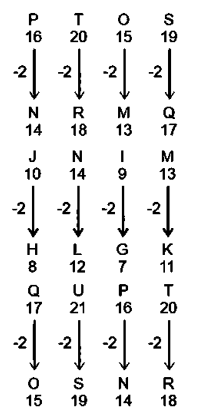
The English alphabetical order is given as follows-

The logic followed here is:

For PTOS is related to NRMQ, we get-

For JNIM is related to HLGK, we get-
Similarly, QUPT is related as-

Therefore, we see that QUPT is related to OSNR by the same logic.

Hence, the correct answer is "Option A".

Q12.

PUQT is related to RWSV in a certain way based on the English alphabetical order. In the same way, SXTW is related to UZVY. To which of the following is KPLO related, following the same logic?​

  • A.

    NRMQ

  • B.

    NRQM

  • C.

    MRNP

  • D.

    MRNQ

    ✓ Correct

Answer & Solution

Correct option is D

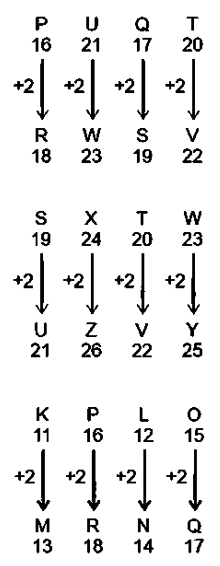
The English alphabetical order is given as follows-

The logic followed here is:

Therefore, we see that KPLO is related to MRNQ by the same logic.

Hence, the correct answer is "Option D".

Q13.

Select the triad in which the numbers are related to each other in the same way as are the numbers of the given triads.
(NOTE: Operations should be performed on the whole numbers, without breaking down the numbers into its constituent digits. E.g. 13 – Operations on 13 such as adding /deleting /multiplying etc. to 13 can be performed. Breaking down 13 into 1 and 3 and then performing mathematical operations on 1 and 3 is not allowed.)
(218, 121, 97)
(254, 138, 116)​

  • A.

    (312, 194, 128)

  • B.

    (325, 184, 141)

    ✓ Correct
  • C.

    (296, 147, 156)

  • D.

    (267, 118, 129)

Answer & Solution

Correct option is B

Solution

The logic followed here is:

Logic: 1st number - 2nd number = 3rd number.

Now,

For (218, 121, 97)

=> 218 - 121 = 97.

For (254, 138, 116)

=> 254 - 138 = 116.

Similarly, for (325, 184, 141)

=> 325 - 184 = 141.

Hence, the correct answer is "Option B".
Q14.

Select the set in which the numbers are related in the same way as are the numbers of the following sets.
(NOTE: Operations should be performed on the whole numbers, without breaking down the numbers into its constituent digits. E.g., 13 – Operations on 13 such as adding/subtracting/multiplying etc. to 13 can be performed. Breaking down 13 into 1 and 3 and then performing mathematical operations on 1 and 3 is not allowed.)
(6, 18, 123)
(17, 9, 168)​

  • A.

    (14, 8, 127)

    ✓ Correct
  • B.

    (18, 5, 100)

  • C.

    (20, 6, 94)

  • D.

    (21, 7, 147)

Answer & Solution

Correct option is A

Solution

The logic followed here is:

Logic: (1st number × 2nd number) + 15 = 3rd number.

Now,

For, (6, 18, 123)

=> (6 × 18) + 15

= 108 + 15 = 123.

For, (17, 9, 168)

=> (17 × 9) + 15

= 153 + 15 = 168.

Similarly, For (14, 8, 127)

=> (14 × 8) + 15

= 112 + 15 = 127.

Hence, the correct answer is "Option A".

Q15.

Select the word-pair that best represents a similar relationship to the one expressed in the pair of words given below.
(The words must be considered as meaningful English words and must not be related to each other based on the number of letters/number of consonants/vowels in the word.)

Pressure : Pascal​

  • A.

    Momentum : Newton

  • B.

    Work : Joule

    ✓ Correct
  • C.

    Force : Watt

  • D.

    Electric Current : Kelvin

Answer & Solution

Correct option is B

Solution

The logic followed here is:

Logic: Units of physical quantities.

Here,

Pressure : Pascal → Pascal is the unit of Pressure.

Similarly,

Work : Joule → Joule is the unit of Work.

Hence, the correct answer is "Option B".