SSC JE Soil Mechanics Questions with Detailed Solutions

Get SSC JE Soil Mechanics Questions to prepare for your upcoming exam. Solve the most expected questions and detailed solutions that can be asked in the exam.

Important SSC JE Soil Mechanics Questions

Q1.

In consistency of soil, the limits are expressed in terms of ___________.

  • A.

    Length

  • B.

    Volume/time

  • C.

    Time

  • D.

    Percentage of water content

    ✓ Correct

Answer & Solution

Correct option is D

Consistency : Consistency related to shear strength. The term consistency is defined only for fine grained soil like clay soil.
• Consistency shows dry, wet, and moist condition of soil sample.
• It can also be defined as the resistance of soil to deformation and rupture.
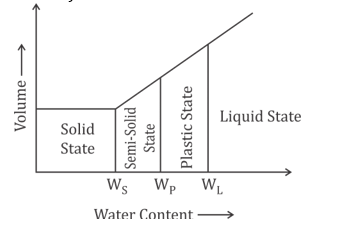
• According to Atterberg, the consistency limit are expressed as percentage of water content.
• Depending upon water content soil may appear in one of these four states :
i) Liquid state
ii) Plastic state
iii) Semi-solid state
iv) Solid state

Q2.

For determining the grain size of soil particles, which of the following equipment can be used?

  • A.

    Gate and runner

  • B.

    Channel

  • C.

    Runner and sprue

  • D.

    Sieve

    ✓ Correct

Answer & Solution

Correct option is D

Sieve analysis : Sieve analysis is done for determining the grain size of soil particles.
Sieve No. : It represent the number of opening in 1 inch length of sieve
or
It is also defined as square root of no. of opening in

area over sieve.
Sieve size : It is the size of one opening in a sieve.
Note : According to Indian standard sieves are designated by sieve size.
→ Minimum 5 sieves are used for sieve analysis at a given time.
→ Minimum size of sieve available in market is 45 micron.
→ Minimum size of sieve used in sieve analysis is 75 micron.

Q3.

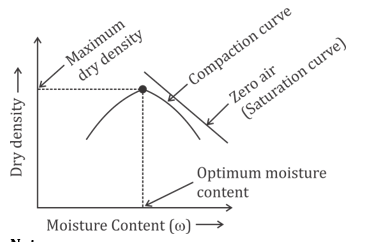
The moisture content at which specified amount of compaction produces maximum dry density is known as ____________.

  • A.

    Specific moisture content

  • B.

    Absolute moisture content

  • C.

    Optimum moisture content

    ✓ Correct
  • D.

    Retained moisture content

Answer & Solution

Correct option is C

Optimum moisture content : The moisture content at which maximum dry density achieved during compaction is known as optimum moisture content.


Note
Some Important Concept
Dry of optimum : When soil is compacted at a moisture content which is less than optimum moisture content (OMC) then soil is said to be dry of optimum.
Wet of optimum : When the soil is compacted at moisture content which is more than the optimum moisture content (OMC) then the soil is said to be compacted wet of optimum.

Q4.

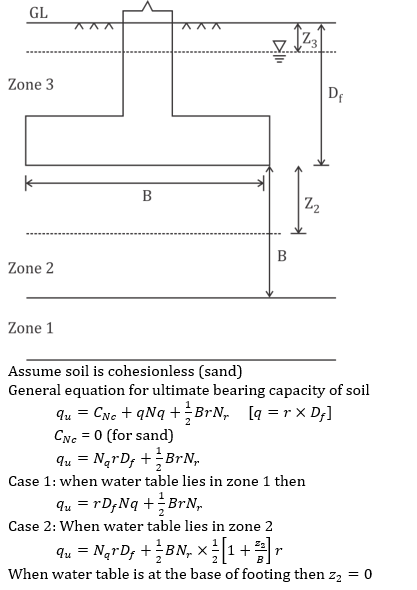
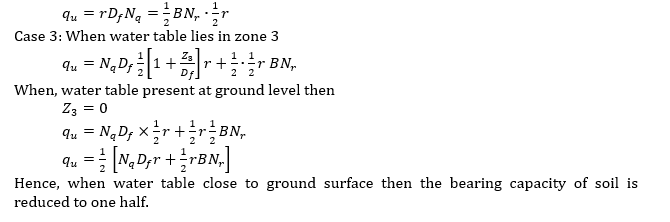
When the water table is close to the ground surface, the bearing capacity of as soil is reduced to __________.

  • A.

    One-third

  • B.

    One-half

    ✓ Correct
  • C.

    One-fifth

  • D.

    Three-seventh

Answer & Solution

Correct option is B

Q5.

The failure plane in direct shear test is the __________.

  • A.

    weakest major plane

  • B.

    horizontal plane

    ✓ Correct
  • C.

    principal vertical plane

  • D.

    major vertical plane

Answer & Solution

Correct option is B

Characteristics of Direct Shear Test:
 It is used to determine the shear strength of cohesionless soils.
 The specimen is not failing along its weakest plane but along a predetermined or induced failure plane i.e. horizontal plane separating the two halves of the shear box.
 During loading, the state of stress cannot be evaluated. It can be evaluated only at failure condition i.e. Mohr circle can be drawn at the failure condition only.

Q6.

Which of the following types of foundation is best suited in an expansive type of soil?

  • A.

    Steel piles

  • B.

    Timber piles

  • C.

    Under reamed piles

    ✓ Correct
  • D.

    Shallow foundation

Answer & Solution

Correct option is C

Under Reamed Pile : These piles are cast in situ piles in which surface area of pile is increased in the form of bulb.
=> These piles are provided in highly compressive soil or expansive soil having low safe bearing capacity.
Under reamed piles are of two types :
i) Single bulb under reamed pile
=> In this one bulb is provided to increase surface area.
ii) Multi bulb under reamed pile
=> In this type more than one bulb is provided to increase surface area for load resistance
=> According to IS 2720 max two bulb can be provided in a pile
=> Size of bulb = 2D to 3D
=> Minimum clear spacing b/w bulb = 1.5 D
=> Clear spacing b/w two underground piles = 2D

Q7.

The strength of the soil is mainly described by its:

  • A.

    tensile strength

  • B.

    torsional strength

  • C.

    shear strength

    ✓ Correct
  • D.

    compressive strength

Answer & Solution

Correct option is C

• Strength of soil is mainly described by its shear strength.
• Shear Strength of Soil :
The maximum shear stress that a soil can carry just before its failure is known as shear strength.
=> Shear strength is a function of effective stress.
=> Shear strength between soil particle depends upon three resistance :
i) Structural Resistance : It represent the resistance offered by interlocking between soil particle.
ii) Frictional Resistance : It is due to the frictional forces between sand particle. This resistance is expressed in angle of internal friction (ϕ).
iii) Cohesion Between Particle : It is due to the surface cohesive forces between clay particle.
As per Mohr-Coulomb theory
τ = σ tan⁡ϕ+C
τ = Shear strength of soil
σ = Normal stress
ϕ = Angle of internal friction
C = Cohesion between soil particle

Q8.
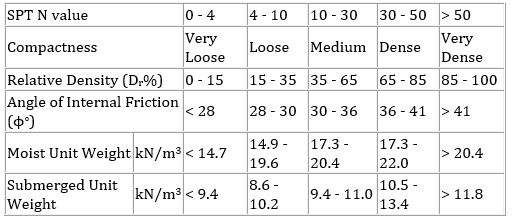
Identify the state of sand, if the number of blow in the SPT test is more than 50.
  • A.Medium dense
  • B.Dense
  • C.Very dense
    ✓ Correct
  • D.Loose

Answer & Solution

Correct option is C

Q9.
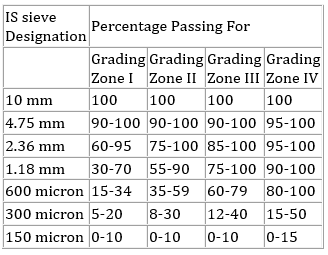
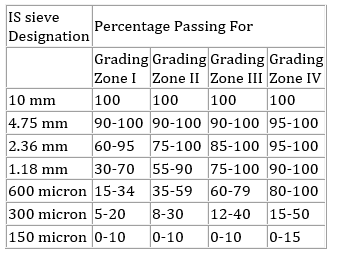
As per IS 383 (1970), the grading limit percentage of fine aggregates in Zone II which are passing through a 4.75 mm IS sieve is _________.
  • A.0-10
  • B.90-100
    ✓ Correct
  • C.15-34
  • D.35-59

Answer & Solution

Correct option is B

As per IS:383-1970:(Table 4)

Q10.
The minimum amount of water required to be added to the soil, expressed as percentage of weight of the soil, that will just make it flow like a liquid when jarred slightly is known as __________.
  • A.liquid limit
    ✓ Correct
  • B.elastic limit
  • C.plastic limit
  • D.shrinkage limit

Answer & Solution

Correct option is A

Liquid limit (WL):
 It is defined as the minimum water content at which the soil is still in the liquid state, but has a small shearing strength against flowing, which can be measured by available means.
 
Plastic limit (Wp):
Defined as the minimum water content at which the soil starts to crumble when rolled into a thread of approximately 3 mm diameter.
Shrinkage limit (Ws):
Defined the maximum water content at which, the reduction in water content will not reduce the volume of the soil mass.
Also, it is the lowest water content at which the soil can still be completely saturated

Q11.
Which of the following soil type has the highest value of co-efficient of permeability?
  • A.Silt
  • B.Fine sand
  • C.Coarse sand
    ✓ Correct
  • D.Clay

Answer & Solution

Correct option is C

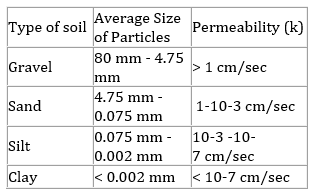
Different types of soil and their standard permeability rate:

Q12.
In a direct shear test, the soil load is subjected to more stress at the _________.
  • A.centre
  • B.top
  • C.edges
    ✓ Correct
  • D.bottom

Answer & Solution

Correct option is C

Direct Shear Test:
This test also called the shear box test, is the oldest shear test that is in use and also quite simple to perform.
The soil specimen that is to be tested, is confined in a metal box of a square cross-section that is split into two halves horizontally, and a small clearance is maintained between the two halves of the box. if the specimen is fully or partially saturated, perforated metal plates and porous stones are placed above and below the specimen to allow free drainage. A solid metal plate is used if the specimen is dry.
A vertical load is applied to the specimen through a static weight hanger and the soil is sheared gradually by applying a horizontal force which causes the two halves of the box to move relative to each other. The shear is normally applied at a constant rate of strain. The magnitude of the shear load is measured by means of a proving ring.
The shear deformation as well as the vertical deformation (change in thickness) are measured during the test with the help of dial gauges.
This test is best suitable for free drainage soil like sand and gravel.
The failure plane is predetermined.

Q13.
As per IS (383-1970), the percentage passing of fine aggregates under a 2.36 mm IS sieve during the grading Zone 1 is ___________.
  • A.0-10%
  • B.25-45%
  • C.60-95%
    ✓ Correct
  • D.95-100%

Answer & Solution

Correct option is C

As per IS:383-1970:(Table 4)

Q14.
Transported soil known as ‘Talus’ is transported by _____________.
  • A.ice
  • B.flowing water
  • C.gravitational force
    ✓ Correct
  • D.wind

Answer & Solution

Correct option is C

Talus is a transported soil which is transported by gravitational forces.

Q15.

Select the correct option for the given statements.
Statement
1 : Consolidation is due to a reduction in the volume of air voids at a given water content.
Statement
2 : In compaction volume reduction is due to expulsion of pore water from voids.

  • A.

    Both statement 1 and statement 2 are false

    ✓ Correct
  • B.

    Both statements 1 and statement 2 are true but statement 2 is not the correct explanation of statement 1

  • C.

    Both statements 1 and statement 2 are true and statement 2 is the correct explanation of statement 1

  • D.

    Statement 1 is true but statement 2 is false

Answer & Solution

Correct option is A

Consolidation occurs due to the expulsion of pore water from the soil voids under sustained loading, mainly in saturated soils.
Therefore, Statement 1 is false because it incorrectly mentions reduction in air voids.
Compaction is the process of densifying soil by reducing the volume of air voids at nearly constant water content through mechanical means.
Therefore, Statement 2 is false because it incorrectly states expulsion of pore water.