SSC JE General Intelligence AND Reasoning Questions with Detailed Solutions

Get SSC JE General Intelligence AND Reasoning Questions to prepare for your upcoming exam. Solve the most expected questions and detailed solutions that can be asked in the exam.

Important SSC JE General Intelligence AND Reasoning Questions

Q1.

What should come in place of the question mark (?) in the given series based on the English alphabetical order?
LFC, IDZ, FBW, CZT, ZXQ, ?

  • A.

    WVN

    ✓ Correct
  • B.

    UWM

  • C.

    XZR

  • D.

    XYP

Answer & Solution

Correct option is A

Given: LFC, IDZ, FBW, CZT, ZXQ, ?

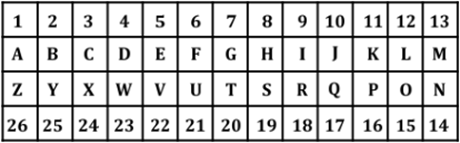
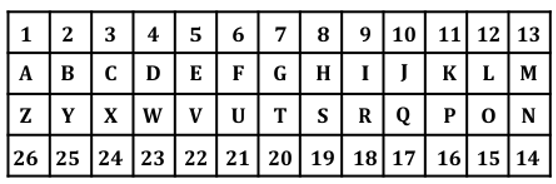
The English alphabetical order is given as follows-

The logic followed here is:
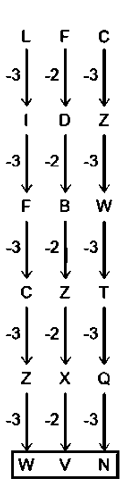
Therefore, by this logic, the next term in the series is WVN.

Hence, the correct answer is "Option A".
Q2.

What should come in place of the question mark (?) in the given series based on the English alphabetical order?
AYH, BWJ, CUL, DSN, ?

  • A.

    EQP

    ✓ Correct
  • B.

    EPL

  • C.

    EQS

  • D.

    FPR

Answer & Solution

Correct option is A

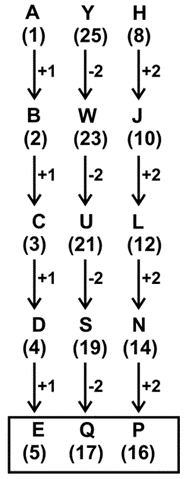
Given: AYH, BWJ, CUL, DSN, ?

The logic followed here is:

So, 'EQP' will replace the question in the given series.

Hence, the correct answer is "Option A".
Q3.

What will come in place of the question mark (?) in the following equation if ‘+’ and ‘÷’ are interchanged and ‘×’ and ‘−’ are interchanged?
84 + 12 × 9 ÷ 13 – 21 = ?​

  • A.

    273

  • B.

    259

  • C.

    264

  • D.

    271

    ✓ Correct

Answer & Solution

Correct option is D

Given equation: 84 + 12 × 9 ÷ 13 - 21 = ?

BODMAS Table:
​​Operation preference wiseSymbolBrackets[],,()Orders, of(power),√(root),ofDivision÷Multiplication×Addition+Subtraction−\begin{array}{|c|c|} \hline\textbf{Operation preference wise} & \textbf{Symbol} \\\hline\text{Brackets} &[], {}, () \\ \hline \text{Orders, of} & (power), √ (root) , of \\ \hline \text{Division}& ÷ \\ \hline \text{Multiplication} & × \\\hline \text{Addition} &+ \\ \hline \text{Subtraction} & - \\\hline\end{array}​​

Now, if ‘+’ and ‘÷’ are interchanged, and ‘×’ and ‘-’ are interchanged, then:

=> 84 ÷ 12 - 9 + 13 × 21 = ?

=> 7 - 9 + 13 × 21 = ?

=> 7 - 9 + 273 = ?

=> 280 - 9 = 271

Hence, the correct answer is "Option D".

Q4.

Read the given statements and conclusions carefully. Assuming that the information given in the statements is true, even if it appears to be at variance with commonly known facts, decide which of the given conclusions logically follow(s) from the statements.
Statements: Some machines are shrugs. All machines are bins. No shrug is a cloth.
Conclusion (I): No cloth is a machine.
Conclusion (II): At least some shrugs are bins.​

  • A.

    Both conclusions (I) and (II) follow

  • B.

    Only conclusion (I) follows

  • C.

    Neither conclusion (I) nor (II) follows

  • D.

    Only conclusion (II) follows

    ✓ Correct

Answer & Solution

Correct option is D

Given Statements:

Some machines are shrugs.
All machines are bins.
No shrug is a cloth.
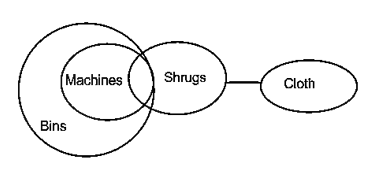
The least possible Venn diagram for the given statement is:

Conclusions:

I. No cloth is a machine - False (We cannot conclude this directly from the given statements. The information provided tells us that no shrug is a cloth, but it does not provide a direct relationship between machines and cloths.)

II. At least some shrugs are bins - True (Since some machines are shrugs and all machines are bins, it follows that some shrugs must also be bins.)

So, only conclusion II follows.

Hence, the correct answer is "Option D".

Q5.

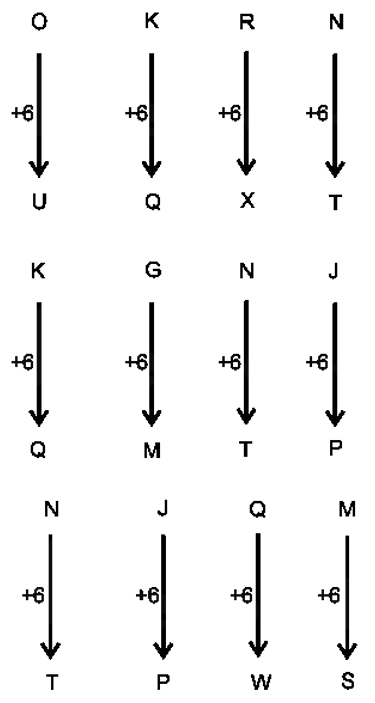
OKRN is related to UQXT in a certain way based on the English alphabetical order. In the same way, KGNJ is related to QMTP. To which of the following is NJQM related, following the same logic?​

  • A.

    TPSW

  • B.

    TPWS

    ✓ Correct
  • C.

    PTWS

  • D.

    PTSW

Answer & Solution

Correct option is B

The English alphabetical series is given as-

Logic: +6
The logic is as follows-
Therefore, we see that NJQM is related to TPWS by the same logic.

Hence, the correct answer is "Option B".

Q6.

Select the pair in which the numbers are related to each other in the same way as are the numbers of the given pairs.
(NOTE: Operations should be performed on the whole numbers, without breaking down the numbers into its constituent digits. E.g. 13 – Operations on 13 such as adding/deleting/multiplying etc. to 13 can be performed. Breaking down 13 into 1 and 3 and then performing mathematical operations on 1 and 3 is not allowed.)
(376, 234)
(354, 212)​

  • A.

    (281, 139)

    ✓ Correct
  • B.

    (328, 283)

  • C.

    (294, 145)

  • D.

    (349, 217)

Answer & Solution

Correct option is A

Solution:

The logic followed here is:

Logic: 1st number - 142 = 2nd number.

Now,

For, (376, 234)

=> 376 - 142 = 234.

For, (354, 212)

=> 354 - 142 = 212.

Similarly, for (281, 139)

=> 281 - 142 = 139.

Hence, the correct answer is "Option A".
Q7.

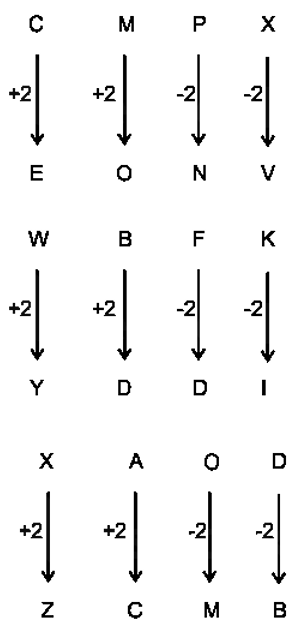
In a certain code language, ‘CMPX’ is coded as ‘EONV’ and ‘WBFK’ is coded as ‘YDDI’. What is the code for ‘XAOD’ in the given language?​

  • A.

    YDND

  • B.

    ZCMB

    ✓ Correct
  • C.

    XDOD

  • D.

    XBMC

Answer & Solution

Correct option is B

The English alphabetical series is given as-

The logic is as follows-
For 'CMPX' is coded as 'EONV' we get-
Therefore, we see that XAOD is coded as ZCMB by the same logic.

Hence, the correct answer is "Option B".
Q8.

Read the given statements and conclusions carefully. Assuming that the information given in the statements is true, even if it appears to be at variance with commonly known facts, decide which of the given conclusions logically follow(s) from the statements.
Statements: Some bowls are spoons. All spoons are plates.
Conclusion 1: Some spoons are bowls.
Conclusion 2: Some bowls are plates.​

  • A.

    Both conclusions (1) and (2) follow

    ✓ Correct
  • B.

    Only conclusion (2) follows

  • C.

    None of the conclusions follow

  • D.

    Only conclusion (1) follows

Answer & Solution

Correct option is A

Given Statements:

Some bowls are spoons.
All spoons are plates.
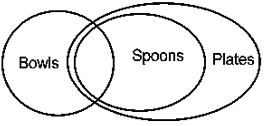
The least possible Venn diagram for the given statement is:

Conclusions:

I. Some spoons are bowls - True (Because, Some bowls are spoons implies that some part of the spoons overlap with the bowls).

II. Some bowls are plates - True (Because, All spoons are plates and some bowls are spoons, it means some part of the bowls, which are spoons, will also be plates).

So, Both conclusions (1) and (2) follow.

Hence, the correct answer is "Option A".
Q9.

E, F, G, H, I, J and K are sitting around a circular table with their backs facing the centre (not necessarily in the same order). J is sitting to the immediate left of G. K is sitting to the immediate right of E. H is sitting to the immediate right of K. I is sitting to the immediate right of H and immediate left of F. F is sitting to the immediate left of J. Who is an
immediate neighbour of both E and J?​

  • A.

    K

  • B.

    H

  • C.

    G

    ✓ Correct
  • D.

    F

Answer & Solution

Correct option is C

Given:

E, F, G, H, I, J and K are sitting around a circular table with their backs facing the centre.
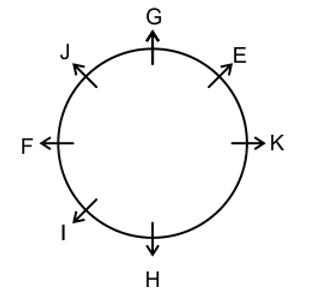
Based on the given conditions in the question, we get the following arrangements-
1. J is sitting to the immediate left of G. F is sitting to the immediate left of J. From these, we get-

2. I is sitting to the immediate right of H and immediate left of F. K is sitting to the immediate right of E. H is sitting to the immediate right of K. From these, we get the final arrangement as follows-

Therefore, we see that G is an immediate neighbor of both E and J.

Hence, the correct answer is “Option C’.

Q10.

CYTV is related to DZUW in a certain way based on the English alphabetical order. In the same way, GKOS is related to HLPT. To which of the following is BAHG related, following the same logic?​

  • A.

    PLIY

  • B.

    ALPO

  • C.

    MJGH

  • D.

    CBIH

    ✓ Correct

Answer & Solution

Correct option is D

The English alphabetical series is given as-

The logic is as follows-
For CYTV is related to DZUW, we get-
Therefore, we see that BAHG is related to CBIH by the same logic.

Hence, the correct answer is "Option D".

Q11.

The position(s) of how many letters will remain unchanged if each of the letter in the word AMPLIFY is arranged in the English alphabetical order?​

  • A.

    1

  • B.

    2

  • C.

    3

    ✓ Correct
  • D.

    4

Answer & Solution

Correct option is C

Given word: 'AMPLIFY'

After arranged in alphabetical order:

Alphabets

A

M

P

L

I

F

Y

Alphabetical order

A

F

I

L

M

P

Y

After arranged in alphabetical order,

Only 'A', 'L', and 'Y' will remain unchanged.

Hence, the correct answer is "Option C".

Q12.

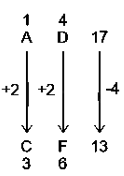
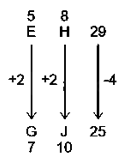
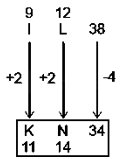
AD 17 is related to CF 13 in a certain way. In the same way, EH 29 is related to GJ 25. To which of the following is IL 38 related, following the same logic?

  • A.

    TZ 35

  • B.

    KN 34

    ✓ Correct
  • C.

    XZ 34

  • D.

    TY 35

Answer & Solution

Correct option is B

The English alphabetical series is given as-

The logic is as follows-
AD 17: CF 13
EH 29: GJ 25
Similarly,
IL 38: ?
Hence, the correct answer is "KN 34".

Q13.

What will come in the place of the question mark (?) in the following equation, if ‘+’ and ‘×’ are interchanged and ‘÷’ and ‘−’ are interchanged?
18 − 6 + 3 × 20 ÷ 9 = ?​

  • A.

    12

  • B.

    6

  • C.

    18

  • D.

    20

    ✓ Correct

Answer & Solution

Correct option is D

Using BODMAS rule.

​Operation preference wiseSymbolBrackets[],,()Orders, of(power),√(root),ofDivision÷Multiplication×Addition+Subtraction−\begin{array}{|c|c|} \hline\textbf{Operation preference wise} & \textbf{Symbol} \\\hline\text{Brackets} &[],{}, () \\ \hline \text{Orders, of} & (power), √ (root) , of \\ \hline \text{Division}& ÷ \\ \hline \text{Multiplication} & × \\ \hline \text{Addition} & + \\ \hline \text{Subtraction} & - \\\hline\end{array}

Given equation: 18 - 6 + 3 × 20 ÷ 9 = ?

Now, if ‘+’ and ‘×’ are interchanged and ‘÷’ and ‘-’ are interchanged, then:

=> 18 ÷ 6 × 3 + 20 - 9 = ?

=> 3 × 3 + 20 - 9 = ?

=> 9 + 20 - 9 = ?

=> 29 - 9 = 20.

Hence, the correct answer is "Option D".

Q14.

The position of how many letters will remain unchanged if each of the letters in the word ADVISER is arranged in the English alphabetical order?​

  • A.

    One

  • B.

    Two

  • C.

    Three

    ✓ Correct
  • D.

    Four

Answer & Solution

Correct option is C

Given word: 'ADVISER'

After arranged in alphabetical order:

Alphabets

A

D

V

I

S

E

R

Alphabetical order

A

D

E

I

R

S

V

After arranged in alphabetical order,

Only 'A', 'D' and 'I' will remain unchanged.

Hence, the correct answer is "Option C".

Q15.

What should come in place of the question mark (?) in the given series based on the English alphabetical order?
FDI, HEK, JFM, LGO, ?

  • A.

    MHQ

  • B.

    NHQ

    ✓ Correct
  • C.

    NOP

  • D.

    MNQ

Answer & Solution

Correct option is B

The English alphabetical series is given as-

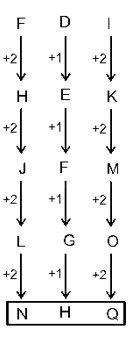
Given: FDI, HEK, JFM, LGO, ?
The logic followed here is-
Therefore, by this logic, the next term in the series is NHQ.

Hence, the correct answer is "Option B".