SSC CGL Number System Questions with Detailed Solutions

Get SSC CGL Number System Questions to prepare for your upcoming exam. Solve the most expected questions and detailed solutions that can be asked in the exam.

Important SSC CGL Number System Questions

Q1.

A two-digit number is such that four times the sum of its digits is equal to the number formed by reversing its digits. If the difference between the digits is 3, find the original number.

  • A.

    63

    ✓ Correct
  • B.

    96

  • C.

    69

  • D.

    36

Answer & Solution

Correct option is A

Given
4 × (Sum of digits) = Number formed by reversing digits
Difference between digits = 3
Formula Used
Original two-digit number = 10x + y
Reversed number = 10y + x
Solution
Let the tens digit be x and units digit be y.
Given condition: 4(x + y) = 10y + x
Expand and simplify the equation:
4x + 4y = 10y + x
3x = 6y
x = 2y
Since x = 2y, we know x is greater than y.
The second condition states the difference between digits is 3:
x - y = 3
Substitute x = 2y into the second equation:
2y - y = 3
y = 3
Now, find x:
x = 2(3) = 6
The original number is 10x + y = 10(6) + 3 = 63.
Final Answer
So the correct answer is (a)

Q2.

What is the remainder when 39393^{939}​ is divided by 8 ?

  • A.

    2

  • B.

    3

    ✓ Correct
  • C.

    5

  • D.

    0

Answer & Solution

Correct option is B

Given
Expression: 3939÷83^{939} ÷ 8​​
Formula Used
Remainder Theorem: If (ax+1)n(ax + 1)^n​ is divided by a, the remainder is always 1.
Solution
We need to express the base 3 in terms of a power that is close to a multiple of 8. We know that 323^2 ​= 9, and 9 divided by 8 leaves a remainder of 1.
3939:3939=3938+1=3938×313939=(32)469×3 3^{939}: \\3^{939} = 3^{938 + 1} = 3^{938} × 3^1\\3^{939} = (3^2)^{469} × 3\\​​
Substitute 323^2​ with 9:
=9469×3= 9^{469} × 3​​
When 9 is divided by 8, the remainder is 1. Therefore, for 9469÷8,9^{469} ÷ 8, ​the remainder is 1469=1.1^{469} = 1.​​
Now multiply this by the remaining part:
Remainder = 1 × 3 = 3
Final Answer
So the correct answer is (b)

Q3.

The least common multiple of x3.5y1.5,y2.5x4.5,x^{3.5} y^{1.5}, \frac{y^{2.5}}{x^{-4.5}},​  and xy3\frac{x}{y^{-3}}​ is :

  • A.

    (xy)3(x3)(xy)^3 √(x^3 )​​

    ✓ Correct
  • B.

    (xy)2(y3)(xy)^2 √(y^3 )​​

  • C.

    (xy)2(x3)(xy)^2 √(x^3 )​​

  • D.

    (xy)3(y3)(xy)^3 √(y^3 )​​

Answer & Solution

Correct option is A

Given:
The terms are:  x3.5y1.5,y2.5x4.5,x^{3.5} y^{1.5}, \frac{y^{2.5}}{x^{-4.5}},​ and xy3\frac{x}{y^{-3}}​​
Formula Used:
am=1ama^{-m} = \frac{1}{a^m}​​
LCM of algebraic terms is the product of all unique prime bases with their highest powers.
Solution:
First, let's simplify all the terms by removing negative exponents:
Term 1 = x3.5y1.5 x^{3.5} y^{1.5}​​
Term 2 = y2.5x4.5=x4.5y2.5y^{2.5} x^{4.5} = x^{4.5} y^{2.5}​​
Term 3 = xy3=x1y3x y^3 = x^{1} y^{3}​​
Now, compare the powers of x and y across all three terms.
Highest power of x = max(3.5, 4.5, 1) = 4.5
Highest power of y = max(1.5, 2.5, 3) = 3
LCM = x4.5y3x^{4.5} y^3​​
Rewriting this in the form of the options:
x4.5y3=x3×x1.5×y3=(xy)3x1.5=(xy)3x3x^{4.5} y^3 = x^3 × x^{1.5} × y^3 = (xy)^3 x^{1.5} = (xy)^3 \sqrt{x^3}​​
Final Answer
So the correct answer is (a)

SSC CGL Number System Questions
Q4.

When a fraction is multiplied by itself and then the product is divided by its reciprocal, its results is 10 296/1728 Find the average of the squares of the numerator and the denominator, when they appear as co-primes, in the original fraction expressed.

  • A.

    101.5

  • B.

    102.5

    ✓ Correct
  • C.

    100.5

  • D.

    108.5

Answer & Solution

Correct option is B

Given:
A fraction multiplied by itself and divided by its reciprocal gives 102961728.10 \frac{296}{1728}.​​
Formula Used:
Average = Sum of valuesNumber of values \frac{\text{Sum of values}}{\text{Number of values}}​​
Solution:
Let the original fraction be ab. \frac{a}{b}.​​
According to the question:
(ab×ab)÷ba=102961728(\frac{a}{b} × \frac{a}{b}) ÷ \frac{b}{a} = 10 \frac{296}{1728}​​

(ab)2×ab=10×1728+2961728(\frac{a}{b})^2 × \frac{a}{b} = \frac{10 × 1728 + 296}{1728}​​

(ab)3=17280+2961728(\frac{a}{b})^3 = \frac{17280 + 296}{1728}​​

(ab)3=175761728(\frac{a}{b})^3 = \frac{17576}{1728}​​

We know that 17576 is the cube of 26 and 1728 is the cube of 12.
(ab)3=(2612)3(\frac{a}{b})^3 = (\frac{26}{12})^3​​

ab=2612\frac{a}{b} = \frac{26}{12}​​

ab=136\frac{a}{b} = \frac{13}{6}​​
The numerator is 13 and the denominator is 6.
We need the average of their squares:
Average = 132+622\frac{13^2 + 6^2}{2}​​

=169+362 \frac{169 + 36}{2}​​

2052\frac{205}{2}​ = 102.5
Final Answer
So the correct answer is (b)

Q5.

Find the greatest five-digit number that on being divided by 8, 12 and 15 leaves 5, 9 and 12 as remainders, respectively.

  • A.

    99957

    ✓ Correct
  • B.

    99975

  • C.

    99967

  • D.

    99947

Answer & Solution

Correct option is A

Given:
The divisors are 8, 12, and 15.
The remainders are 5, 9, and 12 respectively.
Formula Used:
Required Number = (Multiple of LCM) - Common Difference
Solution:
First, we check the difference between each divisor and its corresponding remainder.
8 - 5 = 3
12 - 9 = 3
15 - 12 = 3
The common difference is 3 in all cases.
Next, we find the least common multiple of the divisors 8, 12, and 15.
The LCM of 8, 12, and 15 is 120.
The greatest possible five-digit number is 99999.
We divide 99999 by 120 to find the greatest multiple within five digits.
99999 = 120 × 833 + 39.
The greatest five-digit multiple of 120 is found by subtracting the remainder.
Multiple is 99999 - 39 = 99960.
The required number is obtained by subtracting the common difference from this multiple.
Required Number is 99960 - 3 = 99957.
Final Answer
So the correct answer is (a)

Q6.

What is the largest number that will divide 4358, 4748, 5138 and 5788 to leave a remainder of 3 in each case?

  • A.

    52

  • B.

    55

  • C.

    65

    ✓ Correct
  • D.

    75

Answer & Solution

Correct option is C

Given:
Numbers: 4358, 4748, 5138, 5788
Remainder in each case = 3
Formula Used:
Required number = HCF of (N1R),(N2R),(N3R),(N4R) (N_1 - R), (N_2 - R), (N_3 - R), (N_4 - R)​​
Solution:
Subtract the remainder 3 from each of the given numbers:
4358 - 3 = 4355
4748 - 3 = 4745
5138 - 3 = 5135
5788 - 3 = 5785
Now, find the HCF of 4355, 4745, 5135, and 5785.
Let's find the differences between consecutive terms to simplify:
4745 - 4355 = 390
5135 - 4745 = 390
5785 - 5135 = 650
The required HCF must be a factor of these differences (390 and 650).
HCF(390, 650):
390 = 130 × 3
650 = 130 × 5
The common difference factor is 130. However, 130 is an even number and cannot divide odd numbers like 4355.
Therefore, the actual HCF is a factor of 130. Testing the options, 65 is a factor of 130 and divides all the odd numbers:
4355÷ 65 = 67
4745÷ 65 = 73
Thus, the largest number is 65.
Final Answer
So the correct answer is (c)

SSC CGL Number System Questions
Q7.

What is the minimum value that must be assigned to A so that the 8 -digit number 130A1568 is divisible by 8 ?

  • A.

    0

    ✓ Correct
  • B.

    5

  • C.

    2

  • D.

    3

Answer & Solution

Correct option is A

Given:
An 8-digit number: 130A1568.
The number is divisible by 8.
Formula Used:
A number is divisible by 8 if its last three digits form a number that is divisible by 8.
Solution:
The last three digits of the given number are 568.
Check if 568 is divisible by 8:
5688\frac{568}{8}​ = 71
Since 568 is already perfectly divisible by 8, the condition is satisfied regardless of the digit placed at position A.
The possible values for A are 0 to 9.
The minimum value that can be assigned to A is 0.
Final Answer
So the correct answer is (a)

Q8.

A 6-digit number 648XYZ is divisible by 4, 9 and 10. Find the value of X+Z-Y, where Y is the smallest possible number.

  • A.

    2

  • B.

    0

    ✓ Correct
  • C.

    7

  • D.

    5

Answer & Solution

Correct option is B

Given
Number = 648XYZ
Divisible by = 4, 9, 10
Y is the smallest possible number
Solution
Since the number is divisible by 10, its last digit must be 0.
So, Z = 0.
The number becomes 648XY0.
For divisibility by 4, the last two digits (Y0) must be divisible by 4.
Possible values for Y are 0, 2, 4, 6, 8.
Since Y must be the smallest possible number, Y = 0.
The number becomes 648X00.
For divisibility by 9, the sum of digits must be a multiple of 9.
Sum of digits = 6 + 4 + 8 + X + 0 + 0 = 18 + X.
For 18 + X to be divisible by 9, the smallest single-digit value for X is 0.
So, X = 0.
Required value = X + Z - Y
= 0 + 0 - 0 = 0
Final Answer
So the correct answer is (b)

Q9.

If the numerator of a fraction is increased by 25% and the denominator is decreased by 9%, the value of new fraction becomes 57\frac 57​ Which of the following is the correct statement w.r.t. the original fraction?

  • A.

    The numerator is greater than denominator by 10

  • B.

    The sum of numerator and denominator is 37

  • C.

    The value of denominator is 13

  • D.

    The difference between denominator and numerator is 12

    ✓ Correct

Answer & Solution

Correct option is D

Given
Numerator increased by = 25%
Denominator decreased by = 9%
New fraction = \frac{5}{7}
Formula Used
New Fraction = Numerator×(100+Increase%)Denominator×(100Decrease%) \frac{Numerator × (100 + Increase\%)}{Denominator × (100 - Decrease\%)}​​
Solution
Let the original fraction be xy\frac{x}{y}​​

x×125y×91=57 xy=5×917×125  xy=1×131×25=1325 \frac{x × 125}{y × 91} = \frac{5}{7} \\\ \\\frac{x}{y} = \frac{5 × 91}{7 × 125} \\\ \\ \\\ \\\frac{x}{y} = \frac{1 × 13}{1 × 25} = \frac{13}{25} \\\ \\​​

Original fraction = 1325\frac{13}{25}​​
Difference between denominator and numerator = 25 - 13 = 12
Final Answer
So the correct answer is (d)

SSC CGL Number System Questions
Q10.

The sum of two numbers is 672 and their HCF is 28. How many pairs of such numbers can be formed?

  • A.

    4

    ✓ Correct
  • B.

    3

  • C.

    2

  • D.

    5

Answer & Solution

Correct option is A

Given:
Sum of the two numbers = 672
Highest Common Factor (HCF) = 28
Formula Used:
Let the numbers be 28a and 28b, where 'a' and 'b' are coprime integers.
Solution:
Since the HCF is 28, the numbers can be expressed as 28a and 28b.
According to the problem, their sum is 672:
28a + 28b = 672
Divide the entire equation by 28:
a + b = \frac{672}{28}
a + b = 24
Now, we need to find pairs of coprime numbers (a, b) that add up to 24. Coprime numbers are numbers whose only common factor is 1.
Possible pairs summing to 24:
(1, 23) -> Coprime
(2, 22) -> Not coprime (common factor 2)
(3, 21) -> Not coprime (common factor 3)
(4, 20) -> Not coprime (common factor 4)
(5, 19) -> Coprime
(6, 18) -> Not coprime (common factor 6)
(7, 17) -> Coprime
(8, 16) -> Not coprime (common factor 8)
(9, 15) -> Not coprime (common factor 3)
(10, 14) -> Not coprime (common factor 2)
(11, 13) -> Coprime
(12, 12) -> Not coprime
The coprime pairs are: (1, 23), (5, 19), (7, 17), and (11, 13).
Total number of valid pairs is 4.
Final Answer
So the correct answer is (a)

Q11.

Three co-prime numbers are such that the product of the first two is 527 and that of the last two is 1147. The sum of the three numbers is:

  • A.

    75

  • B.

    85

    ✓ Correct
  • C.

    58

  • D.

    68

Answer & Solution

Correct option is B

Given:
Three co-prime numbers
Product of the first two = 527
Product of the last two = 1147
Solution:
Let the three numbers be a, b, and c.
ab = 527
bc = 1147
Since the numbers are co-prime, b must be the highest common factor (HCF) of 527 and 1147.
Using the division method to find HCF of 527 and 1147:
1147 = 527 × 2 + 93
527 = 93 × 5 + 62
93 = 62 × 1 + 31
62 = 31 × 2 + 0
So, HCF = 31. Therefore, b = 31.
Now find a and c:
a = 52731 \frac{527}{31}​ = 17
c = 114731 \frac{1147}{31}​ = 37
Sum of the three numbers = a + b + c
Sum = 17 + 31 + 37 = 85
Final Answer
So the correct answer is (b)
Q12.

A rectangular courtyard 15 metre * 17 cm long and 17 metre * 22 cm wide is to be paved exactly with square tiles, all of the same size. What is the largest size (in cm²) of the tile that could be used for this purpose?

  • A.

    41

    ✓ Correct
  • B.

    36

  • C.

    35

  • D.

    17

Answer & Solution

Correct option is A

Given:
Length of courtyard = 15 m 17 cm = 1517 cm
Width of courtyard = 17 m 22 cm = 1722 cm
Formula Used:
Maximum side length of a square tile = HCF of Length and Width
Solution:
To find the largest size of the square tile, we need to calculate the Highest Common Factor (HCF) of 1517 cm and 1722 cm.
Using the division method or difference method:
Difference = 1722 - 1517 = 205
Factors of 205 are 1, 5, 41, 205.
Check divisibility by 41:
1517 = 41 × 37
1722 = 41 × 42
Since 41 divides both numbers evenly and 37 and 42 are co-prime, the HCF is 41 cm.
The side length of the largest square tile is 41 cm.
Final Answer
So the correct answer is (a)

SSC CGL Number System Questions
Q13.

415\frac 4{15}​ of 57\frac 57​ of a number is greater than 49\frac 49​ of 25\frac 25​ of the same number by 12. What is one third of that number?

  • A.

    315

    ✓ Correct
  • B.

    630

  • C.

    720

  • D.

    945

Answer & Solution

Correct option is A

Solution
Let the number be x.
415×57×x=421x frac49×25×x=845x 421x845x=12 \frac{4}{15} × \frac{5}{7} × x = \frac{4}{21}x \\\ \\\\frac{4}{9} × \frac{2}{5} × x = \frac{8}{45}x \\\ \\\frac{4}{21}x - \frac{8}{45}x = 12\\\ \\​​
LCM of 21 and 45 is 315.
60x56x315=12 4x315=12 x=12×3154 x=3×315=945 \frac{60x - 56x}{315} = 12 \\\ \\\frac{4x}{315} = 12\\\ \\x = \frac{12 × 315}{4}\\\ \\x = 3 × 315 = 945\\\ \\​​
One third of the number = 9453=315\frac{945}{3} = 315​​

Final Answer
So the correct answer is (a)

Q14.

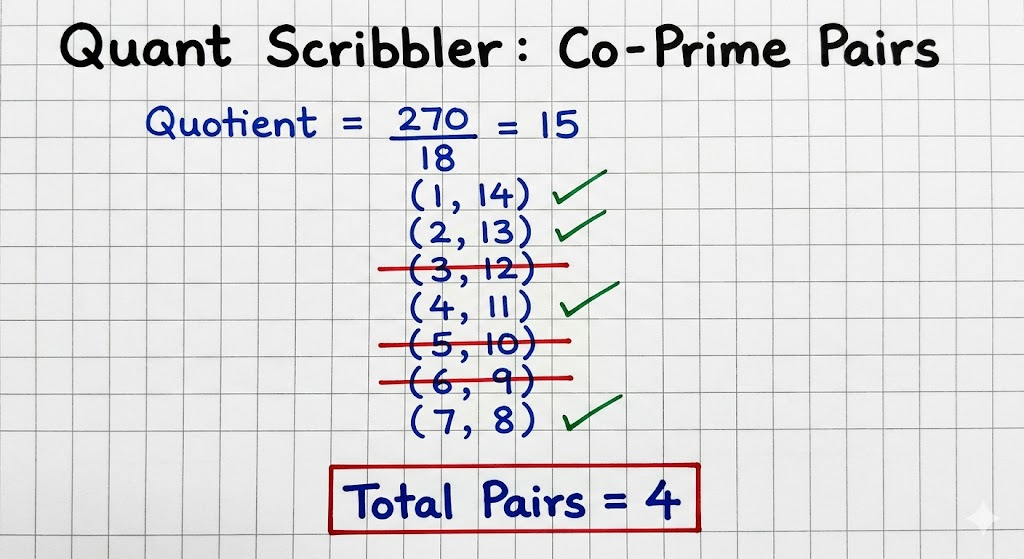
The sum of two numbers is 270 and their HCF is 18. How many pairs of such numbers can be formed?

  • A.

    2

  • B.

    4

    ✓ Correct
  • C.

    5

  • D.

    3

Answer & Solution

Correct option is B

Given
Sum of the two numbers = 270
HCF of the two numbers = 18
Formula Used
Numbers can be represented as HCF × a and HCF × b, where a and b are coprime integers.
Solution
Let the two unknown numbers be 18a and 18b.
According to the given sum:
18a + 18b = 270
18(a + b) = 270
a+b=27018=15a + b= \frac{270}{18} = 15​​
Identify pairs of positive coprime numbers (a, b) that sum to 15:
Pair 1: (1, 14)
Pair 2: (2, 13)
Pair 3: (4, 11) (Note: 3 and 12 are rejected as they share a common factor of 3)
Pair 4: (7, 8) (Note: 5 and 10 share 5; 6 and 9 share 3, so they are rejected)
Total number of valid coprime pairs formed = 4
Final Answer
So the correct answer is (b) 
Exam Hall Method: 


Q15.

In a city, three consecutive traffic lights change after 32, 48 and 76 seconds respectively. If the lights are first switched on at 7.00 AM sharp, then the time they will change simultaneously is:

  • A.

    7:30:04 AM

  • B.

    7:30:24 AM

    ✓ Correct
  • C.

    7:30:34 AM

  • D.

    7:30:44 AM

Answer & Solution

Correct option is B

Given
Light 1 changes after = 32 seconds
Light 2 changes after = 48 seconds
Light 3 changes after = 76 seconds
Starting time = 7:00 AM
Formula Used
Time of simultaneous change = LCM(T1, T2, T3)
Solution
Find the LCM of 32, 48, and 76 using prime factorization:
32 = 252^5​​
48 = 24×3 2^4 × 3​​
76 = 22×192^2 × 19​​
LCM = 25×3×19=32×57=18242^5 × 3 × 19 = 32 × 57 = 1824​ seconds
Convert the total seconds into minutes and seconds:
1824÷601824 \div 60​ = 30 minutes and 24 seconds
Add this duration to the given starting time:
7:00:00 AM + 30 minutes 24 seconds = 7:30:24 AM
Final Answer
So the correct answer is (b)

SSC CGL Number System Questions