SSC CGL Geometry Questions with Detailed Solutions
Get SSC CGL Geometry Questions to prepare for your upcoming exam. Solve the most expected questions and detailed solutions that can be asked in the exam.
Important SSC CGL Geometry Questions
Q1.
In a trapezoid ABCD with AB parallel to CD, the diagonals AC and BD intersect at E. What is the ratio of the area of △ABE to the area of △CDE?
A.
The ratio of AB to CD squared.
✓ Correct
B.
The ratio of AB to CD.
C.
The ratio of the perimeter of △ABE to the perimeter of △CDE.
D.
The ratio of the area of △ABC to the area of △BCD.
Answer & Solution
Correct option is A
Given :
In trapezoid ABCD, AB||CD. Diagonals AC and BD intersect at E.
Formula Used :
Triangles formed between parallel sides and intersecting diagonals are similar.
For similar triangles: Area2Area1=(Corresponding side2Corresponding side1)2
Solution :
Since AB∥CD, triangles △ABE and △CDE are similar.
Corresponding bases are AB and CD.
Therefore, Area of △CDEArea of △ABE
=(CDAB)2
Q2.
The centres of two circles are 36 cm apart. If the radii of these two circles are 15 cm and 9 cm, respectively, then what is the sum of the lengths (in cm) of a direct common tangent and a transverse common tangent of these two circles?
A.
65(7+2)
✓ Correct
B.
67(5+2)
C.
65(5+2)
D.
67(7+2)
Answer & Solution
Correct option is A
Given:
Distance between the centers of the two circles = 36 cm
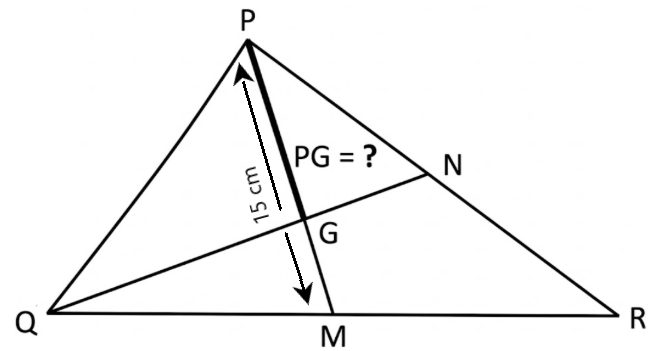
In triangle PQR, medians PM and QN intersect at G. If the length of median PM is 15 cm, what is the length of the segment PG?
A.
4 cm
B.
5 cm
C.
7.5 cm
D.
10 cm
✓ Correct
Answer & Solution
Correct option is D
Given:Median PM length=15G is Centroid.Concept Used:Centroid divides median in 2:1 ratio (Vertex to Base).Solution:
PG=32×PMPG=32×15PG=10 cmFinal Answer10 cm
Q4.
A line cuts two concentric circles. The length of chords formed by this line on the circles is 6 cm and 18 cm. Find thedifference in the squares of the radii of two circles.
A.
90
B.
120
C.
60
D.
72
✓ Correct
Answer & Solution
Correct option is D
Given:
Length of the chord on the smaller circle = 6 cm
Length of the chord on the larger circle = 18 cm
Concept Used:
For a chord of a circle, the distance from the center to the chord (perpendicular distance) and the radius of the circle are related by the Pythagorean theorem:
R2−d2=(2l)2
where:
R is the radius of the circle
d is the perpendicular distance from the center to the chord
l is the length of the chord
Solution:
For the smaller circle:
r12−d2=(26)2=9
For the larger circle:
r22−d2=(218)2=81
Subtract the equation for the smaller circle from the equation for the larger circle:
r22−d2−(r12−d2)=81−9
r22−r12=72
The difference in the squares of the radii of the two circles is 72.
Q5.
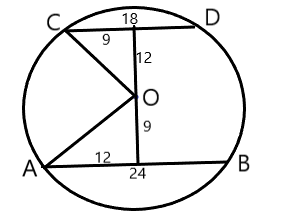
AB and CD are two parallel chords drawn in a circle with centre O. The distance between the two chords is 21 cm. If the lengths of AB and CD are 24 cm and 18 cm, respectively, then the radius of the circle is equal to:
A.
15 cm
✓ Correct
B.
20 cm
C.
18 cm
D.
24 cm
Answer & Solution
Correct option is A
Given:
Two parallel chords ( AB) and ( CD) in a circle with center ( O)
Distance between the chords = 21 cm.
Length of ( AB) = 24 cm.
Length of ( CD) = 18 cm.
Solution:
d1=r2−(2AB)2=r2−122=r2−144
d2=r2−(2CD)2=r2−92=r2−81
d1−d2=21
d1+d2=21
r2−144+r2−81=21
a + b = 21
( a2−b2=(r2−144)−(r2−81)=−63)
(a - b)(a + b) = -63 ⟹(a−b)×21=−63⟹ a - b = -3
2a = 18 ⟹ a = 9
9 + b = 21 ⟹ b = 12
a = r2−144=9⟹r2−144=81⟹r2=225⟹ r = 15 cm
Alternate Method:
Radius = CO
CO = (2CD)2+(2AB)2
CO = (218)2+(224)2
CO = (9)2+(12)2
CO = 81+144
CO = 225
CO = 15
Q6.
A regular hexagon is inscribed inside a circle of radius 10 cm. Find the area of the hexagon.
A.
210.50 cm²
B.
314.16 cm²
C.
173.20 cm²
D.
259.81 cm²
✓ Correct
Answer & Solution
Correct option is D
Given: Radius of the circumscribed circle (r) = 10 cm. Formula Used: For a regular hexagon inscribed in a circle, the side length of the hexagon (a) is equal to the radius of the circle (r). Area of a regular hexagon = 233×a2 3≈1.732 Solution: Side length of the hexagon a = 10 cm. Substitute a into the area formula: Area=233×102Area=233×100Area=1503Area≈150×1.73205Area≈259.8075 Rounding to two decimal places, we get 259.81 cm2 So the correct answer is (d).
Q7.
In a circle, chord PQ and chord RS intersect at T such that PT : TQ = 3 : 4 and RT : TS = 6 : 5. If PQ = p and RS = q, which of the following is true?
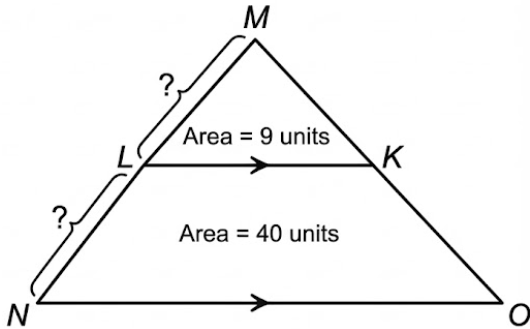
In ∆MNO, line segment LK is parallel to NO. If the ratio of area of ∆MLK to trapezoid LKNO is 9 : 40, what is the ratio of ML to LN?
A.
3 : 4
✓ Correct
B.
3 : 7
C.
4 : 5
D.
4 : 9
Answer & Solution
Correct option is A
Given:△MNOLK∥NOArea of △MLK:Area of trapezoid LKNO=9:40Concept Used:Ratio of areas of similar triangles equals square of ratio of sidesFormula Used:Area of whole triangleArea of smaller triangle=(Whole sideCorresponding side)2Solution:
Let area of △MLK=9xArea of trapezoid LKNO=40xArea of △MNO=49xArea of △MNOArea of △MLK=499(MNML)2=499MNML=73LN=MN−MLML:LN=3:4Final Answer:3:4
Q9.
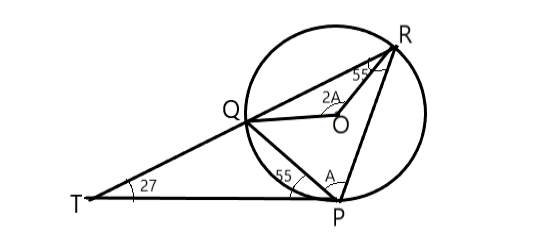
From a point T, a tangent TP at point P, is drawn to a circle with centre O. A secant TQR (point Q is near to point T) is drawn from the point T. ∆PQR is inscribed into the circle by joining the points P, Q and R. Draw lines OQ and OR. If ∠PTQ is 27° and∠ TPQ = 55°, what is the degree measure of ∠ROQ?
A.
86
✓ Correct
B.
82
C.
98
D.
94
Answer & Solution
Correct option is A
Given:
( TP) is a tangent to the circle at point ( P)
( TQR ) is a secant intersecting the circle at points ( Q) and ( R)
(∠PTQ=27∘) and (∠TPQ=55∘)
Concept Used:
Alternate Segment Theorem:
This theorem states that the angle between a tangent and a chord through the point of contact is equal to the angle in the alternate segment
Exterior Angle Theorem (Triangle):
The exterior angle of a triangle is equal to the sum of the two opposite interior angles.
Tangent-Secant Theorem (Power of a Point):
For a point outside the circle with a secant and a tangent:
Solution:
∠PRQ=∠TPQ (Angle between a tangent and a chord through the point of contact is equal to the angle in the alternate segment)
On a circle of radius 7 units, PQ and QR are chords of length 7 units each. What is the length of the chord PR in units?
A.
328
B.
37
C.
314
D.
321
✓ Correct
Answer & Solution
Correct option is D
Given:
Radius of the circle = 7 units
Chords PQ = QR = 7 units
Concept Used:
A Quadrilateral is rhombus if it has four equal side
Formula Used:
For a Rhombus ;
D12+D22=4a2
where, D1,D2 are diagonals, a is side
Solution:
PQ = QR = 7 unit
OP = OR = OQ = 7 unit
Four sides are equal , PQRO is a rhombus
OQ and PR is diagonal
So, OQ2 + PR2 = 4 side2
72 + PR2 = 4× 72
PR2 = 4× 72 - 72
PR2 = 72 ( 4 - 1)
PR2 = 72 × 3
PR = 73 = 321 unit
Q11.
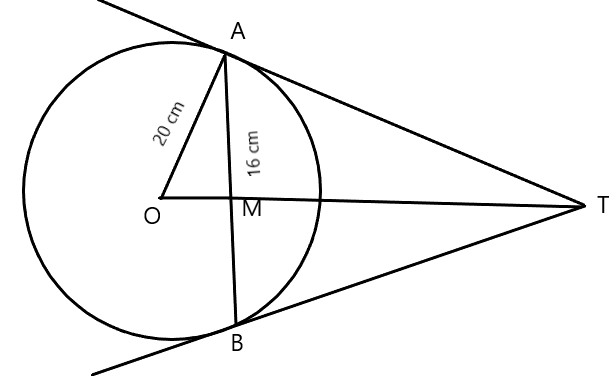
AB is a chord of length 32 cm of a circle of radius 20 cm, the tangents at A and B intersect at a point T. Find length TA(rounded off to two digits after decimal).
A.
36.50 cm
B.
21.33 cm
C.
26.67 cm
✓ Correct
D.
19.93 cm
Answer & Solution
Correct option is C
Given: Radius of the circle r = 20 cm Length of chord AB = 32 cm Concept Used:
The tangent at any point of a circle is perpendicular to the radius through the point of contact.
The line joining the center of the circle to the point of intersection of the tangents bisects the chord.
Pythagorean theorem.
Solution:
Let O be the center of the circle. Let M be the midpoint of chord AB. OM is perpendicular to AB.
AM = MB = 2AB=232=16 cm.
In right triangle OMA, using the Pythagorean theorem:
OM² + AM² = OA²
OM² + 16² = 20²
OM² = 400 - 256 = 14
OM = 12 cm
Triangles OMA and OTA are similar. Therefore:
TAAM=OAOM
TA16=2012
TA = 16×1220
TA = 380= 26.666... cm ≈26.67 cm
Q12.
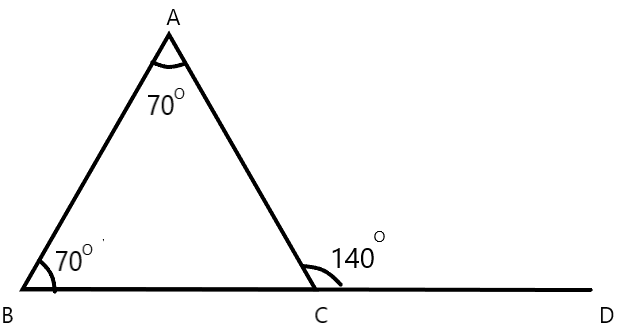
The side BC of ∆ABC is produced to a point D. If AC = BC and ∠BAC = 70°, then find the value of 2.5∠ACD − 1.5∠ABC.
A.
245°
✓ Correct
B.
235°
C.
225°
D.
230°
Answer & Solution
Correct option is A
Given:
Triangle ABC with side BC produced to point D.
AC = BC.
∠BAC = 70°.
Concept Used:
Properties of isosceles triangles: If two sides of a triangle are equal, the angles opposite those sides are also equal.
Angle sum property of a triangle: The sum of the angles in a triangle is 180°.
Linear pair: Angles on a straight line add up to 180°.
Solution:
Triangle ABC is isosceles:
Since AC = BC, ∆ABC is an isosceles triangle.
Therefore, ∠ABC = ∠BAC = 70°.
Using the angle sum property of a triangle:
∠BAC + ∠ABC + ∠ACB = 180°
70° + 70° + ∠ACB = 180°
∠ACB = 180° - 140° = 40°.
∠ACB and ∠ACD form a linear pair.
∠ACB + ∠ACD = 180°
40° + ∠ACD = 180°
∠ACD = 180° - 40° = 140°.
2.5∠ACD - 1.5∠ABC = (2.5 × 140°) - (1.5 × 70°)
= 350 - 105
= 245°.
The value of 2.5∠ACD - 1.5∠ABC is 245°.
Q13.
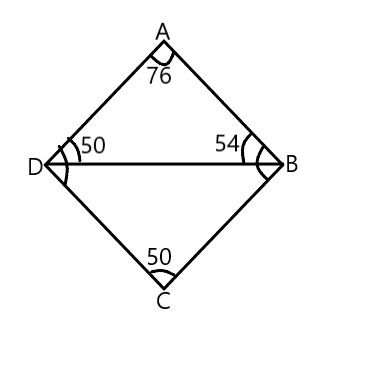
In a kite ABCD, longer diagonal BD is drawn. If ∠ABD = 54°and ∠ADB = 50°, then what is the measure (in degrees) of the ∠DCB?
A.
108
B.
76
✓ Correct
C.
100
D.
54
Answer & Solution
Correct option is B
Given:
Kite ABCD, where BD is the longer diagonal.
∠ABD = 54°
∠ADB = 50°
Solution:
Diagonals of a kite are perpendicular bisectors → BD ⊥ AC.
∠ABC=∠ADC That's Why ∠BDC=54 , ∠DBC=50
∠ADC+∠ABC=2(50)+2(54) = 100 + 108 = 208
In △ABD, sum of interior angles is 180°:
∠ABD + ∠ADB + ∠BAD = 180°
50 + 54 + ∠BAD = 180
∠BAD = 180 - 104 = 76
ABCD = 360∘
∠A+∠B+∠C+∠D=360
76 + 108 + ∠C + 100 = 360
∠C = 360 - 284
76∘
Q14.
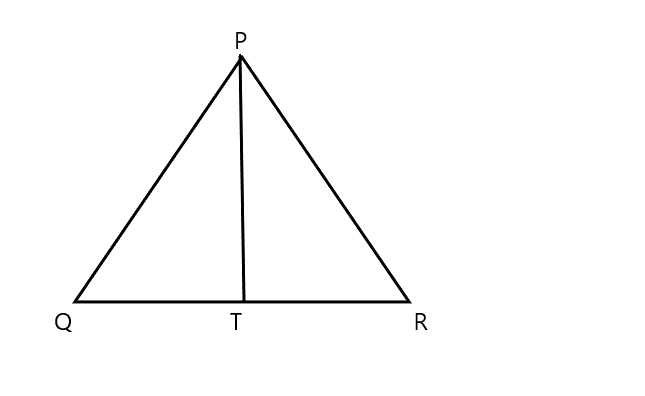
In ΔPQR, if PT is the median, then which of the following is correct?
A.
PQ2+PR2=PT2+QR2
B.
PQ2+PR2=2(PT2+QT2)
✓ Correct
C.
PQ2+PR2=2(PT2−QT2)
D.
PQ2+PR2=PT2+QT2
Answer & Solution
Correct option is B
Given:
In ΔPQR, PT is the median, meaning T is the midpoint of QR.
Concept Used:
The Apollonius Theorem states that in any triangle, if a median is drawn, then:
PQ2+PR2=2(PT2+QT2)
Thus, the correct Option (b)
Proof of Apollonius' Theorem:
Coordinate System Approach
Let the coordinates of the points be:
P(0, h)
Q(-a, 0)
R(a, 0)
Since T is the midpoint of QR, its coordinates are: T(0, 0)
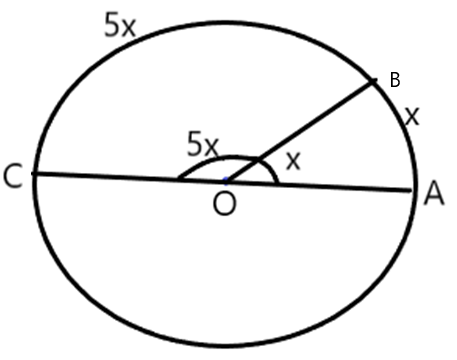
In a circle with centre O, AOC is the diameter. B is a point on the circumference of the circle such that arc AB is 51 of the arc BC. What is the degree measure of ∠BOC ?
A.
120°
B.
150°
✓ Correct
C.
80°
D.
30°
Answer & Solution
Correct option is B
Given:
AOC is the diameter of the circle, meaning ∠AOC = 180∘
B is a point on the circumference such that arc AB is 51 of arc BC
Concept Used:
The central angle subtended by an arc is equal to the degree measure of the arc.
.png)