SSC CGL Trigonometry Questions with Detailed Solutions

Get SSC CGL Trigonometry Questions to prepare for your upcoming exam. Solve the most expected questions and detailed solutions that can be asked in the exam.

Important SSC CGL Trigonometry Questions

Q1.

If sinA+cosA=32\sin A + \cos A = \frac{\sqrt{3}}{2}​ find sin2A+cos2A+2sinAcosA\sin^{2}A + \cos^{2}A + 2 \sin A \cos A​​

  • A.

    1

  • B.

    3\sqrt{3}​​

  • C.

    3/4

    ✓ Correct
  • D.

    1/2

Answer & Solution

Correct option is C

Given:
sinA+cosA=32\sin A + \cos A = \frac{\sqrt{3}}{2}​​
Formula Used:
(a+b)2=a2+b2+2ab(a + b)^2 = a^2 + b^2 + 2ab​​
Solution:
The expression we need to find is sin2A+cos2A+2sinAcosA\sin^2 A + \cos^2 A + 2 \sin A \cos A​​
By algebraic identity, this expression is exactly equal to (sinA+cosA)2(\sin A + \cos A)^2​​
Substitute the given value of (sinA+cosA) (\sin A + \cos A)​ into the expression:
(32)2=34(\frac{\sqrt{3}}{2})^2 = \frac{3}{4}​​
Final Answer
So the correct answer is (c)

Q2.

If cotA=3\cot A = 3​ and A is acute, then find sinA\sin A​​

  • A.

    1010\frac{\sqrt{10}}{10}​​

    ✓ Correct
  • B.

    105\frac{\sqrt{10}}{5}​​

  • C.

    109\frac{\sqrt{10}}{9}​​

  • D.

    910\frac{\sqrt{9}}{10}​​

Answer & Solution

Correct option is A

Given:
cotA=3\cot A = 3​​
Angle A is an acute angle.
Formula Used:
cotA=BasePerpendicular\cot A = \frac{\text{Base}}{\text{Perpendicular}}​​
sinA=PerpendicularHypotenuse\sin A = \frac{\text{Perpendicular}}{\text{Hypotenuse}}​​
Hypotenuse2=Base2+Perpendicular2\text{Hypotenuse}^2 = \text{Base}^2 + \text{Perpendicular}^2​​
Solution:
We can write cotA=31\cot A = \frac{3}{1}​. Thus, Base = 3 and Perpendicular = 1.
Using Pythagoras theorem:
Hypotenuse=32+12=9+1=10\text{Hypotenuse} = \sqrt{3^2 + 1^2} = \sqrt{9 + 1} = \sqrt{10}​​
sinA=PerpendicularHypotenuse=110\sin A = \frac{\text{Perpendicular}}{\text{Hypotenuse}} = \frac{1}{\sqrt{10}}​​
Rationalizing the denominator:
sinA=110×1010=1010\sin A = \frac{1}{\sqrt{10}} \times \frac{\sqrt{10}}{\sqrt{10}} = \frac{\sqrt{10}}{10}​​
Final Answer
So the correct answer is (a)

Q3.

If 1 + cot²θ = cosec²θ, then what is the value of cosec²60° - cot²60°?

  • A.

    1

    ✓ Correct
  • B.

    2

  • C.

    3

  • D.

    4

Answer & Solution

Correct option is A

Given:
Trigonometric identity: 1 + \cot^2\theta = \csc^2\theta
Formula Used:
cosec2θcot2θ=1\cosec^2\theta - \cot^2\theta = 1​​
Solution:
Rearranging the given identity gives cosec2θcot2θ \cosec^2\theta - \cot^2\theta​ = 1.

This identity holds true for all values of θ \theta where the functions are defined.
Therefore, for θ \theta​ = 60°

cosec2(60°)cot2(60°)\cosec^2(60°) - \cot^2(60°)=  1.
So the correct answer is (a).

Q4.

What is 3π/4 radians in degrees?

  • A.

    45°

  • B.

    60°

  • C.

    90°

  • D.

    135°

    ✓ Correct

Answer & Solution

Correct option is D

Given:
Angle in radians = 3π4 \frac{3\pi}{4}​​
Formula Used:
Degrees=Radians×180π\text{Degrees} = \text{Radians} \times \frac{180^\circ}{\pi}​​
Solution:
Angle in degrees = 3π4×180π\frac{3\pi}{4} \times \frac{180^\circ}{\pi}​​
=3×1804= \frac{3 \times 180^\circ}{4}​​
=3×45= 3 \times 45^\circ​​
=135= 135^\circ​​
Final Answer
So the correct answer is (d)

Q5.

If sin x = cos(2x – 10°), find the value of x.

  • A.

    25.52°

  • B.

    33.33°

    ✓ Correct
  • C.

    40°

  • D.

    50°

Answer & Solution

Correct option is B

Given:
sinx=cos(2x10)\sin x = \cos(2x - 10^\circ)​​
Formula Used:
If sinA=cosB,thenA+B=90\sin A = \cos B, then A + B = 90^\circ ​ (for acute angles).
Solution:
Apply the complementary angle property:
x+(2x10)=90 3x10=90 3x=100 x=1003=33.33x + (2x - 10^\circ) = 90^\circ\\ \ \\3x - 10^\circ = 90^\circ\\ \ \\3x = 100^\circ\\ \ \\x = \frac{100^\circ}{3} = 33.33^\circ​​
So the correct answer is (b).

Q6.

If A + B = 90° and tan A = 2, determine the value of tan A × tan B.

  • A.

    2

  • B.

    1

    ✓ Correct
  • C.

    4

  • D.

    1/2

Answer & Solution

Correct option is B

Given:
A + B = 9090^\circ​​
tanA=2\tan A = 2​​
Formula Used:
tan(90θ)=cotθ\tan(90^\circ - \theta) = \cot \theta​​
tanθ×cotθ=1\tan \theta \times \cot \theta = 1​​
Solution:
Since A + B = 9090^\circ​, we have B = 90A.90^\circ - A.​​
Therefore, tanB=tan(90A)=cotA.\tan B = \tan(90^\circ - A) = \cot A.​​
Expression is tanA×tanB.\tan A \times \tan B.​​
Substituting the value, we get tanA×cotA=1 \tan A \times \cot A = 1​​
Final Answer
So the correct answer is (b)

Q7.

If sinx+cosx=1.5\sin x + \cos x = \sqrt{1.5}​, what is the value of sinxcosx\sin x - \cos x​?

  • A.

    1/21/\sqrt{2}​​

    ✓ Correct
  • B.

    1

  • C.

    1/2

  • D.

    2\sqrt{2}​​

Answer & Solution

Correct option is A

Given:
sinx+cosx=1.5\sin x + \cos x = \sqrt{1.5}​​

Formula Used
(sinx+cosx)2+(sinxcosx)2=2(sin2x+cos2x)=2(\sin x + \cos x)^2 + (\sin x - \cos x)^2 = 2(\sin^2 x + \cos^2 x) = 2​​

Solution:
Let the required expression sinxcosx=y\sin x - \cos x = y​​
Square both the given and the target equations:
(sinx+cosx)2=1.5 (sinxcosx)2=y2 (sin2x+cos2x+2sinxcosx)+(sin2x+cos2x2sinxcosx)=1.5+y2(\sin x + \cos x)^2 = 1.5\\ \ \\(\sin x - \cos x)^2 = y^2\\ \ \\(\sin^2 x + \cos^2 x + 2\sin x\cos x) + (\sin^2 x + \cos^2 x - 2\sin x\cos x) = 1.5 + y^2​​
Simplify using the trigonometric identity sin2x+cos2x=1\sin^2 x + \cos^2 x = 1​:
1 + 1 = 1.5 + y2y^2​​
2 = 1.5 + y2y^2​​
y2y^2 ​= 2 - 1.5 = 0.5
y=0.5=12=12y = \sqrt{0.5} = \sqrt{\frac{1}{2}} = \frac{1}{\sqrt{2}}​​
So the correct answer is (a)

Q8.

If tanA=13\tan A = \frac{1}{\sqrt{3}}​, what is the value of  (1sinA)(1+cosA)(1 - \sin A)(1 + \cos A)​?

  • A.

    (2+3)/4(2 + \sqrt{3})/4​​

    ✓ Correct
  • B.

    (23)/4(2 - \sqrt{3})/4​​

  • C.

    (4+3)/4(4 + \sqrt{3})/4​​

  • D.

    (1+3)/4(1 + \sqrt{3})/4​​

Answer & Solution

Correct option is A

Given:
tanA=13\tan A = \frac{1}{\sqrt{3}}​​
Formula Used:
tan30=13 sin30=12 cos30=32\tan 30^\circ = \frac{1}{\sqrt{3}}\\ \ \\\sin 30^\circ = \frac{1}{2}\\ \ \\\cos 30^\circ = \frac{\sqrt{3}}{2}​​
Solution: 
Identify the angle A from the given tangent value:
A = 30^\circ​​
=(1sin30)(1+cos30) =(112)(1+32) =(12)(2+32) =2+34=(1 - \sin 30^\circ)(1 + \cos 30^\circ)\\ \ \\=(1 - \frac{1}{2})(1 + \frac{\sqrt{3}}{2})\\ \ \\=(\frac{1}{2})(\frac{2 + \sqrt{3}}{2})\\ \ \\=\frac{2 + \sqrt{3}}{4}​​
So the correct answer is (a)

Q9.

What is the value of sin75cos15+cos75sin15\sin 75^\circ \cos 15^\circ + \cos 75^\circ \sin 15^\circ​ = ?

  • A.

    1/2

  • B.

    3/2\sqrt{3}/2​​

  • C.

    0

  • D.

    1

    ✓ Correct

Answer & Solution

Correct option is D

Given:
sin75cos15+cos75sin15\sin 75^\circ \cos 15^\circ + \cos 75^\circ \sin 15^\circ​​
Formula Used:
sin(A+B)=sinAcosB+cosAsinB\sin(A + B) = \sin A \cos B + \cos A \sin B​​
Solution:
sin(75+15)\sin(75^\circ + 15^\circ)​​
sin90 \sin 90^\circ
= 1
So the correct answer is (d).
Q10.

If sinα=45\sin \alpha = \frac{4}{5}​ and α(0,π/2)\alpha \in (0, \pi/2)​, then find 1cotα1+cotα\frac{1-\cot \alpha}{1+\cot \alpha}= ?​

  • A.

    3/7

  • B.

    1/4

  • C.

    -1/7

  • D.

    1/7

    ✓ Correct

Answer & Solution

Correct option is D

Given:
sinα=4/5\sin \alpha = 4/5​​
Formula Used:
cotα=BasePerp\cot \alpha = \frac {Base} {Perp}​​

Solution:
P = 4, H = 5 =>\Rightarrow ​B = 3.
cotα=34\cot \alpha = \frac{3}{4}​ 
13/41+3/4\frac{1 - 3/4}{1 + 3/4}​ 

=1/47/4 \frac{1/4}{7/4}​​

= 1/7
So the correct answer is (d)

Q11.

tanθ+cotθ\tan \theta + \cot \theta​ = 2 and θ(0,π/2)\theta \in (0, \pi/2),that what is secθ+cosecθ\sec \theta + \cosec \theta =  ?

  • A.

    222\sqrt{2}​​

    ✓ Correct
  • B.

    2\sqrt{2}​​

  • C.

    2

  • D.

    424\sqrt{2}​​

Answer & Solution

Correct option is A

Given
tanθ+cotθ=2\tan \theta + \cot \theta = 2​​
Solution:
If tanθ+1tanθ=2\tan \theta + \frac{1}{\tan \theta} = 2​,

then tanθ=1\tan \theta = 1​​
Thus, θ=45 \theta = 45^\circ​​
sec45+cosec45=2+2=22\sec 45^\circ + \cosec 45^\circ = \sqrt{2} + \sqrt{2} = 2\sqrt{2}​​
answer (a)

Q12.

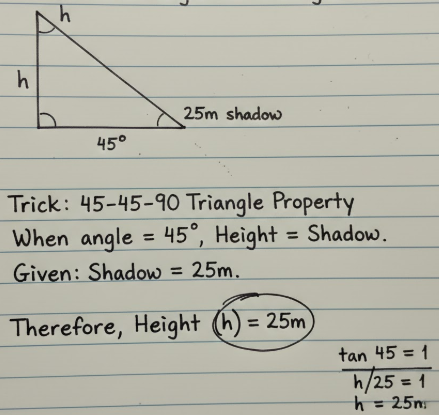
A building generates a shadow that is 25 meters long when the sun’s angle of elevation is 45 degrees. What is the height of the building?

  • A.

    20 m

  • B.

    25 m

    ✓ Correct
  • C.

    30 m

  • D.

    50 m

Answer & Solution

Correct option is B

Given
Shadow length (Base) = 25 m
Angle of elevation (θ)=45°(\theta) = 45°​​

Formula Used
tanθ=Perpendicular (Height)Base (Shadow)\tan \theta = \frac{\text{Perpendicular (Height)}}{\text{Base (Shadow)}}​​
Solution:
Let the height of the building be H.
According to the formula:
tan45=H25 \tan 45^\circ = \frac{H}{25}\\ \ \\       
Since,
tan45=1,​​\tan 45^\circ = 1,​​​​
we have:
1=H251 = \frac{H}{25}​​
H = 25 m
The height of the building is 25 meters.
Final Answer
So the correct answer is (b)
Q13.

If cos⁡A = 4/5 and sin⁡B = 5/13 , A and B∈(0,π/2) , find cos(A - B).

  • A.

    3365\frac{33}{65}​​

  • B.

    4865\frac{48}{65}​​

  • C.

    5665\frac{56}{65}​​

  • D.

    6365\frac{63}{65}​​

    ✓ Correct

Answer & Solution

Correct option is D

Given:
cosA = 4/5
sinB = 5/13
A, B ∈ (0, π/2)
Find cos(A − B)
Concept Used:
Trigonometric identity of cosine difference and Pythagoras identity.
Formula Used:
cos(A − B) = cosA cosB + sinA sinB
sin²θ + cos²θ = 1
Solution:
cosA=45 sinA=1cos2A =11625 =925 =35 sinB=513 cosB=1sin2B =125169 =144169 =1213 cos(AB)=cosAcosB+sinAsinB =(45×1213)+(35×513) =4865+1565=6365\cos A = \frac{4}{5}\\ \ \\\sin A = \sqrt{1 - \cos^2 A}\\ \ \\= \sqrt{1 - \frac{16}{25}}\\ \ \\ = \sqrt{\frac{9}{25}}\\ \ \\= \frac{3}{5}\\ \ \\\sin B = \frac{5}{13}\\ \ \\\cos B = \sqrt{1 - \sin^2 B}\\ \ \\= \sqrt{1 - \frac{25}{169}}\\ \ \\= \sqrt{\frac{144}{169}}\\ \ \\= \frac{12}{13}\\ \ \\\cos(A - B) = \cos A \cos B + \sin A \sin B\\ \ \\= \left(\frac{4}{5} \times \frac{12}{13}\right) + \left(\frac{3}{5} \times \frac{5}{13}\right)\\ \ \\= \frac{48}{65} + \frac{15}{65}= \frac{63}{65}

​​

Q14.

If cos2xsin2x=13\cos^2 x - \sin^2 x = \frac{1}{3}​, find the value of sin2x\sin^2 x​​

  • A.

    13\frac{1}{3}​​

    ✓ Correct
  • B.

    23\frac{2}{3}​​

  • C.

    25\frac{2}{5}​​

  • D.

    12\frac{1}{2}​​

Answer & Solution

Correct option is A

Given:
cos2xsin2x=1/3\cos^2 x - \sin^2 x = 1/3​​
Formula Used:
cos2x=1sin2x\cos^2 x = 1 - \sin^2 x​​
Solution:
(1sin2x)sin2x=1/3(1 - \sin^2 x) - \sin^2 x = 1/3​​
12sin2x=1/31 - 2\sin^2 x = 1/3​​
2sin2x=11/3=2/32\sin^2 x = 1 - 1/3 = 2/3​​
sin2x=1/3\sin^2 x = 1/3​​
Final Answer
So the correct answer is (a)

Q15.

If tanθ=p1p\tan \theta = p - \frac{1}{p}​, find sec2θ\sec^2 \theta​​

  • A.

    p2+1p2+1p^2 + \frac{1}{p^2} + 1​​

  • B.

    p2+1p21p^2 + \frac{1}{p^2} - 1​​

    ✓ Correct
  • C.

    p21p2+1p^2 - \frac{1}{p^2} + 1​​

  • D.

    p2+1p2+2p^2 + \frac{1}{p^2} + 2​​

Answer & Solution

Correct option is B

Given:
tanθ=p1/p.\tan \theta = p - 1/p.​​
Formula Used:
sec2θ=1+tan2θ\sec^2 \theta = 1 + \tan^2 \theta​​
Solution:
tan2θ=(p1/p)2=p2+1/p22\tan^2 \theta = (p - 1/p)^2 = p^2 + 1/p^2 - 2​​
sec2θ=1+(p2+1/p22)\sec^2 \theta = 1 + (p^2 + 1/p^2 - 2)​​
=p2+1/p21= p^2 + 1/p^2 - 1​​
Final Answer
So the correct answer is (b)