SSC CGL Reasoning Questions with Detailed Solutions

Get SSC CGL Reasoning Questions to prepare for your upcoming exam. Solve the most expected questions and detailed solutions that can be asked in the exam.

Important SSC CGL Reasoning Questions

Q1.

AE 31 is related to CF 131 in a certain way. In the same way, FJ 73 is related to HK 173. To which of the given options is TX 58 related, following the same logic?

  • A.

    VZ 158

  • B.

    UZ 148

  • C.

    UY 168

  • D.

    VY 158

    ✓ Correct

Answer & Solution

Correct option is D

1. Information Given:
AE → CF
FJ → HK
Number pattern: +100

2. Formula Used:

First letter → +2
Second letter → +1
Number → +100

3. Explanation:

Check pattern:
AE → CF
A + 2 = C
E + 1 = F
31 + 100 = 131

FJ → HK
F + 2 = H
J + 1 = K
73 + 100 = 173

Now apply to TX 58:

Letters:
T + 2 = V
X + 1 = Y

Number:
58 + 100 = 158
So, result = VY 158

Final Answer:
VY 158

✔ Correct Option:

Q2.

Four words have been given out of which three are alike in some manner, while the fourth one is different. Choose out the odd one.

  • A.

    Kidney

  • B.

    Liver

  • C.

    Lungs

  • D.

    Toe

    ✓ Correct

Answer & Solution

Correct option is D

Let’s group them by type:
Kidney → internal organ
Liver → internal organ
Lungs → internal organ
Toe → external body part (not an internal organ)
So, Toe is odd one out.
Thus, correct option is (d).
Q3.

10 is related to 25 following a certain logic. Following the same logic, 2 is related to 1. To which of the given options is 12 related, following the same logic?
(NOTE: Operations should be performed on the whole numbers, without breaking down the numbers into their constituent digits. E.g. 13 – Operations on 13 such as adding/subtracting/multiplying to 13 can be performed. Breaking down 13 into 1 and 3 and then performing mathematical operations on 1 and 3 is not allowed.)

  • A.

    27

  • B.

    35

  • C.

    31

    ✓ Correct
  • D.

    23

Answer & Solution

Correct option is C

Given:
10 → 25
2 → 1
12 → ?
Logic: Right number = (Left number × 3) − 5
For 10:
10 × 3 − 5 = 30 − 5 = 25 
For 2:
2 × 3 − 5 = 6 − 5 = 1 
For 12:
12 × 3 − 5 = 36 − 5 = 31 
So, 12 is related to 31.
Thus, the correct option is (C) 31

Q4.
Read the given statements and conclusions carefully. Assuming that the information given in the statements is true, even if it appears to be at variance with commonly known facts, decide which of the given conclusions logically follow(s) from the statements.
Statements:
1. All flowers are corianders.
2. All flowers are leaves.
3. All leaves are petals.
Conclusion:
I. All flowers are petals.
II. Some leaves are corianders. ​​
  • A.

    Both conclusions (I) and (II) follow.

    ✓ Correct
  • B.

    Neither conclusion (I) nor (II) follows.

  • C.

    Only conclusion (I) follows.

  • D.

    Only conclusion (II) follows.

Answer & Solution

Correct option is A

Statements:
1. All flowers are corianders.
2. All flowers are leaves.
3. All leaves are petals.
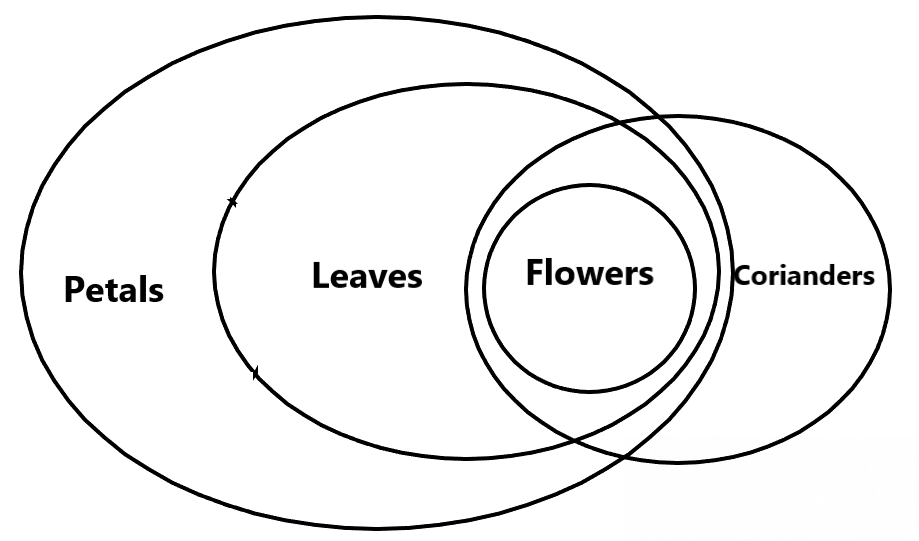
From the given statements possible Venn diagram will be.
Conclusion:
I. All flowers are petals. (True, all flowers are leaves and all leaves are petals, so that means all flowers are petals).
II. Some leaves are corianders. (True, all flowers are corianders and all flowers are leaves, so that means some leaves are corianders).
So, ​Both conclusions (I) and (II) follow.
Thus, correct option is (a).​​
Q5.

What will come in place of the question mark (?) in the given equation, if ‘+’ and ‘−‘ are interchanged and '×’ and ‘÷’ are interchanged?
15 ÷ 21 − 22 + 36 × 4 = ?

  • A.

    329

  • B.

    327

  • C.

    328

    ✓ Correct
  • D.

    330

Answer & Solution

Correct option is C

Given: 15 ÷ 21 − 22 + 36 × 4 = ?
Given Sign
+
×
Interchanged Sign
-
÷
Using BODMAS rule.
Operation preference wiseSymbolBrackets[],,()Orders, of(power),(root),ofDivision÷Multiplication×Addition+Subtraction\begin{array}{|c|c|} \hline\textbf{Operation preference wise} & \textbf{Symbol} \\\hline\text{Brackets} &[],{}, () \\ \hline \text{Orders, of} & (power), √ (root) , of \\ \hline \text{Division}& ÷ \\ \hline \text{Multiplication} & × \\ \hline \text{Addition} & + \\ \hline \text{Subtraction} & - \\\hline\end{array}
New equation: 15 × 21 + 22 - 36 ÷ 4 = ?​​
15 × 21 + 22 - 9 = ?
315 + 22 - 9 = ?
337 - 9 = ?
? = 328
Thus, correct option is (c).
Q6.

If ‘S’ stands for ‘−’ , ‘T’ stands for ‘×’, ‘U’ stands for ‘÷’ and ‘V’ stands for '+', then what will come in place of the question mark (?) in the following equation?
18 U 3 V 1 S 7 T 2 = ?

  • A.

    −8

  • B.

    −14

  • C.

    −17

  • D.

    −7

    ✓ Correct

Answer & Solution

Correct option is D

Given: 18 U 3 V 1 S 7 T 2 = ?
Given Letters
S
T
U
V
New Sign
-
×
÷
+
Using BODMAS rule.
Operation preference wiseSymbolBrackets[],,()Orders, of(power),(root),ofDivision÷Multiplication×Addition+Subtraction\begin{array}{|c|c|} \hline\textbf{Operation preference wise} & \textbf{Symbol} \\\hline\text{Brackets} &[],{}, () \\ \hline \text{Orders, of} & (power), √ (root) , of \\ \hline \text{Division}& ÷ \\ \hline \text{Multiplication} & × \\ \hline \text{Addition} & + \\ \hline \text{Subtraction} & - \\\hline\end{array}
New equation: 18 ÷ 3 + 1 - 7 × 2 = ?
6 + 1 - 7 × 2 = ?
6 + 1 - 14 = ?
7 - 14 = ?
? = - 7
Thus, correct option is (d).
Q7.

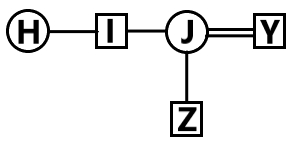
H is the sister of I. I is the brother of J. Y is the father of Z. Z is the son of J. How is Z related to H?

  • A.

    Sister's son

    ✓ Correct
  • B.

    Mother's father

  • C.

    Brother

  • D.

    Son

Answer & Solution

Correct option is A

Given
H is the sister of I.
I is the brother of J.
Y is the father of Z.
Z is the son of J.
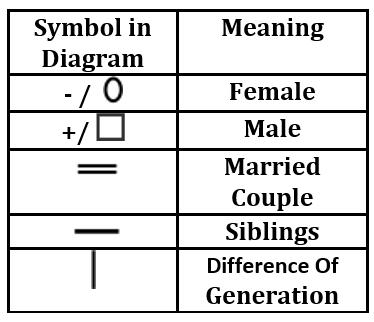
From the given information blood relation diagram will be.
So, Z is the Sister's son of H.
Thus, correct option is (a).
Q8.

Which of the following pairs of numbers and signs, when their positions are interchanged, will correctly solve the given mathematical equation?
16 ÷ 4 × 12 + 14 – 7 = 26

  • A.

    16 and 12, + and –

  • B.

    7 and 16, – and ×

  • C.

    14 and 7, × and ÷

  • D.

    12 and 7, + and –

    ✓ Correct

Answer & Solution

Correct option is D

Given: 16 ÷ 4 × 12 + 14 – 7 = 26
Using BODMAS rule.
Operation preference wiseSymbolBrackets[],,()Orders, of(power),(root),ofDivision÷Multiplication×Addition+Subtraction\begin{array}{|c|c|} \hline\textbf{Operation preference wise} & \textbf{Symbol} \\\hline\text{Brackets} &[],{}, () \\ \hline \text{Orders, of} & (power), √ (root) , of \\ \hline \text{Division}& ÷ \\ \hline \text{Multiplication} & × \\ \hline \text{Addition} & + \\ \hline \text{Subtraction} & - \\\hline\end{array}
Now, we check each options.
​Option (a): ​16 and 12, + and –
New equation: 12 ÷ 4 × 16 - 14 + 7 = 26
3 × 16 - 14 + 7 = 26
48 - 14 + 7 = 26
55 - 14 = 26
41 \ne 26​
​Option (b): ​7 and 16, – and ×
New equation: 7 ÷ 4 - 12 + 14 × 16 = 26
7 is not divisible by 4.
​Option (c): ​14 and 7, × and ÷
New equation: 16 × 4 ÷ 12 + 7 – 14 = 26
4 is not divisible by 12.
​Option (d): ​12 and 7, + and –
New equation: 16 ÷ 4 × 7 - 14 + 12 = 26
4 × 7 - 14 + 12 = 26
28 - 14 + 12 = 26
40 - 14 = 26
26 = 26
Thus, correct option is (d).
Q9.

A group of three interrelated numbers is given. Choose a numbers from the given alternatives that is similar to the given numbers and hence belongs to the same group.
35 : 77 : 143

  • A.

    180

  • B.

    135

  • C.

    270

  • D.

    221

    ✓ Correct

Answer & Solution

Correct option is D

Given: 35 : 77 : 143
Logic: Each number is a product of two consecutive prime numbers.
35 = 5 × 7
77 = 7 × 11
143 = 11 × 13
221 = 13 × 17 (13 and 17 are consecutive primes)
Thus, correct option is (d).
Q10.

What is the product of all the numbers in the dial of a telephone (excluding 0)?

  • A.

    155788

  • B.

    362880

    ✓ Correct
  • C.

    255690

  • D.

    556058

Answer & Solution

Correct option is B

A standard telephone dial (excluding 0) has the digits:
1, 2, 3, 4, 5, 6, 7, 8, 9
The required product is:
1 × 2 × 3 × 4 × 5 × 6 × 7 × 8 × 9
This is simply:
9! = 362880
Thus, correct option is (b).
Q11.

Four words have been given out of which three are alike in some manner, while the fourth one is different. Choose out the odd one.

  • A.

    Lumber

  • B.

    Gallop

  • C.

    Lamb

    ✓ Correct
  • D.

    Trot

Answer & Solution

Correct option is C

Check the nature of each word:
Gallop → a type of movement (of a horse)
Trot → a type of movement (of a horse)
Lumber → also a type of movement (heavy/slow movement)
These three are verbs describing movement.
Lamb → an animal (noun)
So, Lamb is odd one out.
Thus, correct option is (c).
Q12.

The average age of three friends Shyam, Vikas and Raju is 20 years. The average age of Shyam and Vikas is 19 years. What is the age of Raju?

  • A.

    20 years

  • B.

    22 years

    ✓ Correct
  • C.

    23 years

  • D.

    24 years

Answer & Solution

Correct option is B

Given
The average age of three friends Shyam, Vikas and Raju is 20 years.
The average age of Shyam and Vikas is 19 years.
Solution:
Average of Shyam, Vikas, Raju = 20
Total age = (20 × 3 = 60)
Average of Shyam and Vikas = 19
Total age = (19 × 2 = 38)
Raju’s age: 60 - 38 = 22
So, 22 years is the age of Raju.
Thus, correct option is (b).
Q13.

If the month of May 2016 ended on Sunday, then which date was the first Monday of October 2016?

  • A.

    2

  • B.

    3

  • C.

    4

  • D.

    5

    ✓ Correct

Answer & Solution

Correct option is D

Given: If the month of May 2016 ended on Sunday.
Solution:
May 2016 ended on Sunday (31 May).
Now track month-wise:
June (30 days) → +2 days → Tuesday
July (31 days) → +3 days → Friday
August (31 days) → +3 days → Monday
September (30 days) → +2 days → Wednesday
So, 1 October 2016 = Thursday
Now find the first Monday:
1 Oct → Thursday
2 → Friday
3 → Saturday
4 → Sunday
5 → Monday
First Monday = 5 October
So, 5 date was the first Monday of October 2016.
Thus, correct option is (d).
Q14.

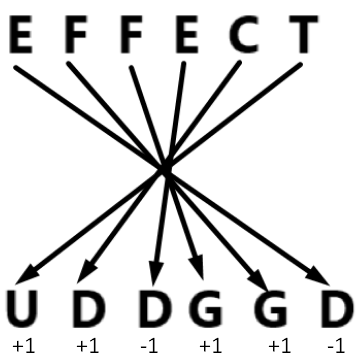
In a certain code language, if the word ORGANISE is coded as RAOESING, then how is the word PROGRESS coded in that language?

  • A.

    EGPSSERO

  • B.

    RHPSTERO

  • C.

    GRPSSERO

  • D.

    RGPSSERO

    ✓ Correct

Answer & Solution

Correct option is D

1. Information Given:
ORGANISE → RAOESING
Find: PROGRESS → ?

2. Formula Used:
Check rearrangement pattern of letters

3. Explanation:

Write positions:

ORGANISE
O R G A N I S E
1 2 3 4 5 6 7 8

Code:
R A O E S I N G

Now match positions:

1 → 2 (O → R)
2 → 4 (R → A)
3 → 1 (G → O)
4 → 8 (A → E)
5 → 7 (N → S)
6 → 6 (I → I)
7 → 5 (S → N)
8 → 3 (E → G)

Pattern:
2, 4, 1, 8, 7, 6, 5, 3

Apply same to PROGRESS:

P R O G R E S S
1 2 3 4 5 6 7 8

Using pattern:

2 → R
4 → G
1 → P
8 → S
7 → S
6 → E
5 → R
3 → O

Result: RGPSSERO
 Final Answer:
RGPSSERO

Final Correct Option:

D) RGPSSERO

Q15.
Read the given statements and conclusions carefully. Assuming that the information given in the statements is true, even if it appears to be at variance with commonly known facts, decide which of the given conclusions logically follow(s) from the statements.
Statements:
1. Some pipe are hose.
2. All hose are tunnel.
Conclusions:
I. Some pipe are tunnel.
II. All tunnel are hose. ​​
  • A.

    Only conclusion (II) follows

  • B.

    Both conclusions (I) and (II) follow

  • C.

    Neither conclusion (I) nor (II) follows

  • D.

    Only conclusion (I) follows

    ✓ Correct

Answer & Solution

Correct option is D

Statements:
1. Some pipe are hose.
2. All hose are tunnel.
From the given statements possible Venn diagram will be.

Conclusions:
I. Some pipe are tunnel. (True, some pipe are hose and all hose are tunnel, so that means some pipe are tunnel).
II. All tunnel are hose. (False, all hose are tunnel).
So, ​Only conclusion (I) follows.
Thus, correct option is (d).