











Correct option is D
The second period contains the elements lithium, beryllium, boron, carbon, nitrogen, oxygen, fluorine, and neon. In a quantum mechanical description of atomic structure, this period corresponds to the filling of the second (n = 2) shell, more specifically its 2s and 2p subshells. Electron affinity: The electron affinity (Eea) of an atom or molecule is defined as the amount of energy released when an electron attaches to a neutral atom or molecule in the gaseous state to form an anion.

To use electron affinities properly, it is essential to keep track of sign. For any reaction that releases energy, the change ΔE in total energy has a negative value and the reaction is called an exothermic process. Electron capture for almost all non-noble gas atoms involves the release of energy and thus is exothermic. The positive values of Eea are amounts or magnitudes. It is the word "released" within the definition "energy released" that supplies the negative sign to ΔE. Confusion arises in mistaking Eea for a change in energy, ΔE, in which case the positive values would be for an endo- not exo-thermic process. The relation between the two is Eea = −ΔE(attach).
However, if the value assigned to Eea is negative, the negative sign implies a reversal of direction, and energy is required to attach an electron. In this case, the electron capture is an endothermic process and the relationship, Eea = −ΔE(attach) is still valid.

Eea generally increases across a period (row) in the periodic table prior to reaching group 18. This is caused by the filling of the valence shell of the atom; a group 17 atom releases more energy than a group 1 atom on gaining an electron because it obtains a filled valence shell and therefore is more stable. In group 18, the valence shell is full, meaning that added electrons are unstable, tending to be ejected very quickly.
Ionization energy: Ionization energy (IE) is the minimum energy required to remove the most loosely bound electron of an isolated gaseous atom, positive ion, or molecule. The first ionization energy is quantitatively expressed as

where X is any atom or molecule, X+ is the resultant ion when the original atom was stripped of a single electron, and e- is the removed electron. Ionization energy is positive for neutral atoms, meaning that the ionization is an endothermic process. Roughly speaking, the closer the outermost electrons are to the nucleus of the atom, the higher the atom's ionization energy.
Ionization energy is also a periodic trend within the periodic table. Moving left to right within a period, the first ionization energy generally increases, with exceptions such as aluminium and sulfur. As the nuclear charge of the nucleus increases across the period, the electrostatic attraction increases between electrons and protons, hence the atomic radius decreases, and the electron cloud comes closer to the nucleus because the electrons, especially the outermost one, are held more tightly by the higher effective nuclear charge.
Proton affinity: The proton affinity (PA, Epa) of an anion or of a neutral atom or molecule is the negative of the enthalpy change in the reaction between the chemical species concerned and a proton in the gas phase:
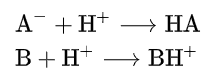
These reactions are always exothermic in the gas phase, i.e. energy is released (enthalpy is negative) when the reaction advances in the direction shown above, while the proton affinity is positive. This is the same sign convention used for electron affinity.
Electronegativity: Electronegativity, symbolized as χ, is the tendency for an atom of a given chemical element to attract shared electrons (or electron density) when forming a chemical bond. An atom's electronegativity is affected by both its atomic number and the distance at which its valence electrons reside from the charged nucleus. The higher the associated electronegativity, the more an atom or a substituent group attracts electrons. In general, electronegativity increases on passing from left to right along a period.
Electron affinity is directly proportional to electronegativity and proton affinity.



