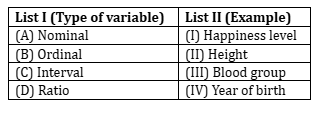
Correct option is B
Quantitative research methodology focuses on collecting and analyzing numerical data to identify patterns, relationships, and trends. Methods in quantitative research often involve structured tools and statistical techniques. Among the options provided:
·
Survey research (B): Surveys are highly structured and often involve numerical data, making them a popular quantitative method. Surveys allow researchers to gather data from a large population and analyze trends or correlations.
·
Correlation research (D): This method explores the relationships between variables quantitatively, using statistical methods to measure the strength and direction of associations between factors.
·
Descriptive research (E): Descriptive research aims to quantify characteristics, behaviors, or phenomena within a population, often using structured formats like surveys or observational data analyzed statistically.
One to One Interviews (A) and
Focus Groups (C) are typically qualitative methods, as they involve gathering in-depth insights and subjective data through open-ended questions.
Information Booster: 1.
Quantitative Methods are usually numerical, objective, and structured, providing data that can be statistically analyzed.
2.
Common Quantitative Techniques include surveys, experiments, and observational studies.
3.
Qualitative vs. Quantitative: Qualitative research is exploratory and subjective, while quantitative research is confirmatory and objective.
4.
Descriptive and Correlational Research are foundational quantitative methods, often used to establish baselines and understand variable relationships.
5.
Quantitative Data Analysis relies on statistical software like SPSS or R for data analysis.
6.
Applicability: Quantitative methods are commonly applied in fields needing objective measurements, such as economics, psychology, and social sciences.
 English
 10 Questions
 20 Marks
 12 Mins