






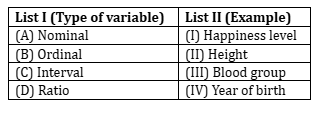
Correct option is C
Nominal → (III) Blood group:
Nominal variables are categorical and have no inherent order.
Example: Blood groups (A, B, AB, O) are categories without a meaningful ranking.
Ordinal → (I) Happiness level:
Ordinal variables represent categories with a meaningful order or ranking but do not have equal intervals between them.
Example: Happiness levels (e.g., unhappy, neutral, happy) can be ranked but lack precise differences.
Interval → (IV) Year of birth:
Interval variables have meaningful intervals but no true zero point.
Example: Year of birth (e.g., 1990, 2000) has equal intervals but no absolute zero.
Ratio → (II) Height:
Ratio variables have all the properties of interval variables, including a true zero point, which allows for meaningful ratios.
Example: Height can be measured with a true zero (no negative height).
Information Booster:
Types of Variables:
Nominal: Categorical, no inherent order (e.g., Gender, Blood group).
Ordinal: Ordered categories without equal intervals (e.g., Ranking, Happiness level).
Interval: Equal intervals, no true zero (e.g., Temperature, Year of birth).
Ratio: Equal intervals with a true zero, allowing meaningful ratios (e.g., Height, Weight).
Key Characteristics:
Nominal: Classification only.
Ordinal: Classification + Order.
Interval: Classification + Order + Equal spacing.
Ratio: Classification + Order + Equal spacing + True zero.
Examples for Better Understanding:
Nominal: Eye color, Blood group.
Ordinal: Education level (High school, Bachelor's, Master's).
Interval: Calendar years, IQ scores.
Ratio: Distance, Salary, Weight.
 English
 10 Questions
 20 Marks
 12 Mins


