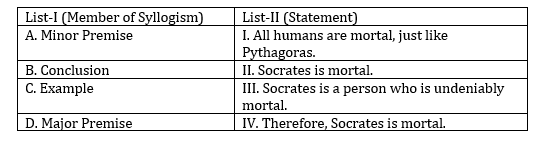
Correct option is B
An inductive argument is a type of reasoning where the premises provide some degree of probability for the conclusion, but not absolute certainty.
Inductive Reasoning Features:
· The conclusion extends beyond the information given in the premises.
· Even if all the premises are true, the conclusion is not guaranteed to be true; it is only probably true.
· Inductive arguments are common in science and everyday reasoning, where conclusions are drawn based on patterns, observations, or statistical data.
Information Booster: · Deductive Argument:
· Claims to provide conclusive support for its conclusion.
· If the premises are true, the conclusion must be true.
· Example: "All humans are mortal. Socrates is a human. Therefore, Socrates is mortal."
· Inductive Argument:
· Provides probable but not certain support for its conclusion.
· Example: "All observed swans are white. Therefore, all swans are probably white."
 English
 10 Questions
 20 Marks
 12 Mins