






Correct option is B
In a syllogism, statements are structured in a logical sequence involving premises (major and minor) and a conclusion. Here’s the correct match:
1.
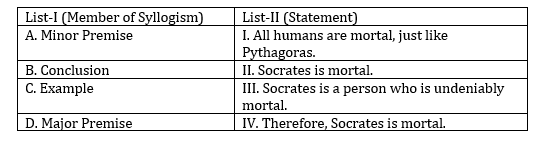
A. Minor Premise → III. Socrates is a person who is undeniably mortal:
· The minor premise identifies a specific instance or example, such as Socrates, to connect to the general rule stated in the major premise.
2.
B. Conclusion → IV. Therefore, Socrates is mortal:
· The conclusion logically follows from the premises, summarizing the inference that Socrates, being human, is mortal.
3.
C. Example → I. All humans are mortal, just like Pythagoras:
· An example is used to illustrate or support the argument by drawing parallels, such as comparing Socrates to Pythagoras.
4.
D. Major Premise → II. Socrates is mortal:
· The major premise states the general rule that applies universally, setting the foundation for the argument.
Information Booster:
1.
Syllogism: A logical argument where a conclusion is inferred from two premises (major and minor).
2.
Major Premise: States a general truth or rule.
3.
Minor Premise: Applies the general rule to a specific case.
4.
Conclusion: The logical inference based on the premises.
 English
 10 Questions
 20 Marks
 12 Mins


