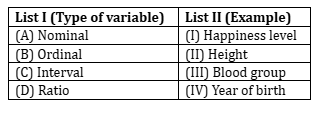
Correct option is C
(A) Answering research questions: Both qualitative and quantitative research are aimed at answering specific research questions. Although their methods differ, the ultimate goal is to address the research problem.
(D) Importance to transparency: Transparency is crucial in both qualitative and quantitative research, as it enhances the credibility and validity of the study. Researchers in both paradigms strive to provide a clear methodology and justification for their findings.
(E) Exploration of variation: Both qualitative and quantitative research explore variations, though they do it differently. Quantitative research looks for variations in numerical data, while qualitative research explores variations in experiences, perspectives, and contexts.
·
(B) Preference to macro data: This is more common in quantitative research, which focuses on larger datasets and broader trends, while qualitative research often focuses on micro-level, in-depth data.
·
(C) Do not suffer from issues of error: This statement is incorrect. Both qualitative and quantitative research are subject to issues of error, bias, and limitations in their respective methodologies.
Information Booster 1.
Research questions guide both qualitative and quantitative studies, forming the foundation for data collection and analysis.
2.
Transparency is key in both methods to ensure replicability in quantitative studies and trustworthiness in qualitative studies.
3.
Variation in research findings is examined in both types of studies, whether through statistical analysis in quantitative research or thematic analysis in qualitative research.
4.
Quantitative research often deals with macro-level data such as large surveys and statistics, whereas
qualitative research typically focuses on individual cases or small groups.
5. Both research types are subject to
errors and bias, such as measurement errors in quantitative studies and interpretive biases in qualitative research.
6. Both methodologies aim to contribute to
theoretical development, although the approach to theory generation may differ (inductive in qualitative vs. deductive in quantitative).
 English
 10 Questions
 20 Marks
 12 Mins