Correct option is B
Explanation:
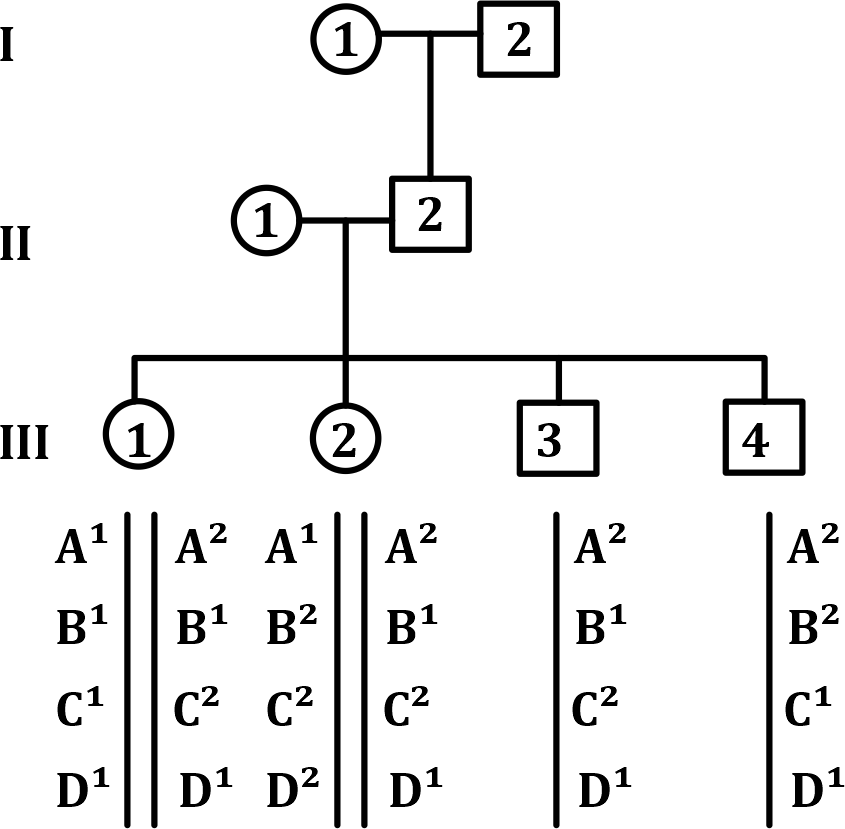
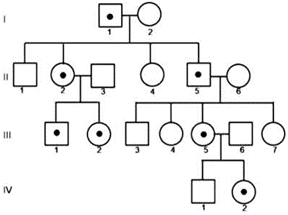
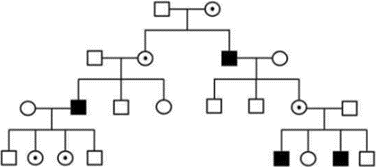
1. Pedigree Analysis (Panel i):
Autosomal Inheritance:
- If a trait appears equally in both males and females and can be passed from father to son, it is likely autosomal. This is because autosomal traits are carried on non-sex chromosomes (autosomes), meaning both sexes have an equal chance of inheriting the trait.
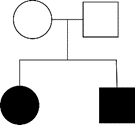
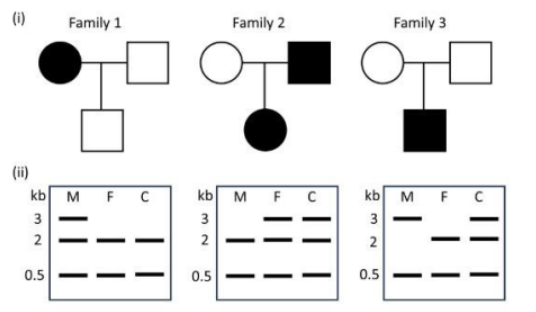
- In the pedigrees of Family 1 and Family 2, both males and females are affected equally. Affected parents pass the trait to both sons and daughters.
- In Family 3, one of the parents is a carrier of the dominant allele but does not express the trait due to incomplete penetrance. This means they are genetically affected but do not show the symptoms of the trait, appearing unaffected in the pedigree. The child inherits the dominant allele from the carrier parent (mother in this case as observed in Panel ii) and expresses the trait. Since the child expresses the trait, they have inherited the dominant allele, and this explains their affected status.
- In a dominant inheritance pattern, affected individuals usually have at least one affected parent. This is because dominant traits require only one copy of the mutant allele to express the trait. If a parent is affected (as in the case of the mother (Aa) in Family 1), they have at least one dominant allele for the trait. The child (aa) might have inherited the unaffected (normal) allele from the mother.
2. PCR Amplification Profiles (Panel ii):
- The PCR profiles show the DNA bands (amplification products) for each member of the family, using a specific primer pair designed to amplify regions linked to the trait.
- Affected individuals have a different amplification pattern compared to unaffected individuals, indicating that they carry a specific mutant allele associated with the trait.
- For example, in all families, you see a unique band in affected individuals that is not present in unaffected individuals, demonstrating the molecular basis of the trait.
- In autosomal dominant traits, one copy of the mutant allele is sufficient to cause the trait. This is reflected in the PCR results, where affected individuals show a distinct banding pattern (indicating the presence of the mutant allele), while unaffected individuals do not.
3. Other Options:
Not Autosomal Recessive:
- In autosomal recessive inheritance, two copies of the mutant allele (one from each parent) are necessary to express the trait. Typically, autosomal recessive traits skip generations, meaning affected children often have unaffected (carrier) parents. This pattern rules out autosomal recessive inheritance.
Not X-linked Recessive or Dominant:
- In X-linked recessive inheritance, males are more frequently affected, and affected fathers cannot pass the trait to their sons. This is because males inherit their X chromosome from their mothers, and if the trait were X-linked recessive, affected males would pass the X chromosome to all their daughters and none of their sons, which is not the case here.
- Both males and females are equally affected, and there is no evidence of the skewed sex ratios typical of X-linked traits.
Correct Answer:
- The inheritance pattern of this trait is Autosomal dominant based on the pedigree and PCR results.