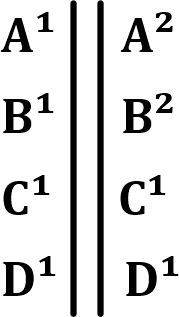
Correct option is C
Explanation-
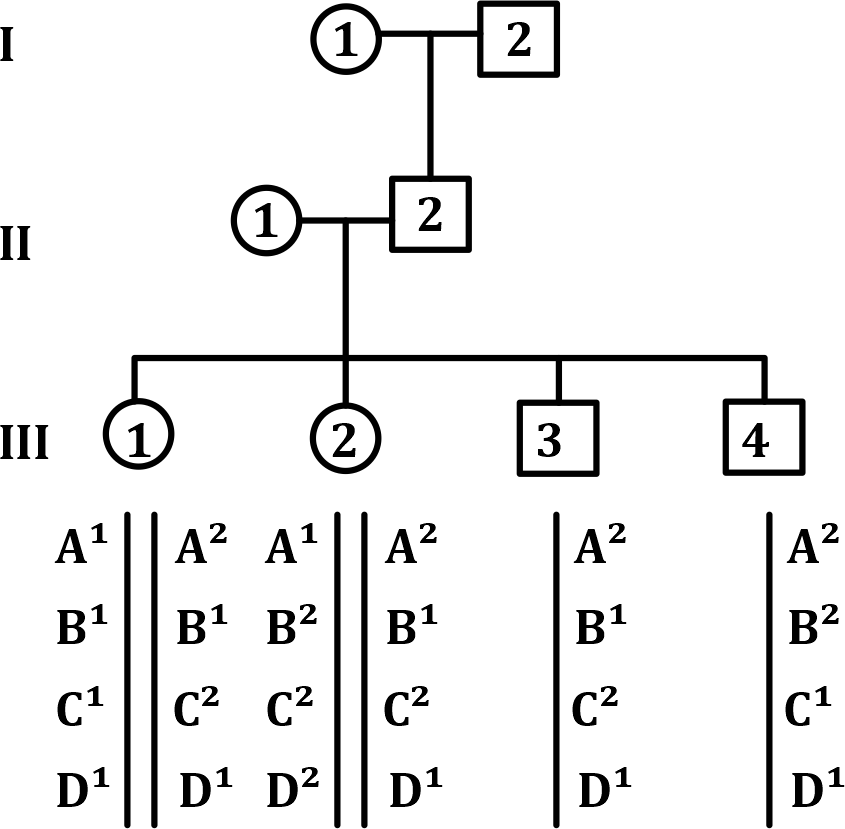
Given - The genotypes of the four children in generation III. Each child receives one allele from each parent at every locus.
Locus A:
Children’s alleles:
III-1: A¹ A²
III-2: A¹ A²
III-3: A¹ A¹
III-4: A¹ A²
From these: A¹ and A² both appear among offspring. III-3 is A¹ A¹, meaning both alleles came from each parent => both parents must carry A¹. Since A² also appears, one of the parents must also carry A².
So, II-1’s genotype at locus A = A¹ A²
Locus B:
Children’s alleles:
III-1: B¹ B²
III-2: B¹ B²
III-3: B¹ B¹
III-4: B² B²
This means - Parent II-1 must carry B¹ (for III-1, III-2, III-3) and must also carry B² (for III-1, III-2, III-4).
So, II-1’s genotype at locus B = B¹ B²
Locus C:
Children’s alleles:
III-1: C¹ C²
III-2: C² C²
III-3: C¹ C²
III-4: C¹ C¹
This suggests - C¹ C², C² C², and C¹ C¹ offspring observed → all combinations. Only way this is possible: II-1 is C¹ C²
So, II-1’s genotype at locus C = C¹ C²
Locus D:
Children’s alleles:
III-1: D¹ D²
III-2: D¹ D²
III-3: D¹ D²
III-4: D¹ D¹
Everyone gets D¹, some get D². Thus one parent is D¹ D¹ (always provides D¹). The other must be D¹ D²
Since III-4 is D¹ D¹, both alleles must be D¹ → one parent is D¹ D¹. Since others have D², the other parent is D¹ D²
Therefore, II-1 = D¹ D²
Final Genotype of II-1:
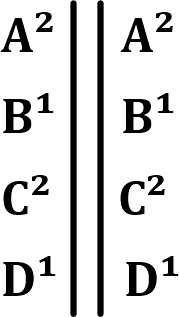
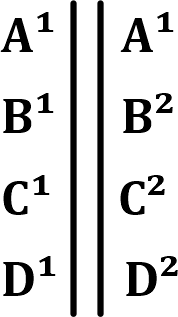
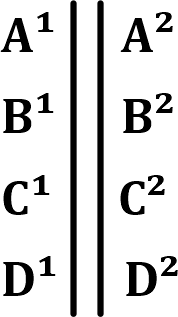
A¹ A², B¹ B², C¹ C², D¹ D² → This matches Option c