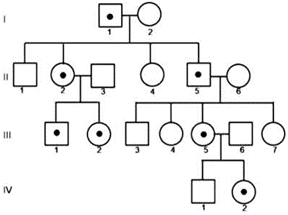
Correct option is B
Explanation-
UBE3A is maternally expressed and paternally imprinted in the brain:
1. Only the maternal allele is active.
2. If the maternal allele carries the mutation, the child shows Angelman Syndrome (AS).
3. If the paternal allele carries the mutation, the child is unaffected (since it's normally silenced).
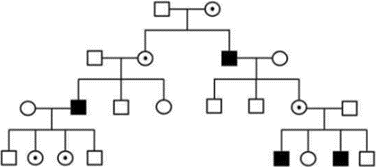
Carriers (with dots) carry the mutation but don’t show symptoms. They can pass on the mutated gene.
Option B: III-1, III-2, and IV-2
III-1
Parent: II-2 (female, carrier)
The mutation is passed maternally, and III-1 likely received the mutated maternal allele.
So, III-1 will show AS.
III-2
Parent: Again, II-2 (female, carrier)
Same as III-1, likely inherited mutated maternal allele.
So, III-2 will show AS.
IV-2
Mother: III-2 (affected female, must have mutant allele)
Since III-2 is affected, she must pass on the mutant allele to her children.
IV-2 is female child, hence if she inherits the mutant allele maternally → she shows AS.
So, IV-2 will also show AS.
Option B correctly lists all individuals likely to show Angelman Syndrome due to inheritance of the mutated maternal UBE3A allele. Thus, Option B is correct.
Incorrect options-
Option A: II-1, III-1, and IV-1
II-1:
Mother: I-2 (carrier female).
Father: I-1 (non-carrier).
II-1 is male child of a carrier mother.
BUT we don’t know if he inherited the mutation. Also, since he's male, he won’t pass it on maternally.
More importantly, his own phenotype is not indicated (not confirmed AS). Not enough info to confirm he shows AS.
III-1: Already discussed — shows AS.
IV-1:
Parent: III-2 (affected female).
IV-1 is male child. Even if he has mutant UBE3A, since it’s maternally inherited — yes, he could show AS.
But the pedigree does not indicate that IV-1 is affected.
It’s ambiguous whether he received the mutant allele or not.
Option C: II-2, III-2, III-5 and IV-2
II-2:
Female with a dot = carrier, not affected. She doesn’t show AS herself.
III-2:
Daughter of II-2 (carrier female) → likely inherited mutant maternal allele → affected
III-5:
Parent: II-5 and II-6 (both no dots = non-carriers). So III-5 cannot inherit a mutant allele.
IV-2:
Daughter of III-2 (affected female) → gets mutated maternal allele → affected
Option D: II-1 and II-5
II-1:
Male child of a carrier female.
Even if he carries the mutation, he does not show AS (only inherited from mother causes AS, and he is male). Pedigree does not show him as affected.
II-5:
No dot = not a carrier, and hence normal.