Correct option is C
The correct option is (c)
Statement A -
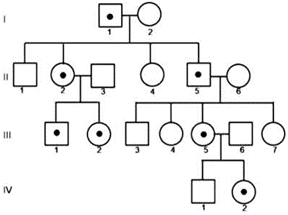
At least one of the children will not carry any mutations linked to this condition.
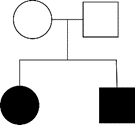
Since the parents are affected due to mutations in two genes, children inherit mutations in some combination.
Given some children are unaffected (empty symbols), at least one child may not carry all disease-causing mutations.
However, because the disease requires mutations in at least two genes, children with fewer or no mutations could be unaffected.
So, this statement is correct.
Statement B-
The mutations causing this disease are recessive.
If the mutations were recessive, both parents must be homozygous for these mutations to be affected.
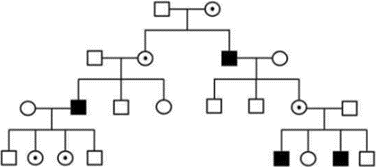
However, the pedigree shows two closely related parents affected with the disease, and their children include both affected and unaffected individuals.
If the disease were recessive, the unaffected children would likely be carriers but not affected.
Since the parents are closely related and both affected, the disease might be due to dominant mutations in more than one gene (digenic dominant inheritance) or another mode rather than recessive inheritance.
The pattern suggests that simultaneous heterozygous mutations (statement D) can cause disease, which conflicts with pure recessive inheritance.
Thus, the mutations are not simply recessive, so statement B is incorrect.
Statement C -
At least one of the mutant genes is on the Y chromosome.
Females are affected (mother is affected) but females do not have a Y chromosome.
So, a mutation on the Y chromosome cannot explain disease in females.
This statement is incorrect.
Statement D-
Simultaneous heterozygous mutations in the involved genes can cause the disease.
The disease requires mutations in at least two genes.
If heterozygous mutations in both genes can cause disease, it indicates a compound heterozygous or digenic inheritance.
Given the parents are affected and children have varying statuses, this is plausible.
This statement is correct.
Among the given options, the one that best fits is option (c) - A and D.