hamburger menu
All Coursesall course arrow
adda247
reward-icon
adda247
    arrow
    arrow
    arrow
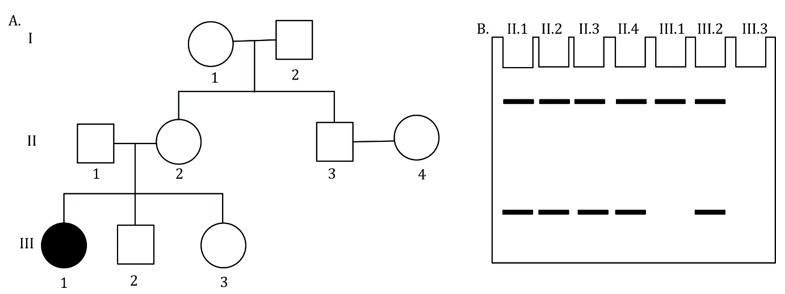
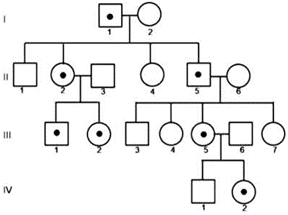
    ​The pedigree (Fig A) represents the inheritance of a monogenic disorder, caused by a defective enzyme encoded by a mutant allele. The functional and
    Question

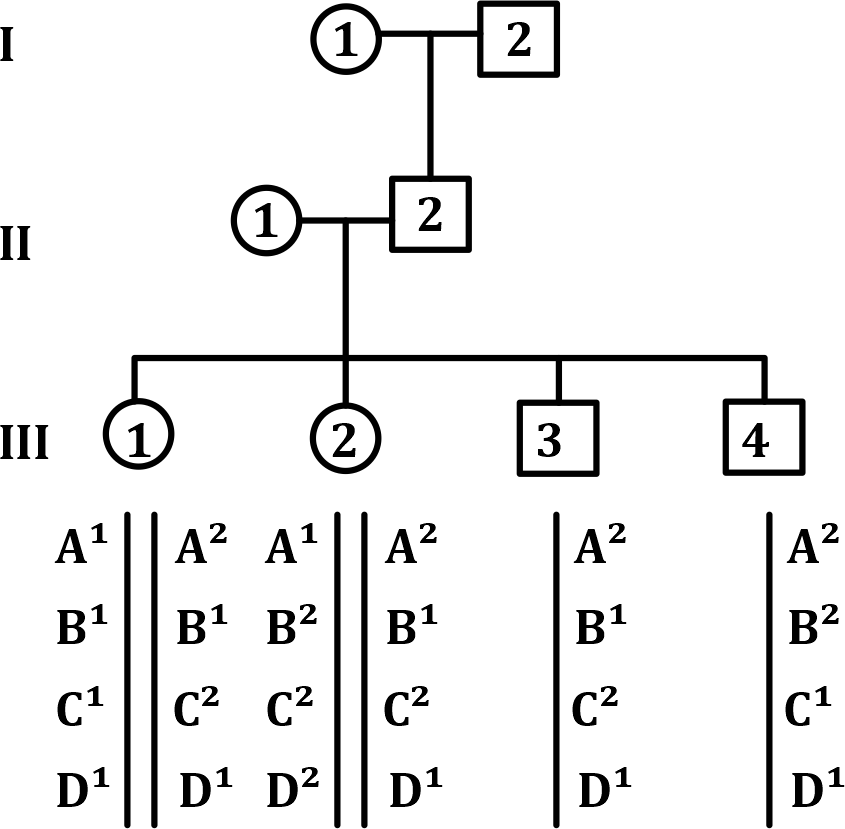
    The pedigree (Fig A) represents the inheritance of a monogenic disorder, caused by a defective enzyme encoded by a mutant allele. The functional and defective enzymes can be resolved by PAGE. The allozyme pattern observed in some of the individuals in the family is represented in Fig B. The frequency of the mutant allele in the population is 0.04.

    Based on the above information, the following statements were made:
    A. The allele encoding the functional enzyme is haplo-sufficient.
    B. The trait shows 100% penetrance.
    C. The probability that a child born to individuals II.3 and II.4 will be homozygous for the gene is 1/4.
    D. Both individuals I.1 and I.2 are necessarily heterozygous for the gene.

    Which one of the following options correctly identifies each statement as True (T) or False (F) from A to D, respectively?

    A.

    T, F, F, F

    B.

    T, F, T, F

    C.

    F, T, T, F

    D.

    F, F, F, T

    Correct option is A

    1. Statement A is True. The affected individual (III.1) shows only the mutant band, indicating a homozygous recessive condition. The unaffected individuals carry at least one functional allele, and those with both enzyme bands (heterozygotes) are unaffected, suggesting haplo-sufficiency – one normal allele is sufficient for normal function.

    2. Statement B is False. While the pedigree indicates some affected individuals, it is not sufficient to claim 100% penetrance without additional evidence from extended pedigrees or population data. The presence of carriers without the phenotype would imply incomplete penetrance.

    3. Statement C is False. Individual II.3 shows only the normal band (homozygous normal), while II.4 shows both bands (heterozygous). A cross between a homozygous normal (AA) and a heterozygote (Aa) cannot produce a homozygous mutant (aa) child. Hence, the probability is 0, not 1/4.

    4. Statement D is False. Individuals I.1 and I.2 must have passed on the mutant allele to produce the affected III.1, but we do not have sufficient enzyme band data for them to confirm they are necessarily heterozygous. They could be, but it is not confirmed.
    Similar Questions

    test-prime-package

    Access ‘CSIR NET Life Sciences’ Mock Tests with

    • 60000+ Mocks and Previous Year Papers
    • Unlimited Re-Attempts
    • Personalised Report Card
    • 500% Refund on Final Selection
    • Largest Community
    students-icon
    354k+ students have already unlocked exclusive benefits with Test Prime!
    test-prime-package

    Access ‘CSIR NET Life Sciences’ Mock Tests with

    • 60000+ Mocks and Previous Year Papers
    • Unlimited Re-Attempts
    • Personalised Report Card
    • 500% Refund on Final Selection
    • Largest Community
    students-icon
    354k+ students have already unlocked exclusive benefits with Test Prime!
    Our Plans
    Monthsup-arrow