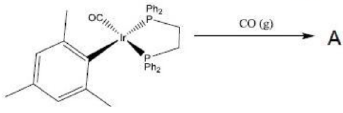
Correct option is A

There is a type of fluxionality that takes place irrespective of the coordination number. This is observed when two or more ligands of the same intrinsic identity are not bound to a metal atom in the same way. Two organo-ligands of the same kind may be bound in different ways, one having a higher hapticity than the other.

was the first organometallic compound for which this phenomenon was studied. The two Cp rings display different bonding modes and the expected structure based on the 18e rule is as follows. The IR data supports this structure.
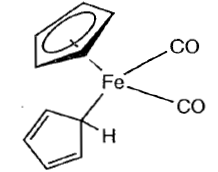
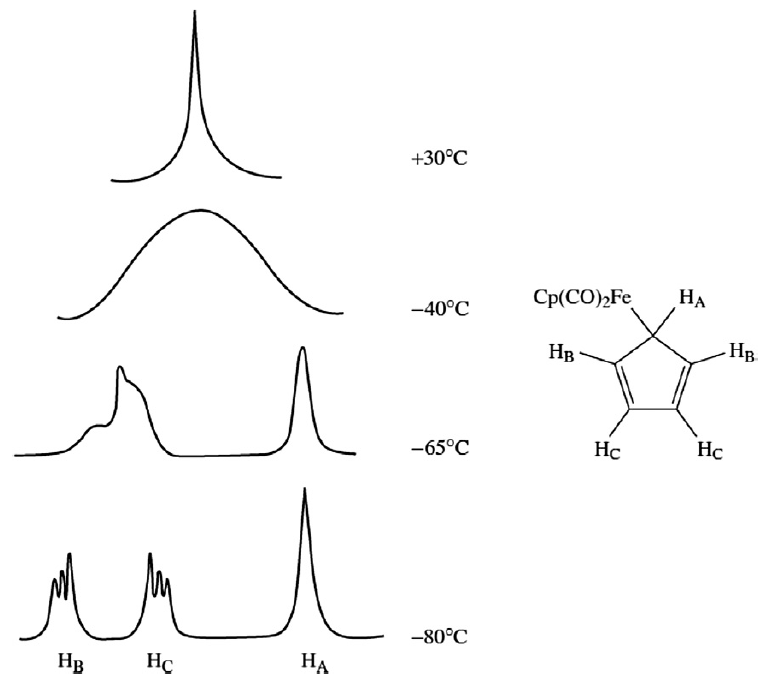
The expected 1H NMR spectrum at ambient temperature should show a singlet for η1-Cp in the range δ3.0-5.0 ppm, an AA'BB' multiplet for the olefinic protons with a relative intensity of 4 in the range δ6.0-6.2 ppm and a singlet of relative intensity 1, at a lower δ value for the C1 proton. All the three separate resonances are observed in the low temperature NMR (-80°C) but surprisingly, the actual spectrum at ambient temperature consists of two singlets of almost equal intensity. The spectra have been explained invoking fluxionality and it was proposed that the iron atom migrates around η1-Cp ring at a rate sufficient enough to average out all the proton resonances in the η1-Cp. Such cyclopentadienyl rings have been termed as ring whizzers. The solution NMR of this compound recorded between -80°C and +30°C gave more information.
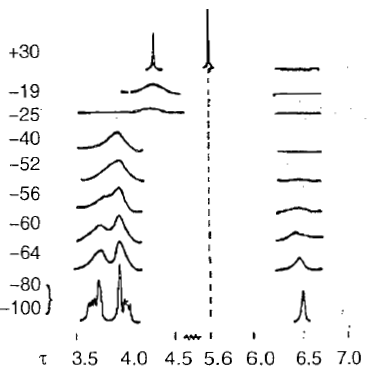
At a low temperature of -80°C, a typical AA 'BB' multiplet spectrum for four protons of η1-Cp was observed. As the temperature was raised, the lines collapsed to a singlet. The downfield part of the multiplet centred at δ6.2 (t 3.8) broadened faster than the other as the temperature was increased. However, the singlet due to the η5-Cp did not change during this temperature change.
Based on these observations, all processes that cause random exchange, that is, dissociation and recombination, were discounted and were not considered. Two possible rearrangements, namely, the 1, 2 or 1, 3 shifts, were considered to explain the experimental data.

The classic example, CpFe(CO)2(η1-C5H5), shows only two proton resonances at room temperature, one for the η5-C5H5 and one for the fluxional η1-C5H5. The iron atom migrates around the η1-C5H5 ring at a rate sufficient to average all the proton environments of the ring. On cooling, separate resonances appear for the three different proton environments in the low-temperature limiting spectrum of the static η1-C5H5. On warming, each signal broadens, but in a different way depending on whether the fluxionality involves 1,2 or 1,3 shifts. Since the HC protons are adjacent, a 1,2 shift—equivalent to a 1,5 shift—will result in one of the HC nuclei staying in an HC site after the shift; in contrast, all the HB nuclei will end up in non-HB sites. The exchange rate for HC will therefore be one-half of the exchange rate for HB, and thus show less initial broadening. Conversely, since HB nuclei are three carbons apart, 1,3 shifts will result in the HB signal showing less initial broadening. Experimentally, a 1,2 shift in fact takes place. To do this analysis, however, we first need to assign HB and HC signals correctly-often a hard step.