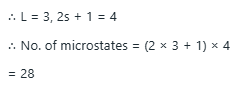
Correct option is C
With sets of quantum numbers in hand, the electronic states (microstates) that are possible for a given electronic configuration can be determined. This is best achieved by constructing a table of microstates, remembering that:
1.no two electrons may possess the same set of quantum numbers (the Pauli exclusion principle);
2.only unique microstates may be included.
The electronic configuration of an atom, ion or molecule is not a complete description of arrangement of electrons in a subshell of an atom. For a given electronic configuration, there are several ways of arrangement of electrons in a subshell. For example, for p2-electronic configuration, there are 15 ways in which electrons can be arranged. Similarly for d2-configuration, there are 45 ways of arrangement of electrons. The different ways in which the electrons can be arranged in the orbitals of a subshell are called microstates of the configuration. Microstates are also called as atomic states.
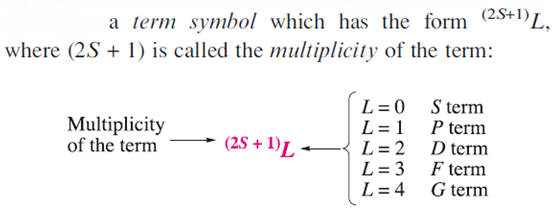
The notation for a full term symbol is:

The energy and the orbital angular momentum of a multielectron species are determined by a quantum number, L. Energy states for which L=0, 1, 2, 3, 4... are known as S, P, D, F, G... terms, respectively.
For any system containing more than one electron, the energy of an electron with principal quantum number n depends on the value of l, and this also determines the orbital angular momentum which is given by the equation:


The spin quantum number, s, determines the magnitude of the spin angular momentum of an electron and has a value of 1/2. For a 1-electron species, ms is the magnetic spin angular momentum and has a value of +1/2 or -1/2. The spin angular momentum for a multielectron species is given by the following equation, where S is the total spin quantum number.

The quantum number MS is obtained by algebraic summation of the ms values for individual electrons:
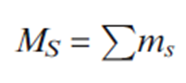
For each value of S, there are (2S+1) values of MS.
The interaction between the total angular orbital momentum, L, and the total spin angular momentum, S is defined by the total angular momentum quantum number, J.
The following equation gives the relationship for the total angular momentum for a multi-electron species.



The value of J for the ground state is given by (L-S) for a sub-shell that is less than half-filled, and by (L+S) for a sub-shell that is more than half-filled.

For the given atomic term,