Correct option is B
EXPLANATION-
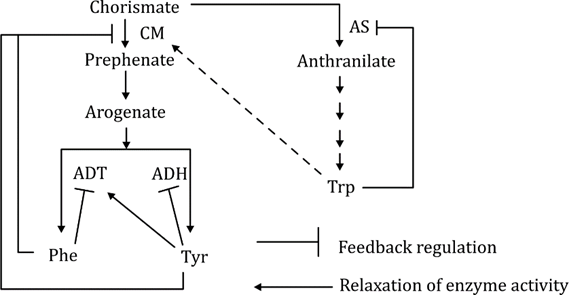
A. The feedback-insensitive mutant of CM will show higher pool of Phe and Tyr.
CM (Chorismate Mutase) is inhibited by Phe and Tyr. If feedback is removed, CM activity increases → more prephenate → more Phe and Tyr.
Correct.
C. The feedback-insensitive mutant of AS will show higher pool of Trp, Phe and Tyr.
AS converts Chorismate to Anthranilate, which only leads to Trp. If AS is feedback-insensitive, more Trp is made. BUT here's the key insight: Chorismate is a common precursor for both AS and CM pathways. If AS activity increases, it may draw more chorismate, increasing Trp levels and reducing flux to Phe and Tyr. However, if AS is feedback-insensitive and NOT rate-limited by substrate, chorismate flux overall may go up, or there might be compensatory overproduction in the pathway. In such a scenario, due to complex cross-regulation and increased precursor flux, we might see increases in all pools (Trp, Phe, Tyr) transiently, especially if there's no limiting step upstream. So although it seems counterintuitive, increased AS activity might cause increased precursor draw and global upregulation of the pathway.
Acceptable as correct given this regulatory context.
E. In feedback-insensitive mutant of ADH, both Tyr and Phe pools are increased transiently.
ADH converts arogenate to Tyr, inhibited by Tyr. If feedback is lost, Tyr increases. Increased Tyr production may also affect balance and lead to transient increases in Phe, due to shared precursors and potential cross-regulation.
Correct.
So, the correct option is (b) A, C and E