hamburger menu
All Coursesall course arrow
adda247
reward-icon
adda247
    arrow
    arrow
    arrow
    Quantitative Trait Loci (QTLs) can be identified using two main approaches: bi-parental matings (BPM) and Genome-Wide Association Studies (GWAS). Belo
    Question

    Quantitative Trait Loci (QTLs) can be identified using two main approaches: bi-parental matings (BPM) and Genome-Wide Association Studies (GWAS). Below are some descriptors related to these strategies:

    A. Large sample size
    B. Small sample size
    C. Population derived from controlled crosses
    D. Random mating populations
    E. Limited to two alleles per locus
    F. Multiple alleles per locus
    G. Linkage-based mapping
    H. Linkage disequilibrium-based mapping

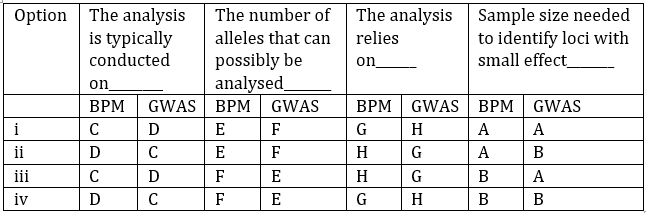
    The table below presents four incomplete statements regarding BPM and GWAS. Each statement can be completed using the above descriptors.

    Which one of the following options correctly completes all statements?

    A.

    i

    B.

    ii

    C.

    iii

    D.

    iv

    Correct option is A

    Explanation:

    • BPM is typically conducted on populations derived from controlled crosses (C) — these are experimental populations made by crossing two parents.

    • GWAS is typically done on random mating natural populations (D), such as landraces or natural accessions.

    • BPM analyzes limited two alleles per locus (E), as crosses involve only two parents.

    • GWAS analyzes multiple alleles per locus (F) because natural populations harbor diverse alleles.

    • BPM relies on linkage-based mapping (G), tracking recombination events in controlled crosses.

    • GWAS relies on linkage disequilibrium-based mapping (H), exploiting historical recombination in natural populations.

    • Both methods require a large sample size (A) to identify loci with small effects, since detecting minor QTL effects needs statistical power.

    Information Booster:

    • Bi-parental mapping (BPM) provides high power to detect QTLs segregating between two parents but is limited in allelic diversity.

    • GWAS captures natural allelic diversity but requires dense markers and large sample sizes due to population structure and allele frequency.

    • The distinction helps breeders and geneticists choose appropriate mapping strategies.
    Similar Questions

    test-prime-package

    Access ‘CSIR NET Life Sciences’ Mock Tests with

    • 60000+ Mocks and Previous Year Papers
    • Unlimited Re-Attempts
    • Personalised Report Card
    • 500% Refund on Final Selection
    • Largest Community
    students-icon
    354k+ students have already unlocked exclusive benefits with Test Prime!
    test-prime-package

    Access ‘CSIR NET Life Sciences’ Mock Tests with

    • 60000+ Mocks and Previous Year Papers
    • Unlimited Re-Attempts
    • Personalised Report Card
    • 500% Refund on Final Selection
    • Largest Community
    students-icon
    354k+ students have already unlocked exclusive benefits with Test Prime!
    Our Plans
    Monthsup-arrow