Correct option is A
Correct Answer
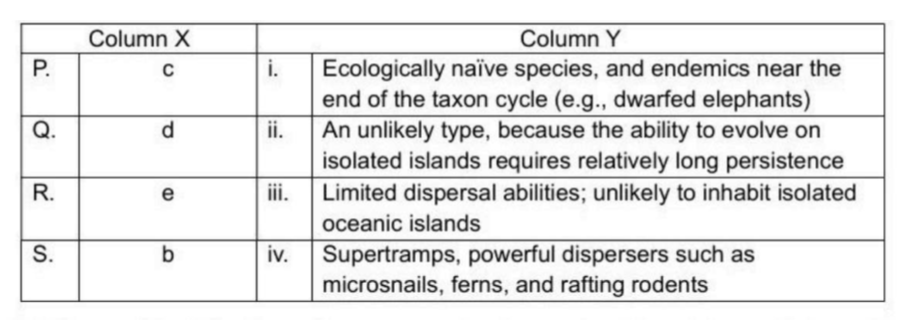
Option (1): P (i), Q (ii), R (iii), S (iv)
Explanation:
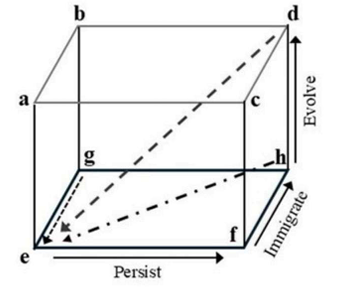
Species type c represents late-stage island endemics that are ecologically naïve, fitting trait (i). Type d lies at the high evolution end and represents an unlikely type because long persistence is needed to evolve on isolated islands, matching (ii). Type e corresponds to species with poor dispersal ability, unlikely to reach remote islands, matching (iii). Type b represents early colonizers with strong dispersal ability or “supertramps,” matching (iv).
Information Booster
• The taxon cycle describes how species transition from widespread, highly dispersive colonizers to localized, specialized endemics over time.
• Island environments strongly filter species based on dispersal ability, persistence, and evolutionary potential.
• This framework is particularly valuable for understanding patterns in island biogeography and conservation biology.