hamburger menu
All Coursesall course arrow
adda247
reward-icon
adda247
    arrow
    arrow
    arrow
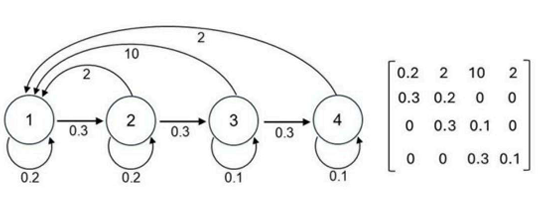
    The figure shows a life-cycle graph and the corresponding population projection matrix (time-invariant) for a population with four successive classes
    Question

    The figure shows a life-cycle graph and the corresponding population projection matrix (time-invariant) for a population with four successive classes (1–4). All contributions to class 1 from other classes occur via fecundity. There is no resource limitation.


    Initial population sizes are:
    n₁ = 95, n₂ = 5, n₃ = 15, n₄ = 4.
    The following statements are made regarding the future population states in a long-term simulation of population growth:
    A. The population will grow and attain a stable class distribution.
    B. The population will grow but the number of individuals in each class will be proportional to the initial numbers.
    C. The population will grow but numbers of individuals in the classes will fluctuate disproportionately over time.
    D. The population will grow at a fixed growth rate and all classes will grow at the same rate.
    Which one of the following options represents a combination of all correct outcomes?

    A.

    A and D

    B.

    A and C

    C.

    B and D

    D.

    B and C

    Correct option is A

    Correct Answer:
    (a) A and D
    Explanation:
    For a time-invariant population projection (Leslie/Lefkovitch-type) matrix with positive growth rate and no resource limitation:
    The population asymptotically approaches a stable class (stage) distribution, independent of the initial population vector → A is correct.
    Long-term growth is governed by the dominant eigenvalue, so the total population and each class grow at the same exponential rate → D is correct.
    Statement B is incorrect because final class structure is not proportional to initial numbers, but to the stable class distribution.
    Statement C is incorrect because long-term dynamics do not show disproportionate fluctuations once the stable distribution is reached.
    Information Booster :
    · Structured population models predict long-term behavior via eigenvalues and eigenvectors.
    · The dominant eigenvalue determines the asymptotic growth rate.
    · The associated eigenvector gives the stable class distribution.
    · Initial conditions affect only transient dynamics, not long-term outcomes.
    Similar Questions

    test-prime-package

    Access ‘CSIR NET Life Sciences’ Mock Tests with

    • 60000+ Mocks and Previous Year Papers
    • Unlimited Re-Attempts
    • Personalised Report Card
    • 500% Refund on Final Selection
    • Largest Community
    students-icon
    354k+ students have already unlocked exclusive benefits with Test Prime!
    test-prime-package

    Access ‘CSIR NET Life Sciences’ Mock Tests with

    • 60000+ Mocks and Previous Year Papers
    • Unlimited Re-Attempts
    • Personalised Report Card
    • 500% Refund on Final Selection
    • Largest Community
    students-icon
    354k+ students have already unlocked exclusive benefits with Test Prime!
    Our Plans
    Monthsup-arrow