






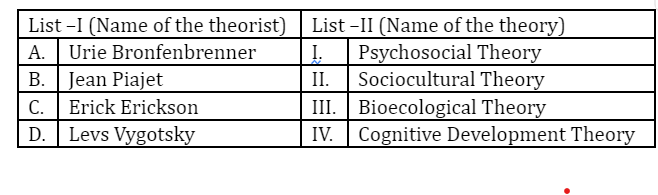
Correct option is D
·
Urie Bronfenbrenner's
Bioecological Theory highlights the influence of multiple environmental systems (like microsystems, macrosystems) on human development.
·
Jean Piaget's
Cognitive Development Theory explains that children pass through stages like sensorimotor, preoperational, concrete operational, and formal operational as they develop thinking skills.
·
Erik Erikson's
Psychosocial Theory includes stages like trust vs. mistrust, autonomy vs. shame, and so on, emphasizing social and emotional development.
·
Lev Vygotsky's
Sociocultural Theory stresses the importance of cultural and social interactions in cognitive growth, including concepts like the Zone of Proximal Development.
Information Booster:
·
Bioecological Theory (Bronfenbrenner): This theory examines how environments, from family and school to society and culture, influence human development.
·
Cognitive Development Theory (Piaget): Piaget argued that children's intellectual development happens in stages, and they actively construct knowledge through interaction with their environment.
·
Psychosocial Theory (Erikson): This theory identifies eight stages where individuals face conflicts that serve as turning points in development. Successful resolution leads to a healthy personality.
·
Sociocultural Theory (Vygotsky): Vygotsky emphasized that learning occurs within a social context, and that children acquire cognitive abilities through guidance and collaboration with more knowledgeable individuals.
 English
 10 Questions
 20 Marks
 12 Mins



