

hamburger menu
All Coursesall course arrow
adda247
reward-icon
adda247
    arrow
    arrow
    arrow
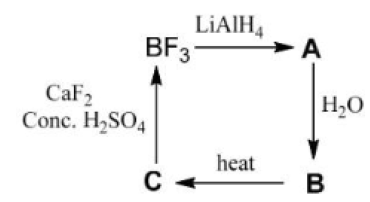
    In the following reaction, A, B and C, respectively, are
    Question


    In the following reaction, A, B and C, respectively, are

    A.

    LiBH₄, BH2(OH) and B₂O₃

    B.

    LiBH₄, B(OH)₃ and amorphous B

    C.

    BH₃, B(OH)₃ and crystalline B₁₂

    D.

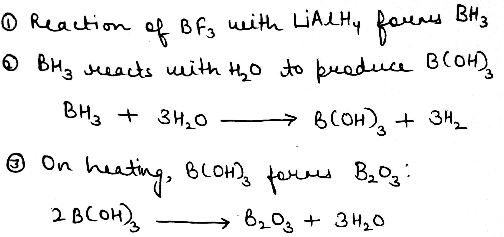
    BH₃, B(OH)₃ and B₂O₃

    Correct option is D


    B₂O₃ is a stable oxide of boron widely used in glass and ceramics. BH₃ is a Lewis acid and exists in dimeric form as diborane (B₂H₆). B(OH)₃ is weakly acidic and has uses in buffer solutions and antiseptics.
    Additional Knowledge:
    1. LiBH₄ (Lithium borohydride) is a reducing agent but not a product here.
    2. Amorphous boron and crystalline B₁₂ represent other allotropes but are unrelated in this context.

    Similar Questions

    test-prime-package

    Access ‘CSIR NET Chemical Sciences’ Mock Tests with

    • 60000+ Mocks and Previous Year Papers
    • Unlimited Re-Attempts
    • Personalised Report Card
    • 500% Refund on Final Selection
    • Largest Community
    students-icon
    354k+ students have already unlocked exclusive benefits with Test Prime!
    test-prime-package

    Access ‘CSIR NET Chemical Sciences’ Mock Tests with

    • 60000+ Mocks and Previous Year Papers
    • Unlimited Re-Attempts
    • Personalised Report Card
    • 500% Refund on Final Selection
    • Largest Community
    students-icon
    354k+ students have already unlocked exclusive benefits with Test Prime!
    Our Plans
    Monthsup-arrow

