Correct option is B
Given:
Population at the end of the third year = 9,47,625
Let the population at the beginning of the first year be P.
Concept Used:
The population decreases by 5% in each of the first two years and increases by 5% in the third year.
The population after a percentage decrease/increase can be calculated using the formula:
Population after change=Initial Population×(1±100Rate of Change)
Solution:
Population at the end of the first year after a 5% decrease:
P×(1−1005)=P×0.9
Population at the end of the second year after another 5% decrease:
P×0.95×0.95=P×(0.95)2
Population at the end of the third year after a 5% increase:
P×(0.95)2×(1+1005)=P×(0.95)2×1.05
We are given that the population at the end of the third year is 9,47,625. Therefore:
P×(0.95)2×1.05=9,47,625
P=(0.95)2×1.059,47,625
First, calculate(0.95)2=0.9025
P=0.9025×1.059,47,625 P=0.9476259,47,625 P=10,00,000
The population at the beginning of the first year was 10,00,000.
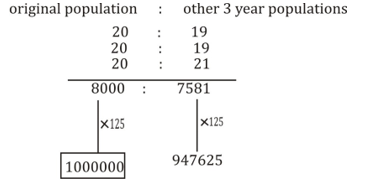
Alternative Method:







 English
 100 Questions
 200 Marks
 60 Mins


